
Loading story…
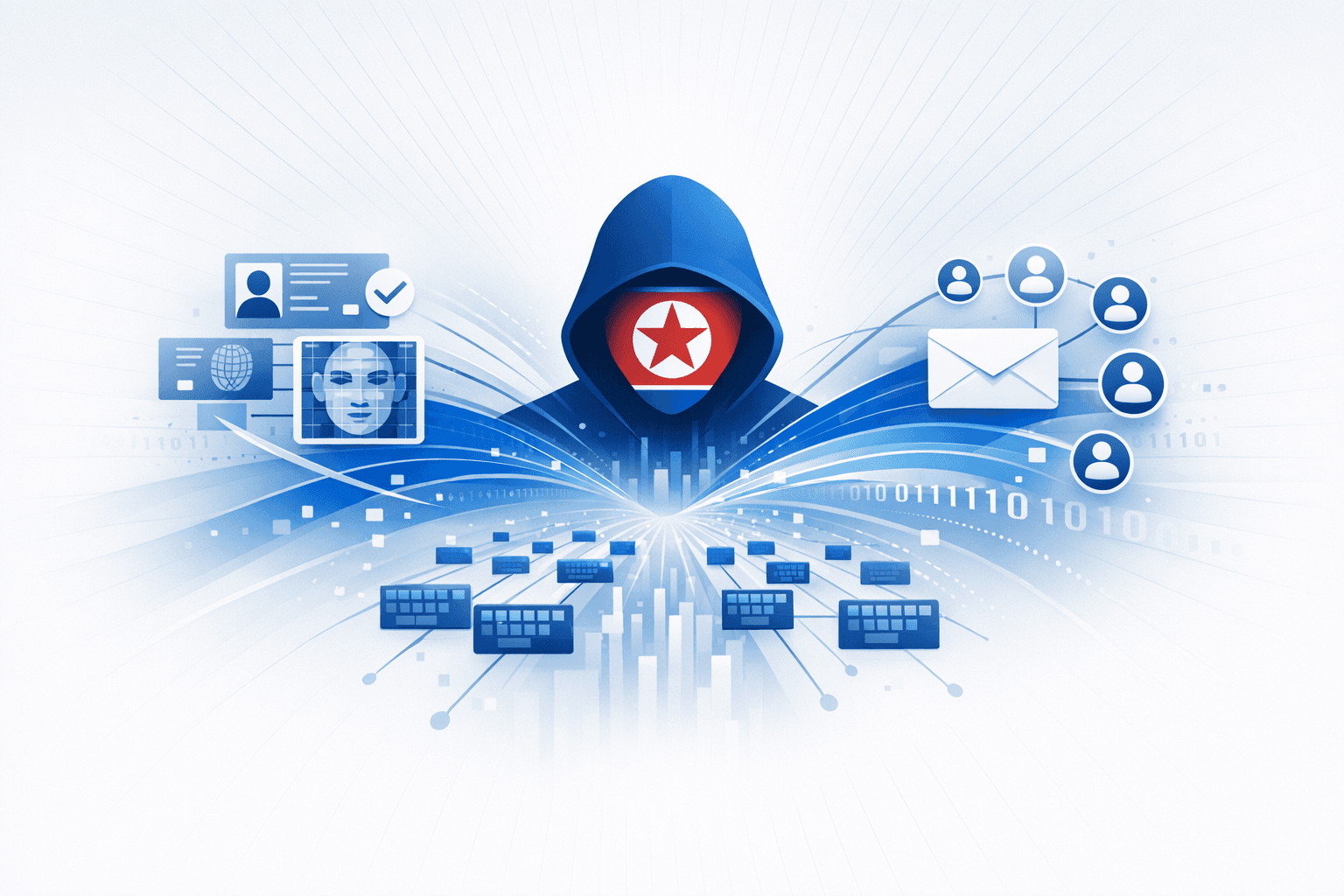
Reporting highlighted ongoing North Korean IT worker operations in which individuals use stolen identities, falsified resumes, and AI-enabled deepfakes to obtain remote roles at Western companies, creating direct insider-risk exposure once hired. The activity was described as affecting thousands of workers and Fortune 500 employers, with claims of "3,000 hands on keyboards" and roughly "30,000 different email addresses" in use to support multiple personas, generating wages that can total hundreds of millions of dollars annually and help fund the North Korean regime.
Recommended screening and verification measures focused on practical controls for remote hiring, including prompting candidates to perform live actions on video (e.g., wave), validating IP address/geolocation consistency with claimed location, and probing discrepancies in a candidate’s stated whereabouts. The reporting framed these checks as necessary to counter identity fraud and synthetic media used to pass interviews and onboarding, and to reduce the likelihood of granting network access to sanctioned or malicious actors operating under false identities.
See attribution, scope, and your downstream exposure.
4 events from the most recent confirmed update back to the earliest known activity.
On 2026-05-07, Nisos published research describing North Korean employment fraud activity aimed at cryptocurrency companies. The report adds a new sector-specific targeting development to the broader DPRK remote worker scheme.
In 2025, SentinelOne reported seeing hundreds of fraudulent personas linked to North Korean job applicant activity. The finding showed the operation had scaled significantly and was using fabricated identities to target remote roles.
In 2024, security awareness company KnowBe4 disclosed that it had hired a North Korean IT worker using a false identity. The worker reportedly loaded malware, demonstrating the insider-risk posed by the campaign.
In 2023, U.S. federal authorities raided an Arizona "laptop farm" linked to North Korean IT workers. The operation was tied to laptops used for remote work at hundreds of companies, illustrating the scale of the scheme.
Vulnerabilities, threat actors, malware, products, organizations, and breaches Mallory has linked to this story.
See attribution, scope, and whether this vendor sits anywhere in your supply chain.
7 references tracked. Mallory keeps watching after this page renders.
nisos.com
Open sourcehelpnetsecurity.com
Open sourcearchive.md
Open sourceimper.ai
Open sourcecybersecuritynews.com
Open sourcegovinfosecurity.com
Open sourcebankinfosecurity.com
Open sourceMap indicators from this story to your assets and identify affected systems in minutes.
Every observed campaign, victim, and pivot linked to actors named in this story.
Malware, exploits, and IOCs connected to the activity described here.
YARA, Sigma, and Snort rules deployed to your SIEM as soon as they’re published.
Get matching new stories delivered to your team as they break — not the next morning.
Ask questions about this story and take action on the answers.
Other stories Mallory is tracking that overlap on entities, sources, or topic labels.

U.S. authorities and multiple security firms detailed a large North Korean scheme in which operatives use stolen or fabricated identities to win remote IT jobs at Western companies, then send the earnings back to Pyongyang in violation of sanctions. Research from IBM X-Force, Flare, Microsoft, LevelBlue, and others described a mature ecosystem of recruiters, facilitators, brokers, laptop-farm operators, and Western collaborators that helps workers pass interviews, receive corporate devices, mask their locations with VPNs, and clear payroll and compliance checks. Estimates cited across the reporting say more than 100,000 workers operating across dozens of countries may be generating roughly **$500 million annually**, while some cases also involved data theft, source-code exfiltration, extortion, and malware activity after hiring. The U.S. Treasury's Office of Foreign Assets Control sanctioned six individuals and two entities tied to the operation, while U.S. courts sentenced three Americans, including a former Army soldier, for helping North Korean workers use false identities and laptop farms to obtain jobs at U.S. companies. Investigations also exposed operational tradecraft including use of **Astrill VPN**, **NetKey/OConnect**, **IP Messenger**, freelance platforms, AI-generated resumes and headshots, and U.S.-based hardware relays such as PiKVM-enabled laptop farms; one hired worker was removed within 10 days after suspicious logins from China and Missouri triggered detection. Researchers and federal advisories warned that remote hiring has become an insider-threat and sanctions-compliance risk, urging tighter identity verification, live skills testing, device and geolocation controls, least-privilege access, and joint oversight by HR, recruiters, and security teams.
Aug 18, 2026
Recorded Future's Insikt Group reported that a North Korean operation it tracks as **PurpleDelta** has used fake identities to pursue remote IT jobs at more than 1,100 companies, primarily targeting North American firms. Active since late 2024 and allegedly operating mainly from Shenyang, China, the cluster used at least 22 fabricated personas, AI-generated profile photos, forged identity documents, and recruitment infrastructure including `minicursor.com` and `trustidcard.com` to move through hiring pipelines. Investigators said the operators relied on transcription, screen recording, remote access, translation, and collaboration tools during interviews and after hiring, while in-country facilitators maintained company-issued laptops and other devices tied to victim organizations. The activity has been described as a new form of insider threat in which access is obtained during recruitment rather than abused after legitimate employment begins. SC Media reported that the FBI is investigating a North Korean remote IT worker employed by a U.S. federal agency, while broader estimates cited from the U.N. say such schemes have embedded operatives in hundreds of private-sector companies and generate **$250 million to $600 million annually**. The campaigns reportedly use stolen identities, deepfakes, VPN-masked locations, and U.S.-based laptop farms to secure remote roles and, in some cases, exfiltrate sensitive data, exposing gaps in conventional background checks and insider-threat programs.
Aug 25, 2026
North Korean IT workers have significantly expanded their operations to infiltrate a wide range of industries beyond the traditional technology sector, according to research published by Okta Threat Intelligence. The scheme involves North Korean nationals, or individuals funneling money back to Pyongyang, fraudulently obtaining remote employment, primarily in software development roles. Okta's research indicates that nearly half of the targeted companies are outside the IT sector, with finance, healthcare, public administration, and professional services now among the most affected industries. The campaign, which initially focused on U.S.-based cryptocurrency and blockchain firms, has evolved to target organizations in dozens of countries, with 27% of targeted entities now located outside the United States. Okta tracked more than 130 identities associated with North Korean facilitators and workers, linking them to over 6,500 initial job interviews at more than 5,000 companies from 2021 through mid-2025. The methodology for identifying these DPRK-aligned identities relies on a combination of technical indicators, behavioral patterns, and employer reporting, though Okta has withheld some details to avoid alerting the threat actors. The scale of the operation is believed to be much larger than the tracked sample, with the FBI and private security firms, including Google's Mandiant, warning that the problem is widespread among Fortune 500 companies. Mandiant's CTO, Charles Carmakal, noted that almost every CISO of a Fortune 500 company he has spoken to has encountered issues with North Korean IT workers. The North Korean operatives use fake or stolen identities to secure remote roles, circumventing international sanctions and generating millions of dollars for the North Korean military. The campaign's adaptability is evident in its shift to any remote role that fits the scheme's requirements, regardless of industry or geography. Okta's findings highlight the persistent and evolving nature of the threat, with North Korean IT workers now targeting a broad spectrum of organizations globally. The report underscores the need for enhanced identity verification and vigilance in remote hiring processes. The expansion of this scheme poses significant risks to sensitive data, intellectual property, and the integrity of critical sectors such as healthcare and finance. The threat is compounded by the difficulty in detecting these operatives, given their use of sophisticated identity obfuscation techniques. Okta's research suggests that the true scale of North Korean IT worker activity is likely much greater than currently documented. The ongoing campaign demonstrates North Korea's commitment to leveraging cyber-enabled means to generate revenue and evade international restrictions. Organizations are urged to review their remote hiring practices and strengthen controls to mitigate the risk of inadvertently employing North Korean operatives. The findings also highlight the importance of cross-sector collaboration and intelligence sharing to counter this persistent threat. The expansion of North Korean IT worker infiltration represents a significant evolution in state-sponsored cyber-enabled financial operations.
Aug 14, 2026