Mallory
← Back to News
state-sponsored-espionagephishing-campaign-intelligencepackage-repository-poisoningloader-delivery-mechanism

North Korean ClickFix Job Lures Spread BeaverTail and Ferret Malware

Threat Actor Intelligence · 17 sources · Updated 3mo ago · First seen Mar 21, 2025
North Korean ClickFix Job Lures Spread BeaverTail and Ferret Malware

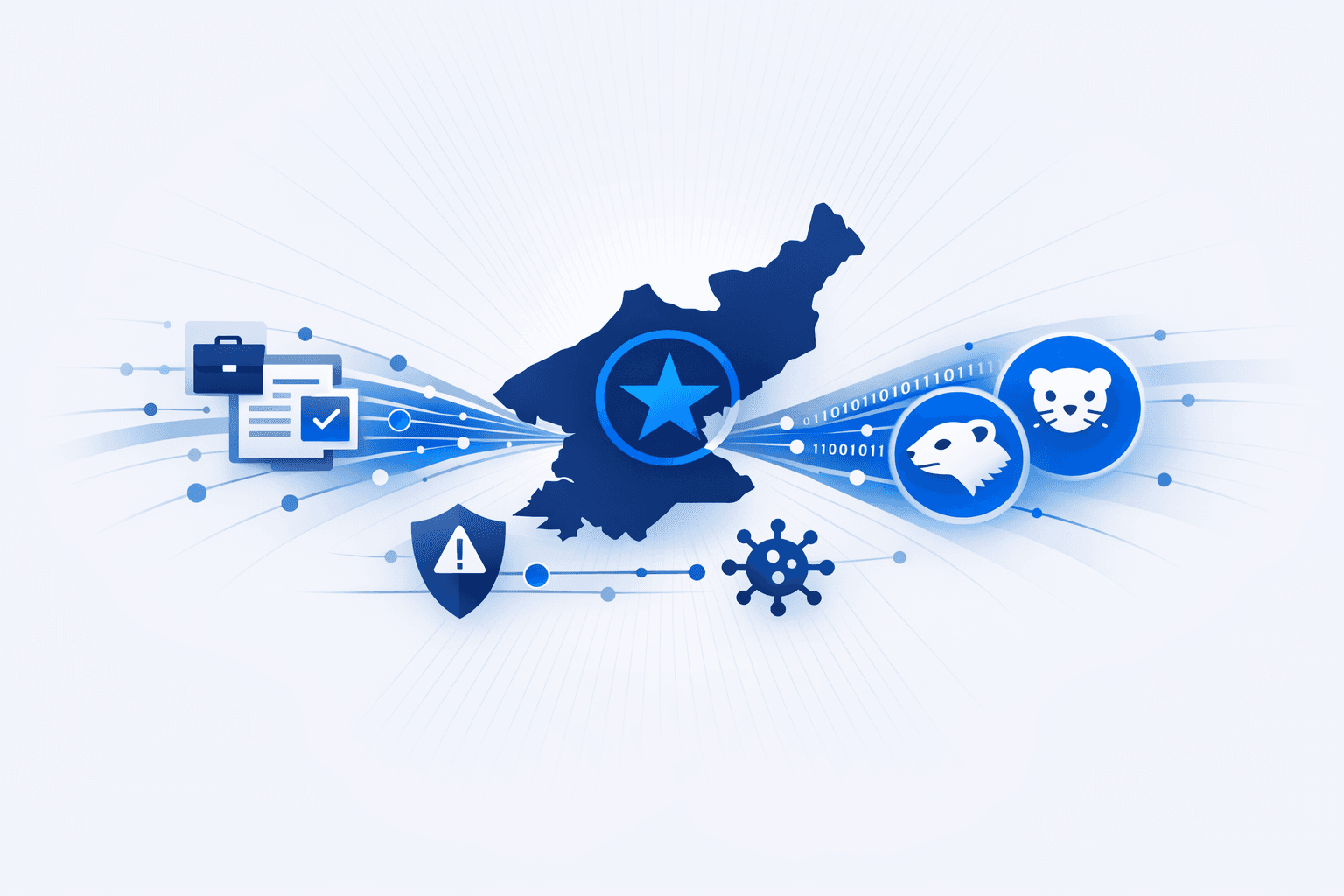
North Korean threat actors linked to Contagious Interview, Famous Chollima, and Lazarus used fake job and hiring platforms to infect applicants with BeaverTail, InvisibleFerret, FlexibleFerret, FrostyFerret, GolangGhost, and related malware families. Researchers said the operation evolved from earlier job-themed campaigns into ClickFix-style social engineering, where victims were told to copy and paste OS-specific troubleshooting commands from bogus interview sites. The infrastructure collected visitor IP and geolocation data, checked for cryptocurrency wallet browser objects, and then delivered tailored payloads for Windows, macOS, and Linux through staged download chains and fake recruiter workflows.

The campaign expanded beyond software developers to target cryptocurrency, marketing, and other less technical roles, reflecting a broader DPRK shift toward centralized finance and job seekers who may be less suspicious of recruiter outreach. Reports tied the activity to malicious repositories, dozens of weaponized npm packages, fake hiring domains such as businesshire[.]top, and backend infrastructure including nvidiasdk.fly[.]dev, while analysts also documented persistence via Run keys and LaunchAgents, password theft on macOS, and malware loaders designed to frustrate analysis through allowlists and low-volume testing. Security firms assessed the activity as an ongoing evolution of the long-running Contagious Interview operation rather than isolated incidents.

Know this adversaryTTPs, infrastructure, and targeting history in one profile.
Get the profile
Event timeline

How this story unfolded

Events from the most recent confirmed update back to the earliest known activity.

16 events · Dec 2022 – May 2025
  1. Reported Jul 20, 20264mo ago

    Securonix reported retooled DEV#POPPER campaign targeting developers

    Securonix disclosed that the DEV#POPPER threat actors had retooled their fake job interview operation, using a malicious ZIP package and obfuscated JavaScript to deliver Python-based malware for Windows, Linux, and macOS. The updated malware added capabilities including AnyDesk-based persistence, expanded FTP exfiltration, keylogging, clipboard monitoring, and browser credential and cookie theft, with victims observed across South Korea, North America, Europe, and the Middle East.

    Research Update: Threat Actors Behind the DEV#POPPER Campaign Have Retooled and are Continuing to Target Software Developers via Social Engineering - Securonix
  2. Reported Jul 30, 20251y ago

    Researchers disclosed new OtterCookie delivery techniques in Contagious Interview

    Researchers analyzing Lazarus's Contagious Interview campaign described three updated payload-delivery mechanisms for BeaverTail, InvisibleFerret, and OtterCookie, including token-gated Vercel-hosted retrieval and a try/catch-based error-path execution method. The report also published related infrastructure artifacts and IOCs, showing added obfuscation intended to evade static and pattern-based detection.

    Lazarus Group Enhances Malware with New OtterCookie Payload Delivery Technique
  3. Reported Jul 14, 20251y ago

    Socket reported escalation with 67 malicious npm packages

    A Socket blog reference indicates reporting on an escalation of the Contagious Interview campaign involving 67 malicious npm packages and a new malware loader.

    Contagious Interview Campaign Escalates With 67 Malicious npm Packages and New Malware Loader
  4. May 2025

    BeaverTail and InvisibleFerret infrastructure active since at least May 2025

    GitLab reported infrastructure used to distribute BeaverTail and InvisibleFerret variants had been in use since at least May 2025.

    Tech Note - BeaverTail variant distributed via malicious repositories and ClickFix lure - GitLab Security Tech Notes
  5. Apr 2025

    Malware files uploaded to GitHub repository in late April 2025

    GitLab found commit history showing malware files were uploaded to the RominaMabelRamirez/dify GitHub repository by the identity Yash-1511 <yash1511@gmail.com> in late April 2025.

    Tech Note - BeaverTail variant distributed via malicious repositories and ClickFix lure - GitLab Security Tech Notes
  6. Reported Mar 31, 20252y ago

    Sekoia published ClickFake Interview findings

    Sekoia published its investigation into the Lazarus ClickFake Interview campaign, linking it to the broader Contagious Interview operation and detailing Windows and macOS infection chains using ClickFix social engineering.

    Lazarus ClickFake Interview Campaign: From Contagious to ClickFix Malware Tactics
  7. Mar 21, 20252y ago

    Private FLINT report documented ClickFake Interview campaign

    Sekoia said its findings were originally issued in a private FLINT report dated 21 March 2025, describing the Lazarus ClickFake Interview campaign targeting cryptocurrency job seekers with fake interview sites and ClickFix lures.

    Lazarus ClickFake Interview Campaign: From Contagious to ClickFix Malware Tactics
  8. Reported Mar 11, 20252y ago

    Walmart analyzed ChromeUpdateAlert macOS payload in fake interview campaign

    Walmart Global Tech published an analysis of a Golang backdoor and the macOS payload ChromeUpdateAlert.app used in a fake job interview malware campaign associated with Contagious Interview activity. The report detailed fake interview infrastructure, Dropbox OAuth-based data exfiltration from the macOS app, and published related domains, IPs, and other indicators of compromise.

    Golang backdoor with a side of ChromeUpdateAlert App | by Jason Reaves | Walmart Global Tech Blog | Medium
  9. Mar 2025

    Bybit theft attributed to Lazarus reported in March 2025

    Sekoia referenced reporting that Lazarus targeted UAE-based crypto exchange Bybit in March 2025, resulting in the theft of $1.5 billion.

    Lazarus ClickFake Interview Campaign: From Contagious to ClickFix Malware Tactics
  10. Feb 7, 20252y ago

    SI-CERT published BeaverTail and InvisibleFerret analysis

    SI-CERT published a technical analysis of a social-engineering campaign targeting Web3 companies and individuals via LinkedIn lures and malicious npm packages that deployed BeaverTail and InvisibleFerret. The report detailed the malware's execution chain, data theft and backdoor capabilities, and released indicators including GitHub lure URLs, hashes, and C2 infrastructure.

    SI-CERT TZ016 / BeaverTail & InvisibleFerret - SI CERT
  11. 2025

    GitLab described new BeaverTail ClickFix campaign

    GitLab reported a 2025 campaign using a fake hiring platform at businesshire[.]top and ClickFix lures to distribute BeaverTail and InvisibleFerret, targeting marketing and cryptocurrency trader roles rather than primarily software developers.

    Tech Note - BeaverTail variant distributed via malicious repositories and ClickFix lure - GitLab Security Tech Notes
  12. Sep 18, 20242y ago

    Proofpoint identified GitHub notification ClickFix campaign

    On 18 September 2024, Proofpoint identified a campaign that abused legitimate GitHub notification emails to lure repository owners and collaborators to a fake GitHub site using ClickFix and reCAPTCHA Phish techniques. If victims executed the copied PowerShell command, it downloaded Lumma Stealer; Proofpoint said the campaign impacted at least 300 organizations globally.

    ClickFix Malware & Social Engineering Threat Grows | Proofpoint US
  13. 2024

    HiSolutions linked fall 2024 crypto theft to Contagious Interview Tsunami malware

    HiSolutions investigated a cryptocurrency theft in a software developer environment in fall 2024 and found an intrusion chain matching the North Korea-linked Contagious Interview campaign. The analysis disclosed the Tsunami malware framework, showing BeaverTail and InvisibleFerret leading to a modular payload that used Pastebin accounts and a Tor onion service for command and control.

    Rolling in the Deep(Web): Lazarus Tsunami | HiSolutions Research
  14. 2024

    DPRK actors stole about $1.3 billion from crypto platforms in 2024

    Sekoia cited Chainalysis estimates that North Korean threat actors stole roughly $1.3 billion from cryptocurrency platforms in 2024, up from $660.5 million in 2023.

    Lazarus ClickFake Interview Campaign: From Contagious to ClickFix Malware Tactics
  15. Nov 2023

    Palo Alto documented two DPRK job-themed campaigns

    Sekoia said Palo Alto documented Contagious Interview in November 2023, establishing public reporting on North Korean job-lure malware activity.

    Lazarus ClickFake Interview Campaign: From Contagious to ClickFix Malware Tactics
  16. Dec 2022

    Contagious Interview campaign active by December 2022

    Sekoia reported that the Lazarus-linked Contagious Interview operation had been ongoing since at least December 2022, using fake job opportunities to target victims.

    Lazarus ClickFake Interview Campaign: From Contagious to ClickFix Malware Tactics
Linked entities

Related entities

Vulnerabilities, threat actors, malware, products, organizations, breaches, and observables Mallory has linked to this story. Indicator values are masked here and available in full in the app.

Open in app →

Threat actors

2 linked

Observables

317 linked

Indicator values are masked on this page. View all 317 in Mallory Domains, IPs, hashes, and URLs are exportable to your SIEM.

Do you run this?See this adversary's TTPs, infrastructure, and targeting history, correlated against your exposure.
Get the Full Actor Profile
Mallory platform

See the full picture, correlated to your attack surface.

This page covers what’s public. Mallory adds the parts that aren’t: which of your assets are affected, which threat actors are using it right now, and what to deploy next.

Exposure mappingMap indicators from this story to your assets and identify affected systems in minutes.
Threat actor evidenceEvery observed campaign, victim, and pivot linked to actors named in this story.
Associated malwareMalware, exploits, and IOCs connected to the activity described here.
Detection signaturesYARA, Sigma, and Snort rules deployed to your SIEM as soon as they’re published.
Scheduled alertsGet matching new stories delivered to your team as they break, not the next morning.
AI threadsAsk questions about this story and take action on the answers.