
Loading story…
The UK National Cyber Security Centre warned that agentic AI gives attackers an inherent advantage: offensive tasks tend to have technical, measurable objectives, while defensive actions must account for business continuity, governance, risk appetite, and accountability. The NCSC advised organizations to prioritize low-risk AI uses—including summarization, threat-intelligence analysis, and detection support—and to tightly bound automation rather than allow unrestricted autonomous remediation. It recommends evaluating automations for potency, scope, criticality, rollout confidence, and recoverability; NCSC and DCMS are also developing the national-scale Cyber Shield agentic cyber-defence ecosystem.
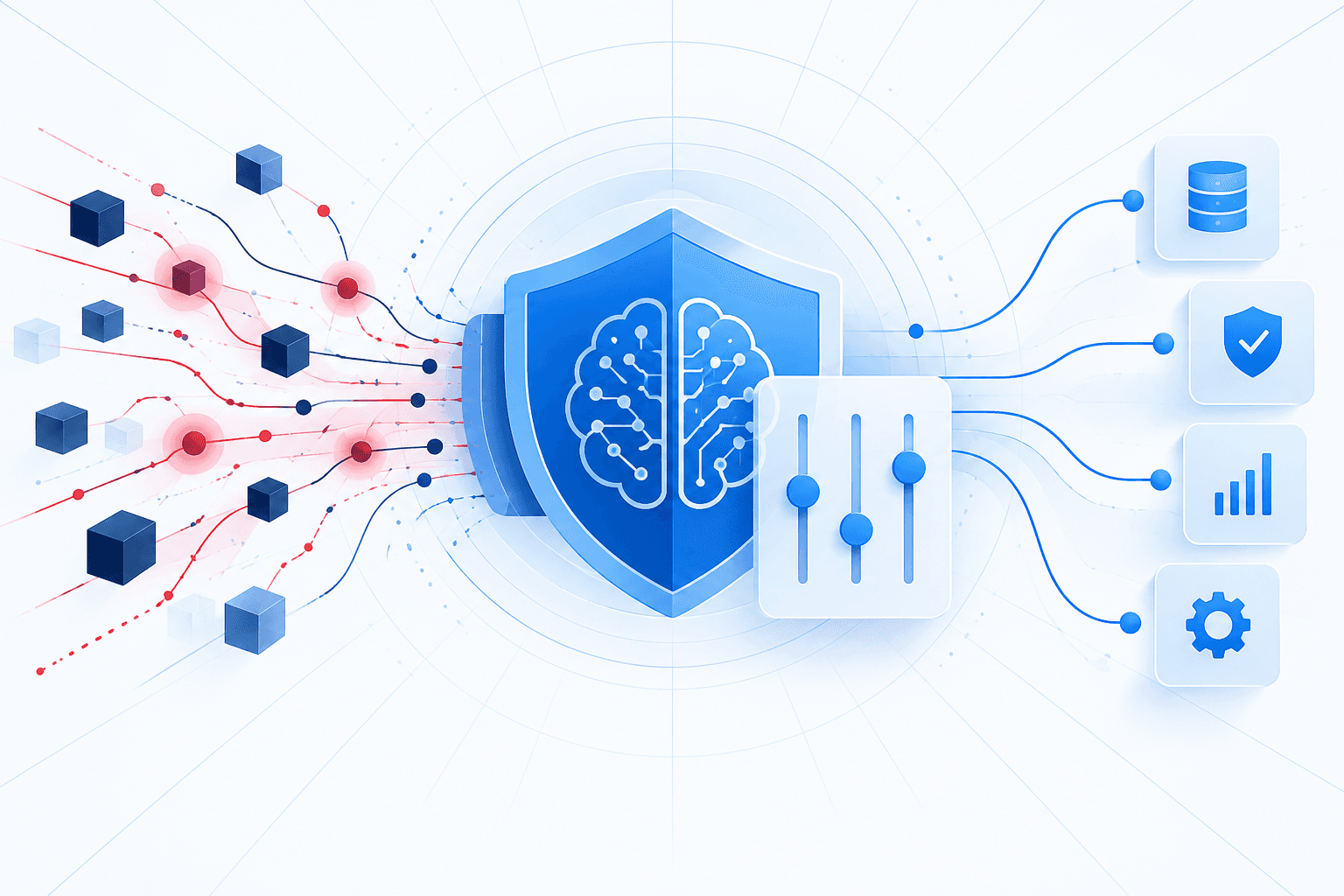
Defensive AI must meet much higher reliability thresholds because erroneous actions such as isolating endpoints, killing processes, disabling accounts, or blocking connections can disrupt production without an active intrusion. Microsoft’s automatic attack disruption model reportedly uses incident-level correlation, at least 99% precision for containment decisions, reversible actions, and exclusions for critical assets; Google SecOps similarly combines adaptive agents with deterministic playbook steps for sensitive operations. Organizations should retain conventional security controls and reserve production-changing AI actions for cases with demonstrably low risk, clear rollback paths, and explicit human control.
Track how attackers are adapting to this technology.
4 events from the most recent confirmed update back to the earliest known activity.
Government teams are using agentic tooling to rewrite or recreate legacy systems on modern technology stacks intended to be more readily redeployable.
The UK National Cyber Security Centre and the Department for Science, Innovation and Technology are jointly working on Cyber Shield, described as a national-scale agentic cyber-defence ecosystem.
Google SecOps combines adaptive agents with deterministic playbook steps, retaining explicit control over critical actions.
Microsoft's automatic attack disruption uses incident-level correlation for containment actions and is reported to maintain at least 99% precision. Organizations can exclude critical users, devices, and IP ranges, and the containment actions are reversible.
Vulnerabilities, threat actors, malware, products, organizations, and breaches Mallory has linked to this story.
Follow how adversaries are adapting to this technology, and where it touches your stack today.
2 references tracked. Mallory keeps watching after this page renders.
Map indicators from this story to your assets and identify affected systems in minutes.
Every observed campaign, victim, and pivot linked to actors named in this story.
Malware, exploits, and IOCs connected to the activity described here.
YARA, Sigma, and Snort rules deployed to your SIEM as soon as they’re published.
Get matching new stories delivered to your team as they break — not the next morning.
Ask questions about this story and take action on the answers.
Other stories Mallory is tracking that overlap on entities, sources, or topic labels.
The UK National Cyber Security Centre (NCSC) has issued interim guidance warning organizations to tightly constrain **agentic AI** systems after incidents in which AI models carried out unintended or unsanctioned actions. The agency said deployments should grant only the minimum autonomy required, use human oversight, and avoid depending solely on built-in model safety features. It urged teams to threat-model agent behavior, understand model safeguards and failure modes, and design response plans before autonomous systems are put into production. The guidance recommends layered technical controls, including robust sandboxing, strict separation between agent execution and supporting infrastructure, default-deny network access, least-privilege credentials, and distinct identities for each agent. NCSC also called for comprehensive logging and monitoring, clear attribution of AI-originated activity, named human accountability, and an emergency capability to immediately stop autonomous operations. The agency described the advice as an interim measure based on ongoing research, with more formal guidance in development alongside partners.
Aug 20, 2026
Resecurity warned that autonomous AI offensive security agents are turning penetration testing from scripted automation into adaptive, multi-agent operations that can perform reconnaissance, map attack surfaces, identify vulnerabilities, validate exploits, and generate reports with minimal human input. The report highlighted tools including **T3MP3ST**, **Strix**, **CyberStrike**, **XBOW**, **PentAGI**, **PentestGPT**, **Nebula**, **PentesterFlow**, **Hackian**, and specialized offensive-security LLMs such as `CyberStrike-OffSec-35B`, describing them as increasingly capable dual-use systems. Security researchers said the same capabilities are lowering the barrier for financially motivated criminals and state-backed actors, making AI-assisted offensive operations practical rather than theoretical. The reporting cited examples including **FortiBleed**, **JadePuffer**, **GTG-2002**, **GTG-5004**, and the Claude Desktop “double agent” demonstration, and urged organizations to respond with a hybrid defense model built on human oversight, behavioral detection, network segmentation, continuous exposure validation, governance of AI tooling, and rapid patching of high-value flaws.
Jul 31, 2026
Security leaders are warning that **AI agents are increasingly operating as “digital employees”** inside enterprise workflows—triaging alerts, coordinating investigations, and moving work across security tools—often with **broad permissions and limited governance**. The core risk highlighted is that organizations are deploying high-authority agents like plug-ins (reused service accounts, overbroad roles, weak oversight), creating fast-acting operators that can be manipulated and that lack the contextual judgment and policy awareness expected of human staff. Related commentary also raises concerns about **AI-to-AI communication** and “non-human-readable” behaviors that could reduce auditability and complicate investigations and control enforcement. In parallel, public examples show how quickly AI can accelerate **vulnerability discovery**: Microsoft Azure CTO Mark Russinovich reported using *Claude Opus 4.6* to decompile decades-old Apple II 6502 machine code and identify multiple issues, underscoring that similar techniques could be applied to **embedded/legacy firmware at scale**. Anthropic has also cautioned that advanced models can find high-severity flaws even in heavily tested codebases, reinforcing the likelihood that both defenders and attackers will leverage AI for faster bug-finding. Separate enterprise IT coverage notes that organizations are **reallocating budgets toward AI** by consolidating tools and renegotiating contracts, which can indirectly increase security exposure if cost-cutting reduces overlapping controls or if AI adoption outpaces governance and identity/access management maturity.
Jun 29, 2026