Exploited SharePoint Flaws Enable Remote Code Execution and Machine-Key Persistence
Active Exploitation · 3 sources · Updated 2mo ago · First seen Jul 16, 2026
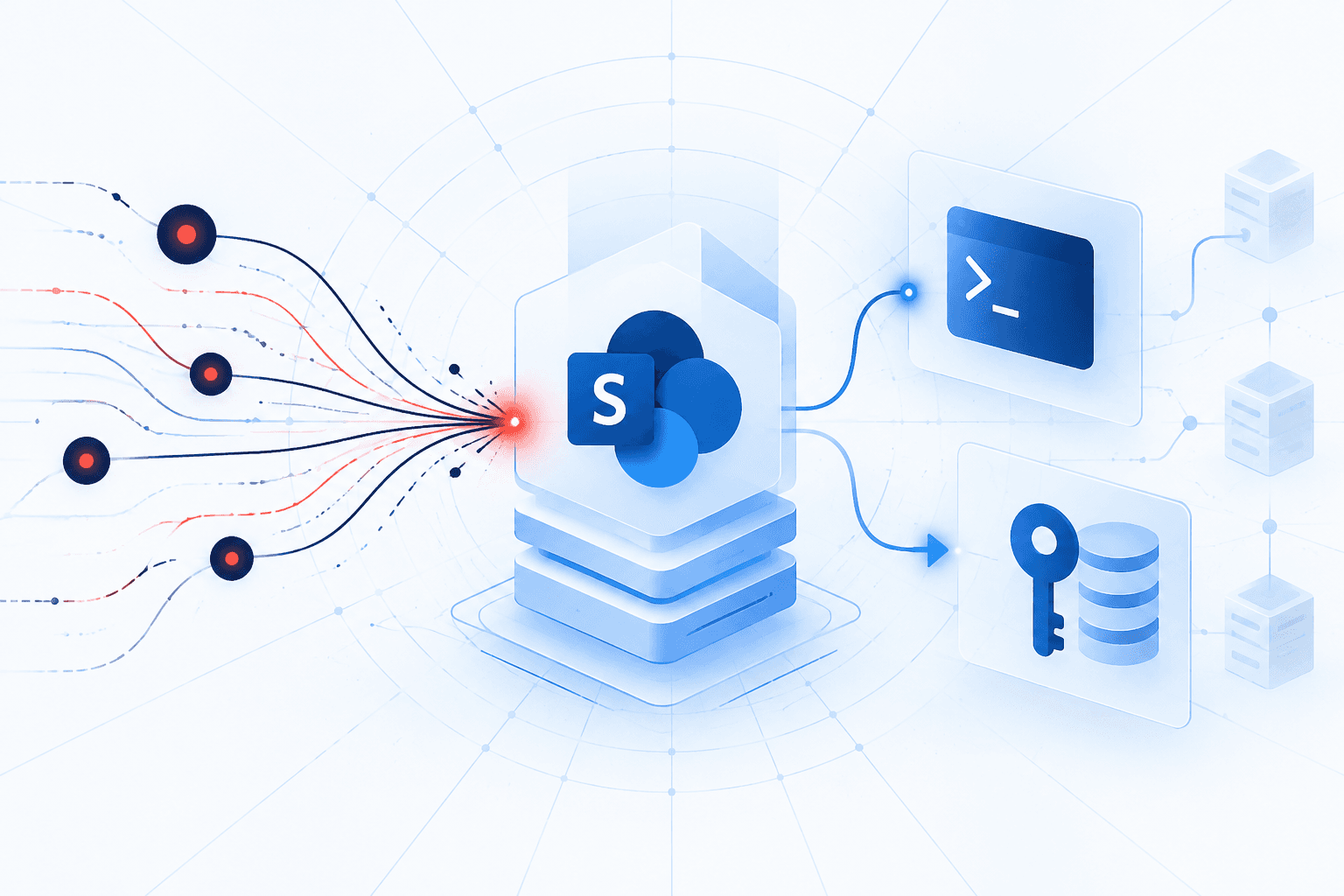
Attackers are reportedly exploiting vulnerabilities in on-premises Microsoft SharePoint Server to gain unauthorized access, execute code, and establish persistence. Resecurity describes six flaws affecting SharePoint Server Subscription Edition, 2019, and 2016, and reports active exploitation and CISA Known Exploited Vulnerabilities catalog inclusion for CVE-2026-32201, CVE-2026-45659, CVE-2026-56164, and CVE-2026-58644. SharePoint Online and Microsoft 365 are reportedly unaffected. Previdian identifies CVE-2026-45659 as an untrusted-data deserialization vulnerability patched in May, and separately reports exploitation of CVE-2026-50522 following July security updates. However, conflicting advisories describe different mechanisms and severity scores for CVE-2026-50522, warranting validation against Microsoft's authoritative guidance.
Reported attacker activity includes deploying web shells, stealing ASP.NET machine keys, and maintaining access through forged ViewState payloads or malicious IIS modules. Patching alone may not eliminate an existing compromise, because stolen keys and implanted persistence can survive updates. Organizations should patch every SharePoint farm server, investigate for web shells and malicious modules, rotate machine keys after cleanup, and rotate affected credentials. Additional recommended defenses include enabling AMSI request-body scanning and restricting network exposure. The reports do not attribute the activity to a specific threat group; Resecurity's illustrative domain-compromise scenario is explicitly fictional, not evidence of an actual breach.
Why it matters
Assessment
Organizations operating on-premises SharePoint Server Subscription Edition, 2019, or 2016 face reported active exploitation enabling remote code execution, document theft, and persistent access. Stolen ASP.NET machine keys and malicious IIS modules can preserve access after patching, making compromise investigation and key rotation essential. SharePoint Online and Microsoft 365 are reported unaffected by these flaws.
- Affected population: Organizations hosting on-premises SharePoint farms, especially internet-accessible deployments; no specific industry targeting is established.
- Business exposure: Sensitive-document loss, administrative compromise, service disruption, regulatory exposure, and potential ransomware deployment. Compromised farm accounts can expose SharePoint databases and provide opportunities for lateral movement into SQL Server and Active Directory.
- Exploitation evidence: The references report exploitation and CISA KEV inclusion for CVE-2026-32201, CVE-2026-45659, CVE-2026-56164, and CVE-2026-58644. Previdian additionally reports exploitation and July 22 KEV inclusion for CVE-2026-50522.
- Scope limitations: No reliable victim count or confirmed threat-group attribution is provided. Seven attempts against one sensor in the CVE-2026-50522 record do not establish campaign scale; Resecurity's Operation FarmKey scenario is fictional, not an observed breach.