
Loading story…
A significant security weakness has been identified in Microsoft Teams' guest chat feature, allowing attackers to bypass Defender for Office 365 protections when users accept invitations to external tenants. Security researchers from Ontinue revealed that when a user joins another organization's Teams environment as a guest, the security policies of the hosting tenant apply, not those of the user's home organization. This architectural flaw means that if the external tenant has minimal or no security controls, all advanced protections such as URL scanning, Safe Links, file sandboxing, and Zero-hour Auto Purge are effectively disabled for the guest user.
Attackers can exploit this by creating their own Microsoft 365 tenants with security features turned off and inviting targets to collaborate, thereby exposing them to phishing, malware, and other threats without the usual safeguards. The issue is not a software bug but a fundamental limitation of how cross-tenant collaboration is managed in Microsoft Teams. Security experts warn that organizations may have a false sense of security, believing their protections follow users across tenants, when in reality, attackers can easily create "protection-free zones" to deliver malicious content undetected.

See affected versions and whether adversaries are exploiting it.
4 events from the most recent confirmed update back to the earliest known activity.
Coverage of the research noted that Microsoft had not yet responded to requests for comment about the cross-tenant Teams guest chat exposure. This indicated there was no public vendor statement or fix at the time of reporting.
Following the disclosure, researchers recommended treating external guest access as a trust boundary, restricting guest invitations to vetted domains, disabling the 'chat with anyone' feature, and enforcing Microsoft Entra cross-tenant access policies. These mitigations were presented as the primary way for organizations to reduce exposure.
Ontinue published research showing that when users join an external Microsoft 365 tenant as a guest in Teams, their home tenant’s Defender for Office 365 protections no longer apply. The company described the issue as an architectural behavior rather than a software bug, warning it could let attackers deliver phishing links, malware, and social engineering from poorly secured attacker-controlled tenants.
Microsoft introduced update MC1182004, a default-enabled Teams feature that allows users to chat with anyone using an email address. Researchers said this expanded the reach of cross-tenant guest invitations and made the exposure easier to exploit.
Vulnerabilities, threat actors, malware, products, organizations, and breaches Mallory has linked to this story.
See whether adversaries are exploiting this yet, and where the affected versions run in your environment.
4 references tracked. Mallory keeps watching after this page renders.
techrepublic.com
Open sourcethehackernews.com
Open sourcecsoonline.com
Open sourcehackread.com
Open sourceMap indicators from this story to your assets and identify affected systems in minutes.
Every observed campaign, victim, and pivot linked to actors named in this story.
Malware, exploits, and IOCs connected to the activity described here.
YARA, Sigma, and Snort rules deployed to your SIEM as soon as they’re published.
Get matching new stories delivered to your team as they break — not the next morning.
Ask questions about this story and take action on the answers.
Other stories Mallory is tracking that overlap on entities, sources, or topic labels.
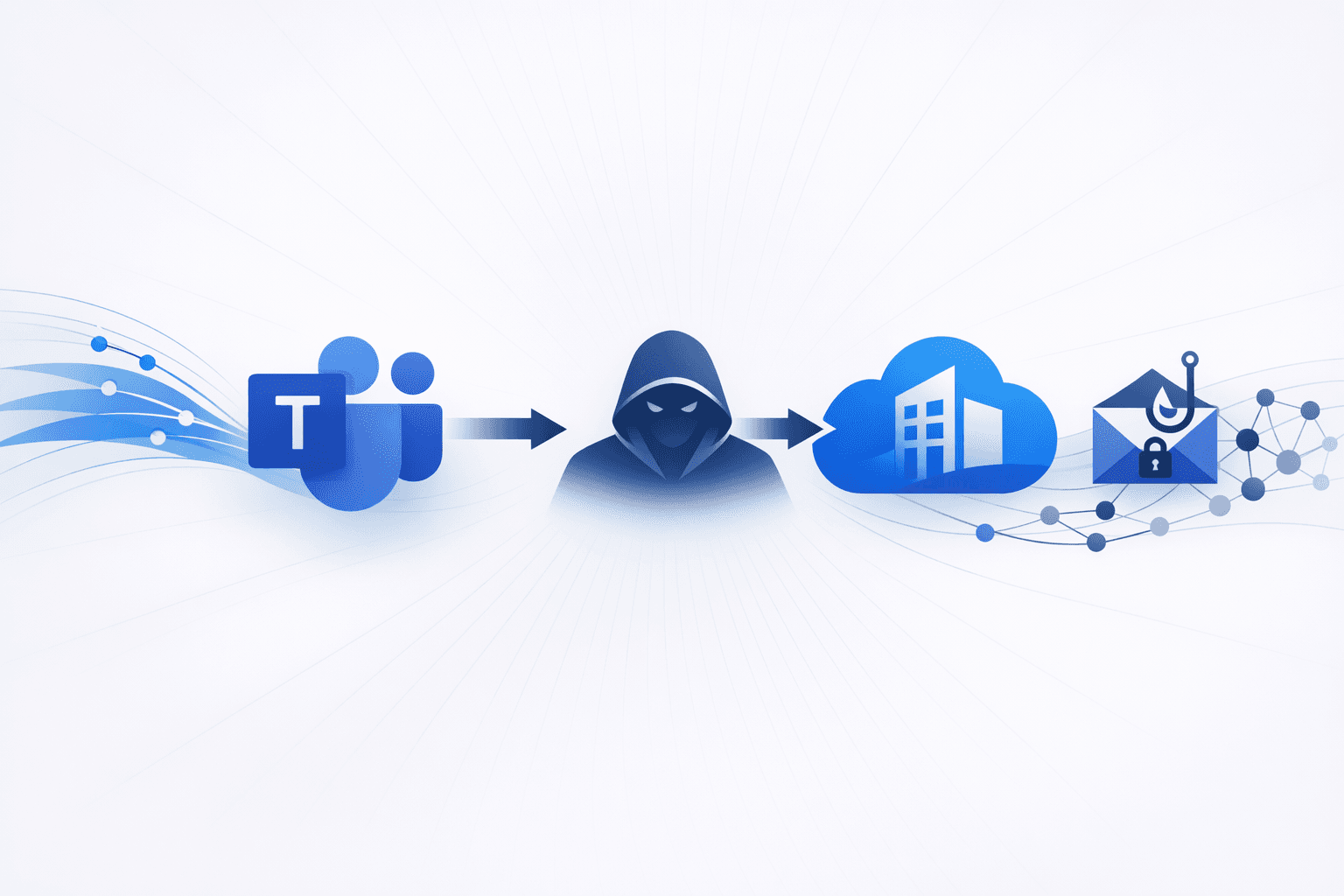
Microsoft is introducing a new feature that allows security administrators to block external users from sending messages, calls, or meeting invitations to their organization via Teams, managed through the Microsoft Defender portal. This integration with Defender for Office 365 enables admins to centrally manage blocked external contacts, supporting up to 4,000 domains and 200 email addresses, and is designed to counteract cybercrime groups, including ransomware actors, who exploit Teams for social engineering. The update will also enhance default security by enabling malicious URL detection and warning admins about suspicious external traffic, aiming to strengthen organizational defenses against external threats. Simultaneously, cybercriminals are exploiting legitimate Microsoft infrastructure, specifically `.onmicrosoft.com` domains assigned to Azure tenants, to launch Telephone-Oriented Attack Delivery (TOAD) scams. Attackers create controlled tenants and send malicious invites that appear to originate from trusted Microsoft addresses, bypassing standard email security filters. These invites contain social engineering lures in the message field, urging recipients to call fraudulent support numbers. Security teams are advised to implement targeted Exchange Transport Rules using Regex to mitigate this threat, as blocking the entire domain would disrupt legitimate operations.
Jun 29, 2026
Researchers at Check Point disclosed four critical vulnerabilities in Microsoft Teams that allowed attackers to impersonate executives, alter chat history, and forge notifications or caller identities without detection. These flaws, now patched, enabled manipulation of message content without the usual 'Edited' label, spoofing of alerts to appear from trusted colleagues, and renaming of chats to misrepresent participants. The vulnerabilities exploited Teams' messaging architecture, including the reuse of unique message identifiers and manipulation of hidden conversation parameters, fundamentally undermining the trust in digital communications for over 320 million monthly users. Microsoft was notified of the issues in March 2024 and addressed them through a series of patches, with the final fix released in October 2025. The vulnerabilities, tracked as CVE-2024-38197 among others, affected both internal users and external guests, posing significant risks of social engineering, data theft, and unauthorized actions. Attackers could trick users into clicking malicious links or sharing sensitive information by making messages and calls appear to originate from high-profile executives or trusted sources, highlighting the importance of prompt patching and ongoing vigilance in collaboration platforms.
Jun 29, 2026
Microsoft has issued warnings about the increasing abuse of Microsoft Teams by both cybercriminals and state-sponsored threat actors for a range of malicious activities, including ransomware deployment, espionage, and social engineering attacks. The collaboration features and widespread adoption of Teams have made it a high-value target, with attackers exploiting its core capabilities such as messaging, calls, meetings, and video-based screen sharing at various stages of the attack chain. Threat actors have been observed conducting reconnaissance by enumerating directory objects and mapping relationships and privileges within Teams environments, often leveraging Microsoft Entra ID identities. Attackers may exploit federation tenant configurations to determine if external communication is permitted, which can be inferred from API responses. Microsoft has responded by strengthening default security through its Secure Future Initiative, but emphasizes that defenders must also utilize customer-facing security controls across identity, endpoints, data, apps, and network layers to harden Teams environments. The company provides detailed guidance for disrupting adversarial objectives, including recommendations for monitoring, detection, and response tailored to the unique risks of Teams. The attack chain often begins with reconnaissance and can progress to lateral movement, data exfiltration, or ransomware deployment, depending on the attacker’s objectives. Social engineering tactics, such as phishing via Teams chat or impersonation during meetings, have been reported as effective vectors for initial access. Microsoft highlights the importance of understanding the multi-tenant and cross-tenant communication features of Teams, which can be abused for lateral movement or to bypass traditional security boundaries. The guidance also addresses the need for robust logging and monitoring to detect suspicious activity, as well as the implementation of least privilege access and strong authentication measures. Organizations are urged to review their Teams configurations, especially regarding guest and external access, to minimize exposure. Microsoft’s recommendations are designed to complement existing security development lifecycle practices and provide actionable steps for enterprise defenders. The company continues to monitor evolving attacker techniques and update its security guidance accordingly. The warnings underscore the critical need for organizations to treat collaboration platforms like Teams as high-value assets requiring dedicated security strategies. By proactively implementing Microsoft’s recommended controls and maintaining vigilance, organizations can reduce the risk of compromise via Teams. The evolving threat landscape demonstrates that attackers are increasingly targeting collaboration tools as entry points into enterprise environments. Microsoft’s ongoing research and public advisories aim to equip defenders with the knowledge and tools necessary to counter these sophisticated threats.
Jun 29, 2026