
Loading story…
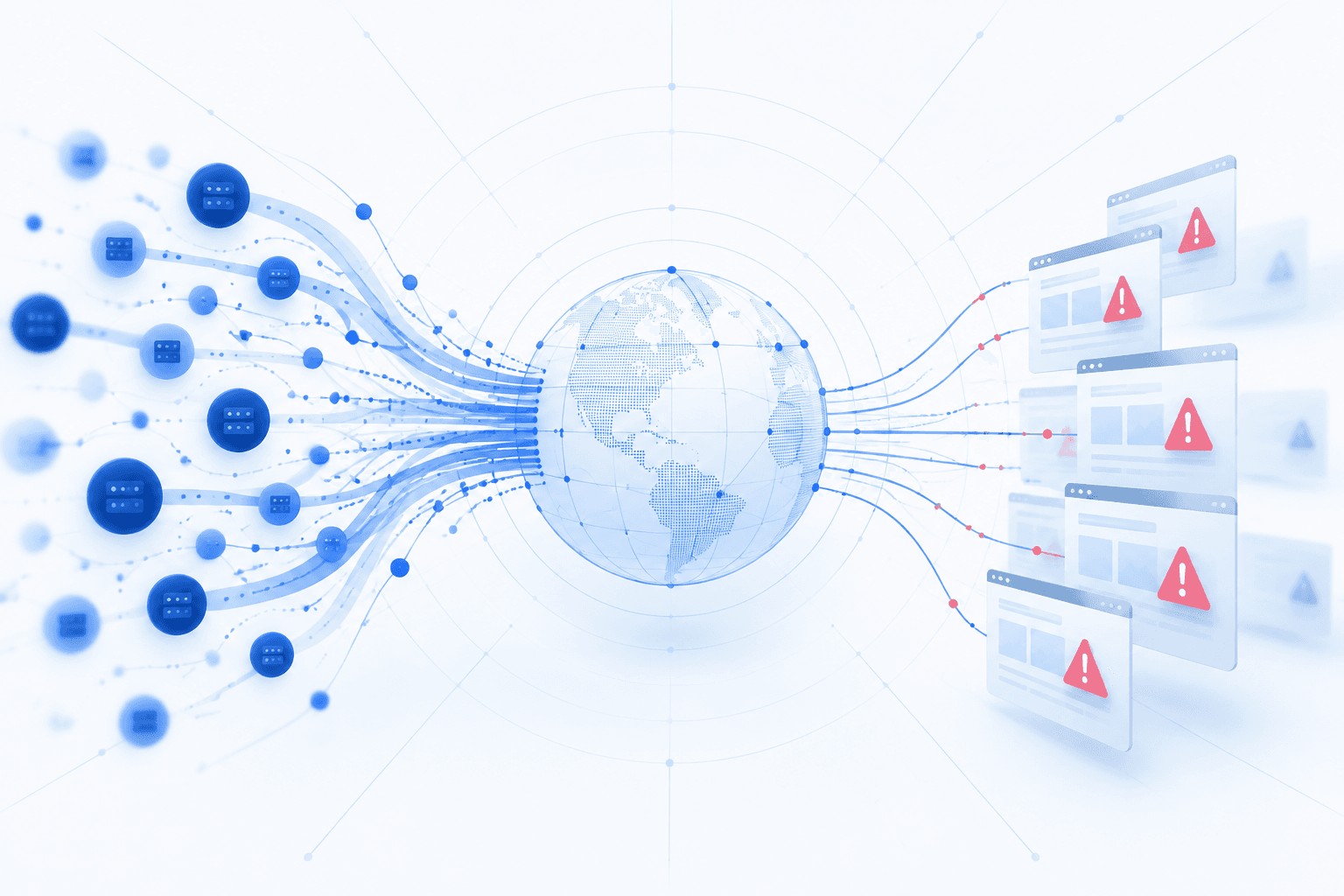
Cloudflare's 2025 review highlights a dramatic increase in global internet traffic, with a 19% year-over-year surge largely attributed to the proliferation of bots and AI crawlers. These non-human actors, including search crawlers, AI agents, and malicious automation, now account for approximately 30% of all web traffic, placing unprecedented strain on network infrastructure and security defenses. The surge in AI-driven bot activity has led to data request spikes that can rival Distributed Denial of Service (DDoS) attacks, forcing website owners and service providers to adapt rapidly. Cloudflare's CEO described this trend as a fundamental rewiring of the internet, with AI not only driving traffic but also reshaping the threat landscape.
Akamai's analysis corroborates these findings, noting that while AI bot traffic is significant, the larger and more persistent threat comes from evasive scrapers, which generate nearly three times more traffic than AI bots. These scrapers adapt quickly to new controls and continue to probe for valuable content, especially when AI bots are blocked. The rapid expansion of AI use, combined with the growing volume of automated traffic, is creating new challenges for security, resilience, and equitable access to online resources. As AI becomes embedded in everyday applications, the need for robust mitigation strategies and infrastructure upgrades becomes critical to maintaining internet stability and security.

Track how attackers are adapting to this technology.
6 events from the most recent confirmed update back to the earliest known activity.
Cloudflare's 2025 review found that Starlink traffic more than doubled and expanded significantly across more than 20 countries. The company cited satellite connectivity growth as an increasingly important factor in global internet access patterns.
Cloudflare said post-quantum encryption adoption had exceeded 50% of human-driven internet traffic in 2025. The review presented this as a major milestone in the deployment of quantum-resistant protections on the public internet.
In its 2025 review, Cloudflare highlighted record-breaking DDoS attacks, including a 31 Tbps incident, and described hyper-volumetric botnet attacks as increasing in size and frequency. The report also noted 174 major outages worldwide linked to infrastructure failures, government shutdowns, and cable cuts, underscoring the internet's fragility.
Cloudflare's 2025 Radar Year in Review reported roughly 19% to 20% annual global internet traffic growth and said much of the increase was driven by bots, AI crawlers, and automated attacks. The review also highlighted the growing role of AI-related bot activity in reshaping internet usage and security conditions.
Akamai said vendors such as OpenAI, Anthropic, and Perplexity used different collection approaches, with OpenAI showing the most varied activity and Anthropic focusing mainly on training. It also observed that tarpit-style mitigations usually caused AI bots to reduce activity rather than become more evasive, while warning that blocking bots alone does not prevent indirect content harvesting through aggregators and redistributors.
Akamai reported that AI bot traffic was present across its network, with AI training crawlers continuing to grow in the media sector. The company also found that evasive scrapers generated nearly three times more automated content collection traffic than identifiable AI bots.
Vulnerabilities, threat actors, malware, products, organizations, and breaches Mallory has linked to this story.
Follow how adversaries are adapting to this technology, and where it touches your stack today.
4 references tracked. Mallory keeps watching after this page renders.
securitysenses.com
Open sourcezdnet.com
Open sourcesecurityonline.info
Open sourceakamai.com
Open sourceMap indicators from this story to your assets and identify affected systems in minutes.
Every observed campaign, victim, and pivot linked to actors named in this story.
Malware, exploits, and IOCs connected to the activity described here.
YARA, Sigma, and Snort rules deployed to your SIEM as soon as they’re published.
Get matching new stories delivered to your team as they break — not the next morning.
Ask questions about this story and take action on the answers.
Other stories Mallory is tracking that overlap on entities, sources, or topic labels.
DataDome reported that malicious automated traffic increased **124%** between July 2025 and June 2026, compared with 13.2% growth in human traffic. Analysis spanning more than one trillion requests across over 75,000 customer sites found that bots and AI agents accounted for roughly 26.5% of traffic. Web scraping represented 70.9% of malicious bot activity and rose 185.2%, driven in part by collection of data for AI-model training; scalping, fake-account creation, and DDoS activity also grew. AI-agent and LLM-crawler traffic rose 82.3%, while monthly AI-bot activity against login pages increased more than eightfold during the first half of 2026, increasing exposure to credential testing and account abuse. In testing of 21,491 popular websites, 65.3% failed to detect any of 10 simulated bot types and only 2.4% stopped or challenged all of them; telecommunications organizations performed worst. DataDome advised organizations to distinguish authorized AI assistants from malicious automation through behavioral context rather than relying only on individual-request or browser-side indicators.
Sep 24, 2026
The rapid integration of artificial intelligence into enterprise environments is fundamentally reshaping the cybersecurity landscape, introducing new risks and operational challenges. Analyst firm Gartner has advised organizations to block the use of AI-powered browsers, such as Perplexity’s Comet and OpenAI’s ChatGPT Atlas, due to concerns that default settings prioritize user experience over security, potentially exposing sensitive data to cloud-based AI backends. Cloudflare has reported blocking over 416 billion AI bot scraping requests in five months, highlighting the scale at which AI-driven automation is targeting web content and raising concerns about the sustainability of current internet business models. Meanwhile, security leaders are increasing budgets and focusing on cloud and data security, but many still feel unprepared to address the evolving threat landscape, as AI accelerates both attack and defense capabilities. Industry reports and expert commentary emphasize that attackers are leveraging AI and automation to industrialize cybercrime, enabling faster, more scalable, and more sophisticated attacks. The Fortinet Cyberthreat Predictions Report for 2026 notes that AI-powered agents are automating key stages of the attack chain, from credential theft to lateral movement and data monetization, while the proliferation of non-human identities (machine-to-machine interactions) is becoming a critical security concern. As organizations face mounting pressure to defend at machine speed, the need for robust identity management, automated threat intelligence, and board-level prioritization of cyber resilience is more urgent than ever, especially for critical infrastructure sectors where the consequences of a breach can be catastrophic.
Jun 29, 2026
The rapid integration of AI platforms and agentic workflows into enterprise environments is creating new security challenges, particularly through the accumulation of AI technical debt and the proliferation of legitimate bot traffic. AI technical debt arises when organizations rush to deploy AI systems without addressing foundational security and governance issues, such as poorly managed data pipelines, overly permissive access controls, and deferred architectural decisions. These shortcuts expand the attack surface, erode data visibility, and make systems more difficult to maintain or secure, increasing the risk of significant breaches as AI systems evolve and interact with more environments. Simultaneously, the rise of legitimate bots—including search engine crawlers, AI model scrapers, and agentic AI systems—has introduced a growing blind spot for security teams. While these bots are not inherently malicious, their large-scale, persistent interactions with web applications and APIs can degrade performance, increase operational costs, and expose sensitive content. Traditional bot management strategies, such as static allow/deny lists, are proving inadequate in this AI-driven landscape, as legitimate automation often bypasses conventional controls and blends into normal traffic patterns. Security teams must now adapt by improving visibility, historical context, and governance to address these evolving risks.
Jun 29, 2026