
Loading story…
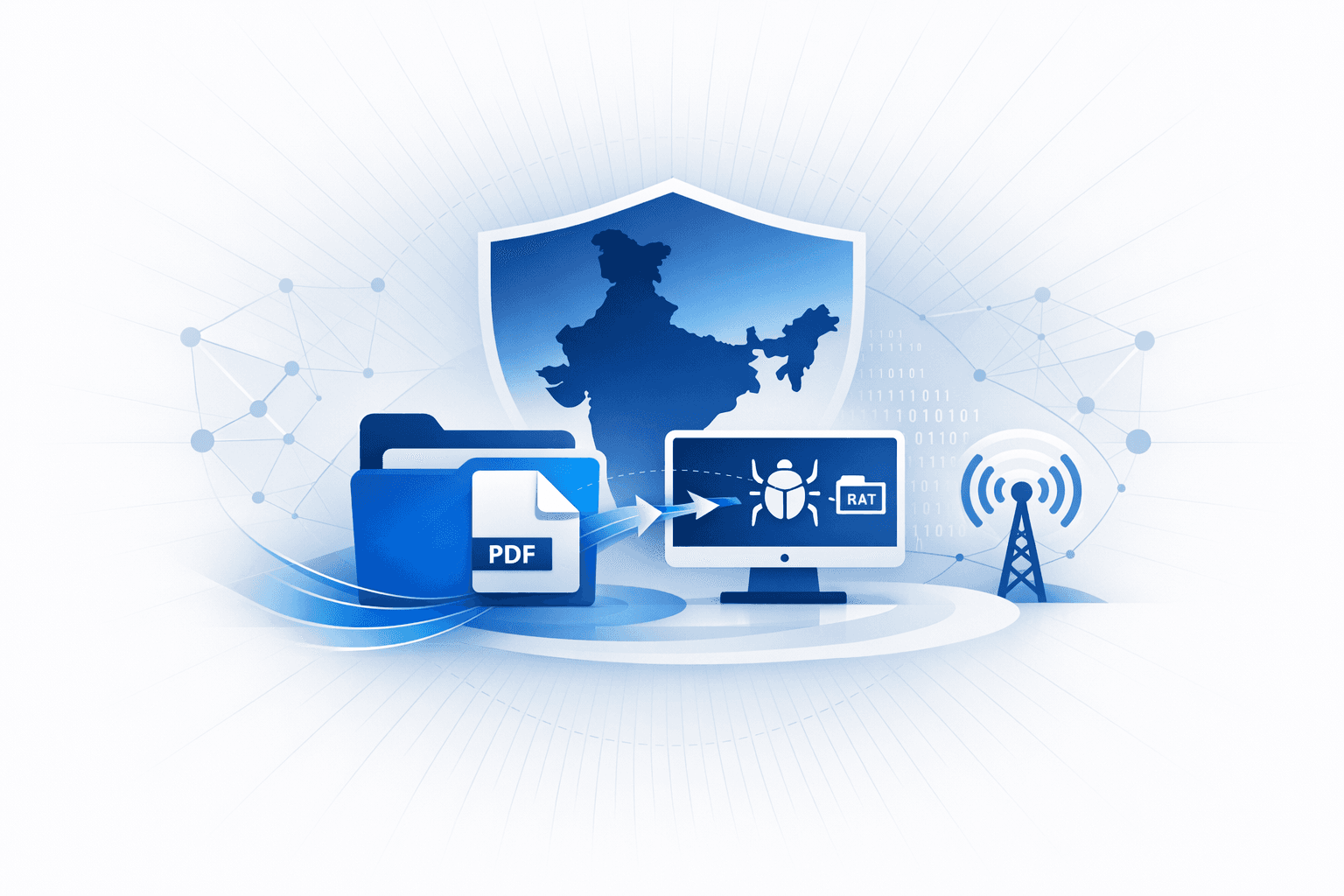
The threat actor known as Transparent Tribe, or APT36, has launched a new wave of cyber espionage campaigns targeting Indian government, academic, and strategic organizations. These attacks leverage spear-phishing emails containing ZIP archives with Windows LNK shortcut files disguised as legitimate PDF documents. When opened, these shortcuts execute remote HTML Application (HTA) scripts using mshta.exe, which in turn decrypt and load a .NET-based Remote Access Trojan (RAT) directly into memory, providing the attackers with persistent remote control, data theft, and surveillance capabilities. The campaigns employ sophisticated evasion techniques, such as embedding full PDF content and images within the LNK files to avoid suspicion, and adapting persistence methods based on detected antivirus solutions.
Researchers from Cyfirma have detailed how the malware communicates with its command-and-control infrastructure over encrypted channels and uses trusted Windows tools to evade detection. The infection chain is designed for long-term spying, with the attackers able to profile the victim's environment and manipulate runtime execution for reliability. The use of double extension tricks and abnormal file sizes further enhances the campaign's effectiveness in deceiving targets. These campaigns highlight the evolving tactics of APT36 and the ongoing threat posed to Indian governmental and strategic sectors by state-sponsored cyber espionage groups.
TTPs, infrastructure, and targeting history in one profile.
2 events from the most recent confirmed update back to the earliest known activity.
Cyfirma researchers documented the campaign's use of mshta.exe, remote HTA scripts, in-memory .NET RAT loading, decoy documents, and abuse of trusted Windows components for evasion. Reporting also identified malware components and RAT capabilities including remote control, surveillance, data theft, persistence, and clipboard monitoring.
Transparent Tribe (APT36) initiated a spear-phishing campaign targeting Indian government, academic, and other strategic entities using ZIP archives themed around the "Online JLPT Exam Dec 2025." The lures delivered malicious Windows LNK files disguised as PDFs to begin a multi-stage intrusion.
Vulnerabilities, threat actors, malware, products, organizations, breaches, and observables Mallory has linked to this story. Indicator values are masked here and available in full in the app.
Indicator values are masked on this page. See the values in Mallory Domains, IPs, hashes, and URLs are exportable to your SIEM.
See this adversary's TTPs, infrastructure, and targeting history, correlated against your exposure.
4 references tracked. Mallory keeps watching after this page renders.
securityonline.info
Open sourcethehackernews.com
Open sourcetherecord.media
Open sourcecybersecuritynews.com
Open sourceMap indicators from this story to your assets and identify affected systems in minutes.
Every observed campaign, victim, and pivot linked to actors named in this story.
Malware, exploits, and IOCs connected to the activity described here.
YARA, Sigma, and Snort rules deployed to your SIEM as soon as they’re published.
Get matching new stories delivered to your team as they break — not the next morning.
Ask questions about this story and take action on the answers.
Other stories Mallory is tracking that overlap on entities, sources, or topic labels.

**Transparent Tribe (APT36)**, a Pakistan-aligned threat actor historically associated with espionage against Indian government, defense, and education targets, has been observed expanding operations into **India’s startup ecosystem**, with a particular focus on startups connected to **cybersecurity, intelligence, and law-enforcement support**. Researchers reported the activity after identifying suspicious, India-origin uploads and startup-themed lure material, including the apparent use of personal details tied to a real startup founder to increase the credibility of spear-phishing content. The intrusion chain described relies on **spear-phishing emails** delivering an **ISO container** (e.g., `MeetBisht.iso`) that includes a **malicious LNK shortcut** masquerading as a legitimate document (such as an Excel file) plus a hidden folder containing a **decoy document**, a **batch script** to execute/maintain the infection flow, and the **Crimson RAT** payload (disguised as an executable named like *Excel*). Once installed, **Crimson RAT** enables broad surveillance and control capabilities (e.g., screen monitoring, audio recording, file theft, and system control), aligning with APT36’s established intelligence-collection objectives even as targeting broadens to startup-linked individuals with proximity to sensitive government or security operations.
Jun 29, 2026
Pakistan-linked threat activity targeting Indian organizations has expanded across government, defense, education, and energy sectors, with researchers tying much of the activity to **Transparent Tribe (APT36)** and **SideCopy**. Seqrite reported that SideCopy ran multiple spear-phishing campaigns using malicious `LNK` files, `MSHTA`, staged `HTA` and `DLL` payloads, and dual **AllaKore RAT** variants against Indian government and military-themed targets, while Transparent Tribe used `XLAM` add-ins, macro-enabled files, and updated **Crimson RAT** delivery chains. Infrastructure overlaps, malware similarities, and passive DNS correlations were cited as evidence linking the groups, and lures referenced Indian Ministry of Defence allowances, DGMS themes, and Army posting policies to increase credibility. Other reporting shows the same broader espionage pattern has persisted for years and widened beyond traditional military targets. SentinelOne, K7, and Seqrite documented Transparent Tribe campaigns against Indian educational institutions using malicious Office documents and `.NET` malware with **Crimson RAT**-like behavior, while Cyble described a defense-themed malware chain delivered in a `.vhdx` image that checked for India Standard Time before deploying a second-stage payload. Separately, EclecticIQ's **Operation FlightNight** targeted Indian government entities and private energy companies with an ISO-delivered stealer based on **HackBrowserData**, exfiltrating browser data and selected documents to attacker-controlled Slack workspaces; analysts linked it to an earlier **Go-Stealer** campaign and assessed the motive as cyber espionage.
Aug 15, 2026
Transparent Tribe (`APT36`), a suspected Pakistan-aligned threat actor, targeted India’s education sector with malicious Microsoft Office documents designed to deliver **Crimson RAT**. Researchers said the campaign used both traditional macro-enabled files and a newer `OLE` embedding technique that tricks victims into double-clicking a fake **"View Document"** prompt, launching the malware under the filename `MicrosoftUpdate.exe`. SentinelOne identified multiple **Crimson RAT** `.NET` variants compiled between July and September 2022 that used the command-and-control domain `richa-sharma.ddns[.]net`. The samples showed anti-analysis delays, persistence checks, and differing obfuscation approaches, including **Eazfuscator**, indicating continued tool refinement as the group broadened its targeting beyond Indian military and government entities to include educational institutions and students across the subcontinent.
Jul 12, 2026