
Loading story…
A CSC domain security study reported that many large enterprises continue to leave domain names and DNS underprotected, creating an exploitable gap outside traditional perimeter controls. The research highlights how attackers leverage domain weaknesses—such as lookalike registrations, domain hijacking, and reuse of lapsed or forgotten domains—to enable phishing, business email compromise (BEC), malware delivery, impersonation, and traffic redirection, particularly when registrar accounts are compromised.
The report found 67% of Global 2000 organizations have implemented fewer than half of recommended domain security measures, despite improvements in email authentication: DMARC adoption is near 80%, influenced by regulatory pressure including the EU’s NIS2 directive. Other protections remain uncommon, including DNSSEC (~11%) and registry lock (<25%), increasing exposure to unauthorized domain changes and DNS integrity attacks. DNS availability was also flagged as a resilience risk, with many organizations consolidating on a single cloud DNS provider and limited use of DNS redundancy (notably among unicorns, where reliance on single-cloud infrastructure is high), while CSC cautioned that using non-enterprise registrars can elevate the risk of hijacking and impersonation.

Get the infrastructure and lures behind it.
2 events from the most recent confirmed update back to the earliest known activity.
Coverage of the CSC findings emphasized that DMARC adoption had risen to nearly 80%, partly due to regulatory pressure including the EU NIS2 directive, while many firms remained exposed to domain hijacking, spoofing, and business email compromise. The reporting also noted growing risk from reliance on single cloud DNS providers and weaker security at consumer-grade registrars.
Corporation Service Co. published research on the Forbes Global 2000 and top private unicorns finding that most Global 2000 firms had implemented fewer than half of recommended domain security controls. The study highlighted low adoption of protections such as DNSSEC, registry lock, and DNS redundancy, despite improved DMARC uptake.
Get the infrastructure, lures, and IOCs behind this campaign, ready to push into your email and identity stack.
2 references tracked. Mallory keeps watching after this page renders.
Map indicators from this story to your assets and identify affected systems in minutes.
Every observed campaign, victim, and pivot linked to actors named in this story.
Malware, exploits, and IOCs connected to the activity described here.
YARA, Sigma, and Snort rules deployed to your SIEM as soon as they’re published.
Get matching new stories delivered to your team as they break — not the next morning.
Ask questions about this story and take action on the answers.
Other stories Mallory is tracking that overlap on entities, sources, or topic labels.
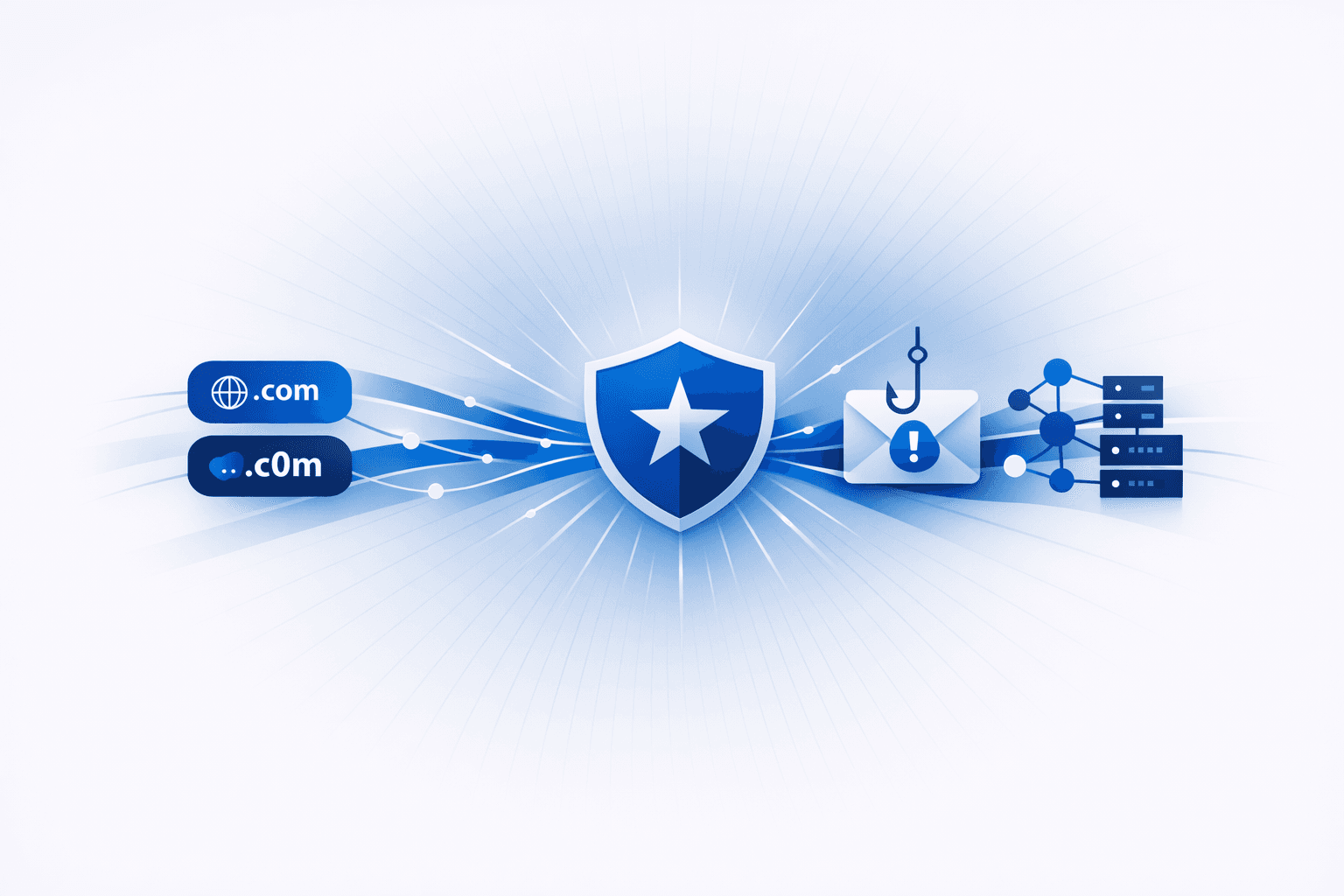
A senior **U.S. Secret Service** official warned that weaknesses in the internet’s domain registration and governance model are being actively exploited to scale phishing and fraud, citing the ease with which attackers can register deceptive, brand-imitating domains and then force defenders into reactive, court-driven takedowns. The official argued that insufficient identity validation in domain registration and abuse concentration in certain networks (e.g., via **ASNs**) represent systemic gaps that enable business email compromise and link-based phishing campaigns across SMS and email. Threat intelligence reporting on Canada-linked fraud activity illustrates how these domain-registration weaknesses translate into operational campaigns: attackers are using lookalike domains, SMS lures, and paid ads to drive victims to convincing fake portals impersonating **PayBC, ServiceOntario, Canada Post, CRA, and Air Canada** to steal credentials and payment data. CloudSEK attributed much of the activity to the **“PayTool” phishing ecosystem**, describing reusable phishing kits and shared infrastructure that can be rapidly rebranded and expanded from provincial payment portals into broader “Government of Canada” themed entry points. Separate coverage of Anguilla’s `.ai` domain boom is primarily economic/industry-focused and does not provide substantive security reporting tied to the phishing and domain-abuse problem described above.
Jun 29, 2026
Microsoft has published a cluster of DNS-related security advisories covering **remote code execution, denial of service, cache poisoning, heap overflow, and access-control bypass** conditions across Windows DNS Server and third-party DNS components. The newly listed issues include `CVE-2026-33278` for possible arbitrary code execution during **DNSSEC** validation, `CVE-2026-42959` for crashes triggered by malicious DNSSEC content, `CVE-2026-42960` for possible cache poisoning through promiscuous authority-section records, and `CVE-2026-42944` for a heap overflow involving multiple `NSID`, `COOKIE`, and `PADDING` **EDNS** options. Additional advisories describe degradation-of-service conditions tied to long EDNS option lists (`CVE-2026-41292`), unbounded name compression (`CVE-2026-44390`), and a "packet of death" affecting **DNSCrypt** (`CVE-2026-32792`). The disclosures also reference flaws in widely used DNS software, including a **BIND 9** resolver unbounded resend loop (`CVE-2026-5950`), invalid handling of `CLASS != IN` (`CVE-2026-5946`), and a **CoreDNS** ACL bypass (`CVE-2026-26017`). Earlier Microsoft advisories for Windows DNS Server remote code execution, including `CVE-2021-33754` and `CVE-2021-33746`, show that DNS services remain a recurring high-impact target because they are network-exposed and central to enterprise operations. For defenders, the combined set of advisories highlights the need to prioritize patching DNS infrastructure, review exposure of DNSSEC, EDNS, and DNSCrypt features, and monitor for service instability or anomalous DNS responses that could indicate exploitation attempts.
Jun 29, 2026
UK reporting highlighted persistent weaknesses in baseline cyber hygiene and a growing expectation that **phishing and social engineering** will succeed against many organizations. A Vodafone Business-commissioned snapshot cited by Tech Radar/SC Media reported that **63% of UK businesses** feel more exposed to cyberattacks than a year ago, **71% of leaders** think employees are vulnerable to phishing, and staff reuse work passwords across an average of **11 personal accounts**; only **45%** of organizations said all staff had completed basic cyber awareness training. The same coverage noted increasing concern about **AI-enabled scams and deepfakes**, with **70%** reporting greater suspicion of video calls impersonating senior leaders, and pointed to the UK government’s planned *Telecommunications Fraud Charter* as part of broader anti-fraud efforts. Separately, the Bank of England’s 2025 CBEST review (summarized by The Register) found that regulated financial firms and **financial market infrastructures (FMIs)** still commonly fail on fundamentals observed during **13 CBEST assessments and regulator-backed penetration tests**, including **weak access controls**, poor password practices, **misconfigured and inconsistently patched systems**, and gaps in **intrusion detection** and vulnerability management. The report emphasized that firms should be prepared to **handle breaches** rather than relying only on preventive controls, and that weak security culture enables attackers to bypass controls via social engineering; it also warned that inadequate helpdesk identity-verification processes can enable fraudulent credential access, with the NCSC noting such tradecraft aligns with groups like **Scattered Spider**.
Jul 12, 2026