
Loading story…
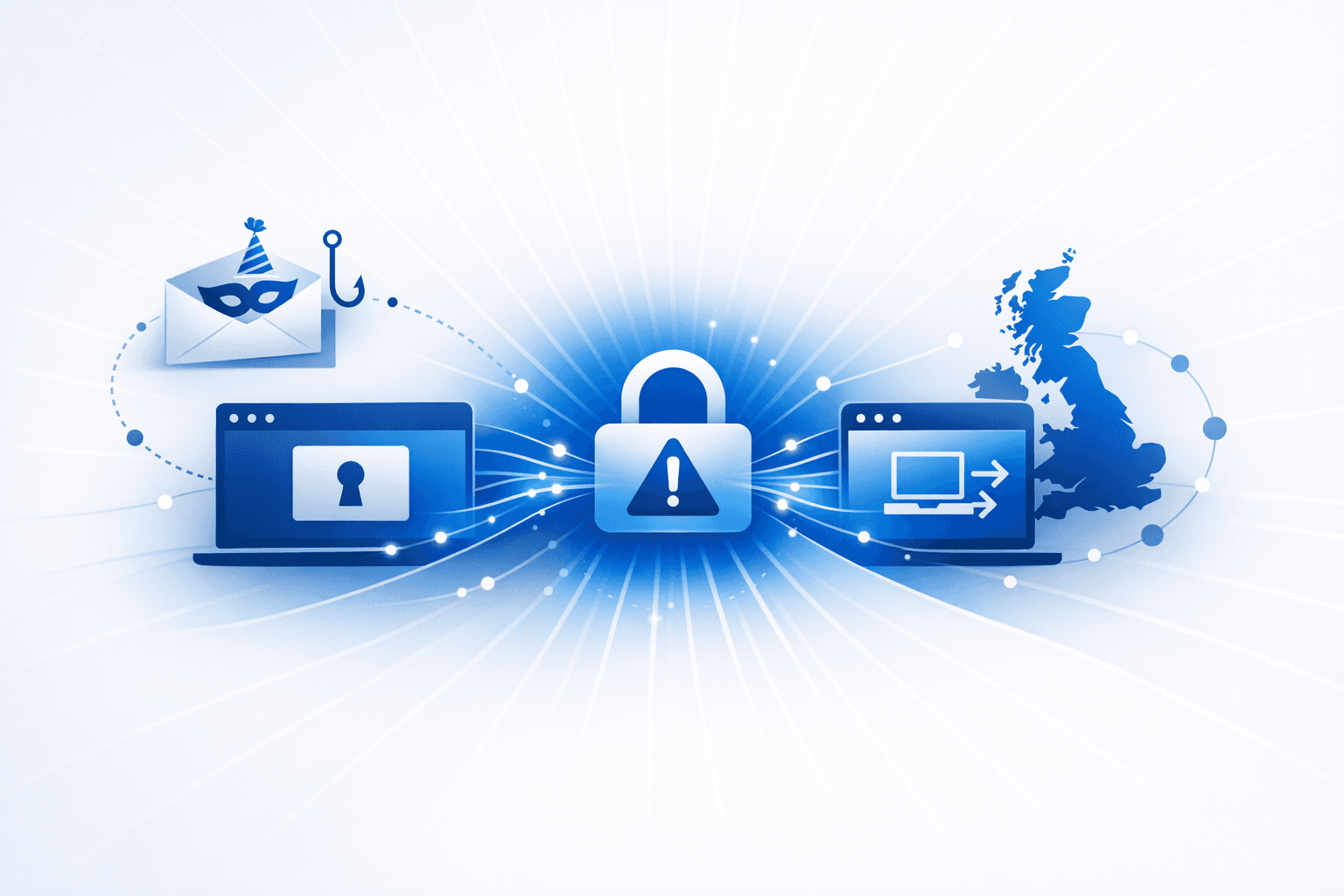
Two separate social-engineering campaigns are abusing legitimate remote access software to obtain interactive control of victim systems. One phishing operation uses fake party invitation emails—often appearing to come from compromised email accounts—to lure recipients to a spoofed invitation webpage that pressures them to download and run an RSVPPartyInvitationCard.msi installer. Malwarebytes researchers reported the activity primarily targeting the UK, with the MSI using msiexec.exe to silently install the ScreenConnect remote support client, enabling attackers to access files, credentials, and other sensitive data.
A different, automated campaign is targeting RustDesk users by bombarding exposed RustDesk IDs with unsolicited connection requests labeled “Go Client” from many IPs/IDs. The activity is described as not exploiting a RustDesk vulnerability; instead it relies on users mistakenly clicking Accept, after which the botnet can run scripted actions to deploy additional malware and establish persistence. Recommended mitigations include refusing unexpected connection prompts and configuring RustDesk to require a password (and strong credentials) for session acceptance, reducing the risk of one-click authorization leading to takeover.
Get the infrastructure and lures behind it.
5 events from the most recent confirmed update back to the earliest known activity.
By 2026-03-12, researchers documented an active campaign using Spanish- and English-language invoice lures to install legitimately signed ConnectWise ScreenConnect clients configured for attacker-controlled relays, giving persistent unattended access. The report identified live infrastructure on 80.76.49[.]161 and described an obfuscated VBS dropper that elevated privileges, downloaded the MSI, installed it silently, and removed the installer.
As the RustDesk connection-flooding campaign was reported, the RustDesk team recommended requiring passwords for incoming connections, using strong passwords, and considering self-hosting with protected server details. Additional mitigations included ACLs in the Professional self-hosted edition, 2FA, and IP whitelisting to restrict access to trusted sources.
A phishing campaign used fake party-invitation emails, often sent from compromised accounts, to trick recipients into downloading an MSI that silently installed the legitimate ScreenConnect remote access client. Malwarebytes reported the activity as primarily targeting users in the United Kingdom, giving attackers persistent remote control over infected Windows systems.
In late January 2026, attackers launched an opportunistic botnet-driven campaign that scanned for active RustDesk IDs and sent unsolicited connection requests from many IP addresses and identifiers. The activity relied on social engineering rather than a software vulnerability, attempting to trick users into accepting a connection from a client labeled "Go Client."
Beginning as early as April 2025, Sophos says threat cluster STAC6405 targeted more than 80 organizations across multiple U.S. sectors with phishing lures such as Punchbowl invitations and tender solicitations. The attackers delivered legitimate RMM tools, primarily LogMeIn Resolve and sometimes ScreenConnect, preconfigured for attacker-controlled remote access to establish persistent initial access.
Vulnerabilities, threat actors, malware, products, organizations, breaches, and observables Mallory has linked to this story. Indicator values are masked here and available in full in the app.
Indicator values are masked on this page. View all 32 in Mallory Domains, IPs, hashes, and URLs are exportable to your SIEM.
Get the infrastructure, lures, and IOCs behind this campaign, ready to push into your email and identity stack.
5 references tracked. Mallory keeps watching after this page renders.
cybersecuritynews.com
Open sourceintel.breakglass.tech
Open sourceintel.breakglass.tech
Open sourcecybersecuritynews.com
Open sourcesecurityonline.info
Open sourceMap indicators from this story to your assets and identify affected systems in minutes.
Every observed campaign, victim, and pivot linked to actors named in this story.
Malware, exploits, and IOCs connected to the activity described here.
YARA, Sigma, and Snort rules deployed to your SIEM as soon as they’re published.
Get matching new stories delivered to your team as they break — not the next morning.
Ask questions about this story and take action on the answers.
Other stories Mallory is tracking that overlap on entities, sources, or topic labels.
Rapid7 reported multiple intrusions tied to an ongoing social-engineering campaign that starts with email bombing and follow-up calls, often over Microsoft Teams, to pressure users into installing **AnyDesk**. In the observed June 2024 cases, the operators moved away from earlier Quick Assist and batch-script tradecraft and instead used a signed .NET credential harvester, `AntiSpam.exe`, followed by payloads masquerading as software updates. Those payloads included **SystemBC**, Golang HTTP beacons, SOCKS proxy implants, a PowerShell proxy script, reverse SSH tunnels, and **Level RMM** for persistence and lateral movement, with several binaries signed by the same certificate to appear legitimate. Rapid7 said one payload, `update6.exe`, attempted to exploit **`CVE-2022-26923`** to add a machine account for privilege escalation on vulnerable domain controllers, then moved to **Kerberoasting** by requesting Kerberos service tickets tied to service principal names and cracking them offline to recover service-account credentials. That technique can provide valid account access and support further privilege escalation, persistence, and lateral movement inside Windows domains. Rapid7 published indicators of compromise and urged defenders to use application allowlisting, block unapproved remote monitoring and management tools and related domains, train users to resist help-desk impersonation, and patch systems exposed to `CVE-2022-26923`.
Aug 15, 2026
Threat researchers reported multiple phishing-driven intrusions in which attackers impersonate trusted brands and agencies to trick victims into installing legitimate remote monitoring and management (RMM) software for persistent access. In **Operation DoppelBrand**, financially motivated actor **GS7** spoofed Fortune 500 financial and technology brands (including **Wells Fargo** and **USAA**) using more than **150** lookalike domains to harvest credentials and exfiltrate data via attacker-controlled **Telegram bots**; researchers also identified nearly **200** additional domains with short registration terms, automated SSL, wildcard DNS, and brand-specific subdomains supporting the campaign. Separately, Forcepoint X-Labs described a wave of emails impersonating the **U.S. Social Security Administration** that delivers an attached `.cmd` script to weaken Windows defenses and enable silent installation of **ConnectWise ScreenConnect**. The script checks/elevates privileges, disables **Windows SmartScreen** via registry changes, removes **Mark-of-the-Web**, and uses **Alternate Data Streams (ADS)** for stealth before installing an MSI and configuring ScreenConnect (via `System.config`) to beacon to an attacker-controlled server (reported as `dof-connecttop` on port `8041`). Both activity sets highlight a recurring tradecraft pattern: **brand impersonation + scripted defense evasion + abuse of legitimate RMM tooling** (e.g., *LogMeIn Resolve*, *ScreenConnect*) to gain remote control and facilitate follow-on theft or persistence.
Jun 29, 2026
Sophos X-Ops reported that a phishing campaign tracked as **STAC6405** used invitation-themed lures to trick targets into installing legitimate remote monitoring and management tools, including **LogMeIn Resolve** and **ScreenConnect**, giving attackers unattended remote access. The activity was first observed in April 2025, peaked in October and November 2025, and affected more than 80 organizations, primarily in the United States. Sophos said some phishing links were still active at the time of reporting, indicating the campaign may still be ongoing. In most intrusions, the attackers stopped after establishing remote access, suggesting the operation may support initial access brokerage or maintain dormant persistence for later use. In two cases, however, the compromise advanced to second-stage activity: one intrusion deployed a **HeartCrypt**-packed infostealer that hid the mouse cursor, injected into `csc.exe`, contacted `45[.]56.162.138`, and stole browser, wallet, and system data; another used a ScreenConnect-based payload bundled with Java components and a likely **SimpleHelp**-related remote access binary to obtain interactive access before defenders contained the incident.
Jun 29, 2026