
Loading story…
North Korea-linked Lazarus Group has been tied to an expanded “fake recruiter” operation targeting cryptocurrency-sector Python and JavaScript developers by luring them with job offers and coding assessments that require installing trojanized dependencies from npm and PyPI. ReversingLabs reports the activity has been ongoing since May 2025 and uses a multi-stage, modular infection chain that hides malicious functionality behind layers of indirection across public services such as GitHub, npm, and PyPI, helping the operation persist even as individual components are removed.
The campaign (codenamed Graphalgo) reportedly uses a “bait-and-switch” approach in which initially benign packages build trust and download volume before later versions introduce malicious payloads; one highlighted npm package, bigmathutils, exceeded 10,000 downloads prior to the malicious update. Reported package names associated with the operation include npm packages such as graphalgo, graphlibcore, and bigmathutils, and PyPI packages such as graphalgo, graphlibx, and bigmathutils; the threat actors also create supporting legitimacy artifacts (e.g., a purported crypto firm like Veltrix Capital, related domains, and GitHub organizations/repositories) to make the recruitment workflow appear authentic and to deliver the compromised projects used in “assessments.”

Trace attribution and downstream blast radius.
10 events from the most recent confirmed update back to the earliest known activity.
Sophos Counter Threat Unit reported that the North Korean group Nickel Alley targeted freelance and high-value software developers through fake interviews on LinkedIn, Upwork, and Fiverr, using fraudulent company pages, GitHub repositories, and malicious or typosquatted npm packages. The campaign used ClickFix-style lures and npm-based execution to deploy PyLangGhost RAT, with Sophos noting earlier use of a GoLangGhost variant and warning the activity could support cryptocurrency theft, supply-chain compromise, or espionage.
A ReversingLabs publication referenced on 2026-04-09 said the Lazarus-linked Graphalgo fake recruiter-test campaign had re-emerged. This indicates the operation was still active or had resumed in a new wave after its earlier public disclosure.
An April 2026 investigation uncovered a malicious npm dependency chain tied to the GitHub organizations Mentonex and FluxMarketX, including packages such as logkitx, logger-base, and dev-log-core that delivered a backdoor via Vercel-hosted infrastructure. The report also mapped multiple fake developer personas and facilitator recruitment activity across GitHub, LinkedIn, dev.to, freelance sites, and job boards, assessing the cluster as closely aligned with North Korean tradecraft.
Reporting also highlighted an npm-based extortion scheme dubbed "XPACK ATTACK," in which package installs were blocked with an HTTP 402-style paywall demanding 0.1 USDC or ETH. The campaign additionally collected GitHub usernames and device fingerprints from affected users.
Separately from Graphalgo, JFrog reported that the npm package "duer-js" delivered the "Bada Stealer" malware, which stole browser and Discord data, exfiltrated it via Discord webhook and Gofile, and downloaded a secondary payload for Discord persistence. This was disclosed alongside broader reporting on malicious package abuse in the npm ecosystem.
In February 2026, ReversingLabs disclosed the "graphalgo" operation and attributed it to Lazarus with medium-to-high confidence based on tradecraft overlap, crypto targeting, token-based C2 similarities to prior activity, and GMT+9 commit-time artifacts. The report said the campaign remained active with no signs of stopping.
Developers who executed the trojanized coding projects pulled malicious dependencies from npm or PyPI that ultimately installed a remote access trojan. The malware supported system and process discovery, command execution, file access and exfiltration, additional payload delivery, and checked for MetaMask, indicating likely cryptocurrency theft objectives.
One npm package, "bigmathutils," was reportedly first distributed as a benign package and accumulated more than 10,000 downloads before a later bait-and-switch update introduced a malicious payload, including version 1.1.0. This reflected the campaign's tactic of delaying malicious updates to evade detection and build victim trust.
As the campaign unfolded, the threat actor set up fake company fronts such as Veltrix Capital, used LinkedIn, Facebook, Reddit, and GitHub to approach candidates, and published malicious packages to npm and PyPI. Researchers identified 192 malicious packages used as part of the multi-stage infection chain.
ReversingLabs assessed the North Korea-linked Lazarus Group's recruitment-themed supply-chain campaign, later dubbed "graphalgo," as active since early May 2025. The operation targeted JavaScript and Python developers, especially in crypto and Web3, through fake recruiter outreach and coding challenges.
Vulnerabilities, threat actors, malware, products, organizations, breaches, and observables Mallory has linked to this story. Indicator values are masked here and available in full in the app.
Indicator values are masked on this page. View all 20 in Mallory Domains, IPs, hashes, and URLs are exportable to your SIEM.
See attribution and downstream blast radius, and whether this package or vendor reaches your builds.
10 references tracked. Mallory keeps watching after this page renders.
itpro.com
Open sourcebsky.app
Open sourcenkinternet.com
Open sourcesecurityaffairs.com
Open sourcesecurityonline.info
Open sourcebleepingcomputer.com
Open sourcevulnu.com
Open sourcethehackernews.com
Open sourceMap indicators from this story to your assets and identify affected systems in minutes.
Every observed campaign, victim, and pivot linked to actors named in this story.
Malware, exploits, and IOCs connected to the activity described here.
YARA, Sigma, and Snort rules deployed to your SIEM as soon as they’re published.
Get matching new stories delivered to your team as they break — not the next morning.
Ask questions about this story and take action on the answers.
Other stories Mallory is tracking that overlap on entities, sources, or topic labels.
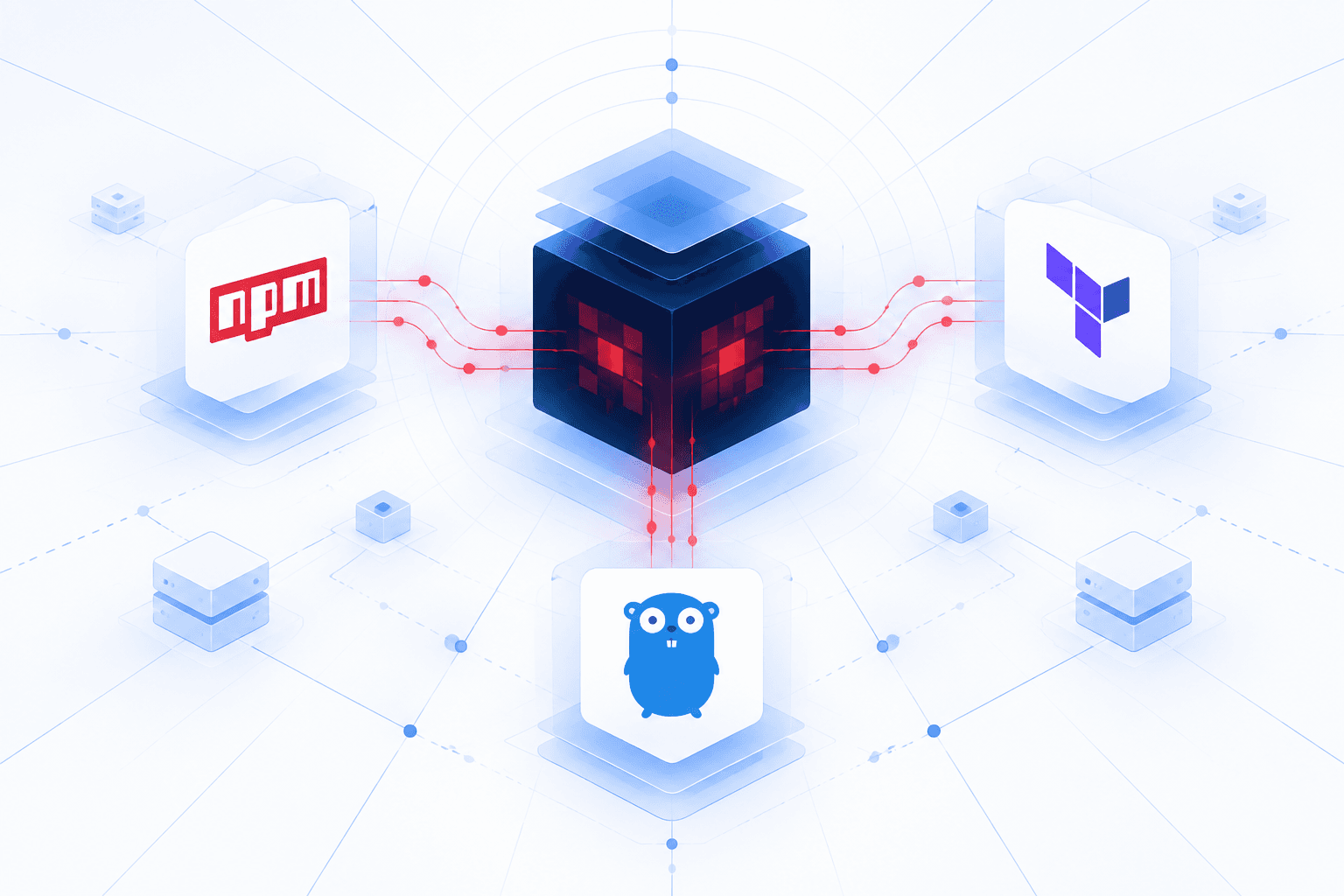
A threat actor has distributed a Go implementation of the **Graphalgo** malware through two malicious Terraform providers and two Go modules—the first reported systematic abuse of Terraform providers for malware delivery. The packages used trigger-gated, encrypted payloads to selectively infect victims, then installed a second-stage Go remote-access trojan on Windows, Linux, and macOS systems. The RAT communicated through encrypted Slack infrastructure and the Arbitrum Sepolia blockchain; shared public-key, Slack, and blockchain infrastructure links the activity to the earlier Graphalgo npm campaign. The operators also established fake Go-package ecosystems, including `gocommunity.io` and `gogets.dev`, to make the malicious modules appear legitimate and target Go developers and DevOps staff. The expansion follows prior Graphalgo activity using fake recruiter-test lures and coincides with the separate "Equation of Compromise" npm operation targeting DeFi and quantitative developers through trigger-activated packages and Sepolia-based command-and-control. Both campaigns demonstrate continued supply-chain targeting using conditional execution, encrypted multistage payloads, and blockchain-backed C2, although the available reporting does not establish that they are operated by the same actor.
Sep 22, 2026
North Korean state-sponsored threat actors have significantly escalated their 'Contagious Interview' campaign by flooding the npm registry with over 338 malicious packages designed to steal cryptocurrency and sensitive credentials. The operation leverages a repeatable playbook, with threat actors creating more than 180 fake personas and using new npm aliases and registration emails to distribute the malware. These malicious packages have collectively been downloaded over 50,000 times, indicating a substantial reach and potential impact on the developer community. The attackers primarily target Web3, cryptocurrency, and blockchain developers, as well as technical job seekers, often approaching them on LinkedIn under the guise of recruiters or hiring managers. The campaign follows a multi-stage attack chain, beginning with reconnaissance on social media, followed by weaponization through the publication of typosquatted npm packages. Delivery occurs via recruiter lures, leading to exploitation through malware loaders that execute in memory. The malware tooling has evolved, with initial stages using direct BeaverTail droppers, and more recent waves employing HexEval, XORIndex, and encrypted loaders that reconstruct BeaverTail in memory. Once executed, these loaders typically fetch the InvisibleFerret backdoor, which establishes persistence and enables further malicious actions. The attackers use over a dozen command and control endpoints to manage the compromised systems. The campaign is iterative, with new malicious packages appearing weekly and loader code being regularly tweaked to evade detection. The npm security team has been notified, and takedown requests have been submitted, but as of the latest reports, 25 malicious packages remain live on the registry. The operation has resulted in multi-stage compromises, including the theft of wallet keys and sensitive credentials, leading to financial losses for victims. The attackers' use of social engineering, technical obfuscation, and rapid distribution across new aliases demonstrates a high level of sophistication and adaptability. The campaign has been mapped to the Lockheed Martin Cyber Kill Chain, illustrating its comprehensive approach from reconnaissance to actions on objectives. Security researchers emphasize the need for heightened vigilance among developers, especially those in the cryptocurrency and blockchain sectors, and recommend immediate review of npm dependencies and enhanced monitoring for suspicious package activity. The ongoing nature of the campaign and the attackers' ability to quickly adapt their tactics pose a persistent threat to the software supply chain. Organizations are urged to implement robust security controls, educate staff about social engineering risks, and coordinate with npm and security vendors to mitigate exposure. The incident highlights the growing risk of supply chain attacks via open-source ecosystems and the need for industry-wide collaboration to address such threats.
Jun 29, 2026
A cyber campaign targeted blockchain developers through a fake recruitment process that directed victims to a polished GitHub repository posing as a legitimate company project. Investigators found multiple hidden compromise paths in the codebase, including a malicious VSCode task that could run when the folder was opened and a trojanized `npm` dependency that delivered another infection route. The operation used a multi-stage chain with short-lived JWTs, behavior-based filtering on command-and-control infrastructure, and anti-analysis measures designed to frustrate defenders. Analysis of the repository’s 574 commits uncovered four malicious artifacts and showed how the attackers blended social engineering with developer tooling abuse to gain execution on targets’ machines. Researchers reported that AI-assisted review significantly accelerated static analysis and helped reconstruct the attack chain, while human validation remained necessary to correct false assumptions during investigation, including the discovery that failed second-stage requests were tied to User-Agent filtering that expected an `npm`-like fingerprint rather than simple IP-based blocking.
Jun 29, 2026