
Loading story…
Researchers reported the first confirmed appearance of the PylangGhost remote access trojan on the npm registry, where it was hidden in two malicious JavaScript packages: @jaime9008/math-service and react-refresh-update. The activity has been linked to FAMOUS CHOLLIMA, a North Korean state-sponsored threat group previously associated with developer-focused social engineering and trojanized software campaigns. The packages were reportedly uploaded by the user jaime9008, tied to the email jaimeandujo086[@]gmail.com, and contained a PylangGhost loader embedded in files including runtime.js, babel.js, and lib/lib.js.
The reported campaign used the hardcoded identifier "ML2J" and communicated with infrastructure including malicanbur[.]pro and 173.211.46[.]22:8080. The reporting indicates the npm activity represents an escalation of software supply chain targeting aimed at developers and development pipelines, extending a malware family that had previously been disclosed by Cisco Talos and attributed to the same DPRK-linked actor. A social post amplifying the Kmsec finding is consistent with that same event, while separate posts about Konni spear-phishing and KakaoTalk-linked activity describe a different DPRK-related campaign and are not part of this incident.
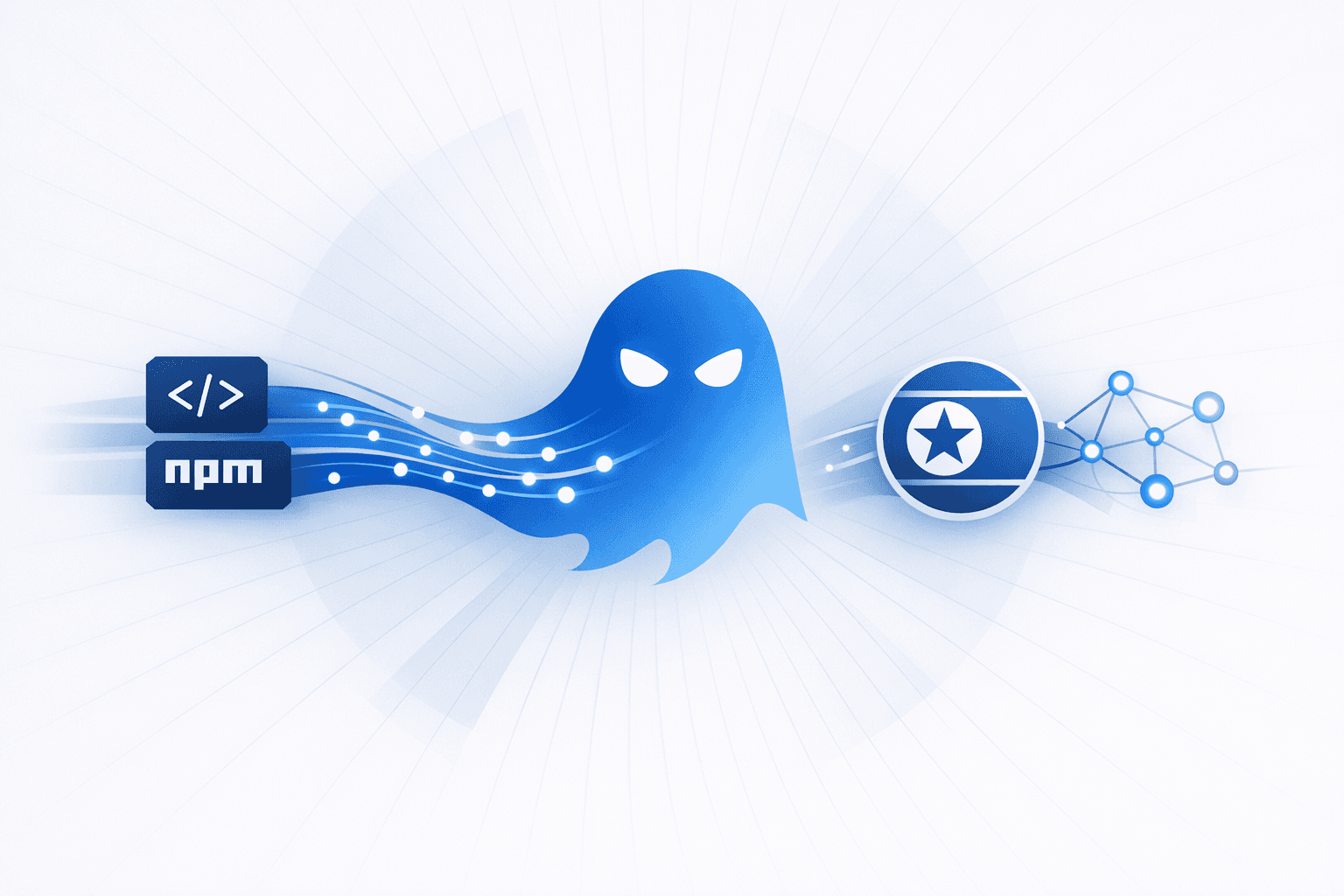
Trace attribution and downstream blast radius.
2 events from the most recent confirmed update back to the earliest known activity.
Researchers reported the first observed instance of the North Korea-linked PylangGhost RAT on the npm registry and attributed the activity to FAMOUS CHOLLIMA. The report also disclosed campaign details including the "ML2J" identifier and infrastructure such as malicanbur[.]pro and 173.211.46[.]22:8080.
In early 2026, the npm user "jaime9008" published two malicious JavaScript packages, @jaime9008/math-service and react-refresh-update, that contained a loader for the PylangGhost remote access trojan. The packages targeted Windows, macOS, and Linux systems as part of a software supply chain campaign.
Vulnerabilities, threat actors, malware, products, organizations, breaches, and observables Mallory has linked to this story. Indicator values are masked here and available in full in the app.
Indicator values are masked on this page. See the values in Mallory Domains, IPs, hashes, and URLs are exportable to your SIEM.
See attribution and downstream blast radius, and whether this package or vendor reaches your builds.
2 references tracked. Mallory keeps watching after this page renders.
Map indicators from this story to your assets and identify affected systems in minutes.
Every observed campaign, victim, and pivot linked to actors named in this story.
Malware, exploits, and IOCs connected to the activity described here.
YARA, Sigma, and Snort rules deployed to your SIEM as soon as they’re published.
Get matching new stories delivered to your team as they break — not the next morning.
Ask questions about this story and take action on the answers.
Other stories Mallory is tracking that overlap on entities, sources, or topic labels.
Researchers tied a cluster of malicious npm packages to **FAMOUS CHOLLIMA**, linking typo-squatted and fake utility libraries including `bigmathix`, `bigmathex`, `bignumx`, `bigmathutils`, `axios-net`, `some-promise`, and `json-ptype` to a broader campaign aimed at developers, particularly in the cryptocurrency sector. ReversingLabs reported the activity as part of a fake recruiter operation targeting crypto developers, while separate analysis showed the packages delivered a multi-stage Node.js malware chain that ultimately installed a cross-platform JavaScript RAT capable of command execution, file theft, persistence on Windows, Linux, and macOS, self-deletion, and checks for the **MetaMask** browser extension. Multiple operational security failures exposed details of the operators’ workflow. Analysts found a stray Windows `.lnk` file embedded in packages published in May and June 2025, revealing a VMware-based build environment and a shared folder path tied to package development, while another package exposed an `err.log` file showing a Windows host, the username `dvant`, `Node.js v22.19.0`, and a local path suggesting direct modification of the legitimate `any-promise` package. A separate leaked `ordinary.txt` reference file contained commented test code, localhost references to port 4444, and logic for evaluating server-supplied content, reinforcing assessments that the same DPRK-linked operator or closely coordinated team reused infrastructure, payloads, and naming patterns across the npm supply-chain campaign.
Aug 14, 2026
North Korean-linked threat actor **Famous Chollima** has been using fake job interviews and skill assessments to infect cryptocurrency and Web3 professionals with the **PylangGhost** and **GolangGhost** remote access trojans. Researchers said the operation impersonates firms including Coinbase, Robinhood, Uniswap, Archblock, and Parallel Studios, with lures delivered through LinkedIn, Discord, Telegram, email, and fraudulent interview sites. Victims are told to fix supposed camera or microphone problems by copying and pasting malicious commands, a **ClickFix/ClickFake** technique that installs malware on Windows and macOS systems; recent reporting said Linux was not targeted in the latest wave. The malware provides remote shell access, file transfer, system reconnaissance, persistence, and theft of browser credentials, cookies, and data from more than 80 browser extensions, including cryptocurrency wallets and password managers. Reporting indicates **PylangGhost** is a Python-based RAT functionally similar to GolangGhost, while **GolangGhost** on macOS can also deploy a SwiftUI credential harvester; both families use encrypted HTTP-based command-and-control communications. Investigators also described tailored fake assessment panels, invite-link validation, browser fingerprinting, mobile-device blocking, countdown timers, clipboard hijacking, and typosquatted infrastructure hosted largely through providers such as Hostinger and NameCheap, underscoring a financially motivated DPRK campaign aimed at stealing cryptocurrency and gaining access to company funds.
Aug 19, 2026
Security researchers reported multiple **software supply chain-style malware distribution** efforts abusing developer-adjacent platforms. JFrog detailed a malicious npm package, `@openclaw-ai/openclawai`, masquerading as an *OpenClaw* CLI installer; once executed, it uses a `postinstall` hook to reinstall globally and drop an obfuscated first-stage (`setup.js`) that deploys a multi-stage payload internally identified as **GhostLoader** (campaign tracked as **GhostClaw**). The malware is designed to persist and exfiltrate a broad set of sensitive data from developer workstations, including credentials (e.g., cloud config artifacts for **AWS/GCP/Azure**), macOS Keychain data, browser sessions, SSH keys, and cryptocurrency wallet/seed material. Separately, Trend Micro reported a large-scale distribution operation for the **BoryptGrab** information stealer via **100+ public GitHub repositories** that pose as legitimate tools and game cheats. The campaign uses SEO manipulation (keyword-stuffed READMEs and lookalike download pages) to drive victims from search results into redirect chains that ultimately deliver ZIP archives containing the stealer; some variants also deploy a PyInstaller backdoor (**TunnesshClient**) that establishes a reverse SSH tunnel for attacker communications. Reported indicators (e.g., Russian-language comments and related infrastructure) suggest a possible Russian nexus, and the observed targeting focuses on harvesting browser data, crypto wallets, system information, and user files.
Jun 29, 2026