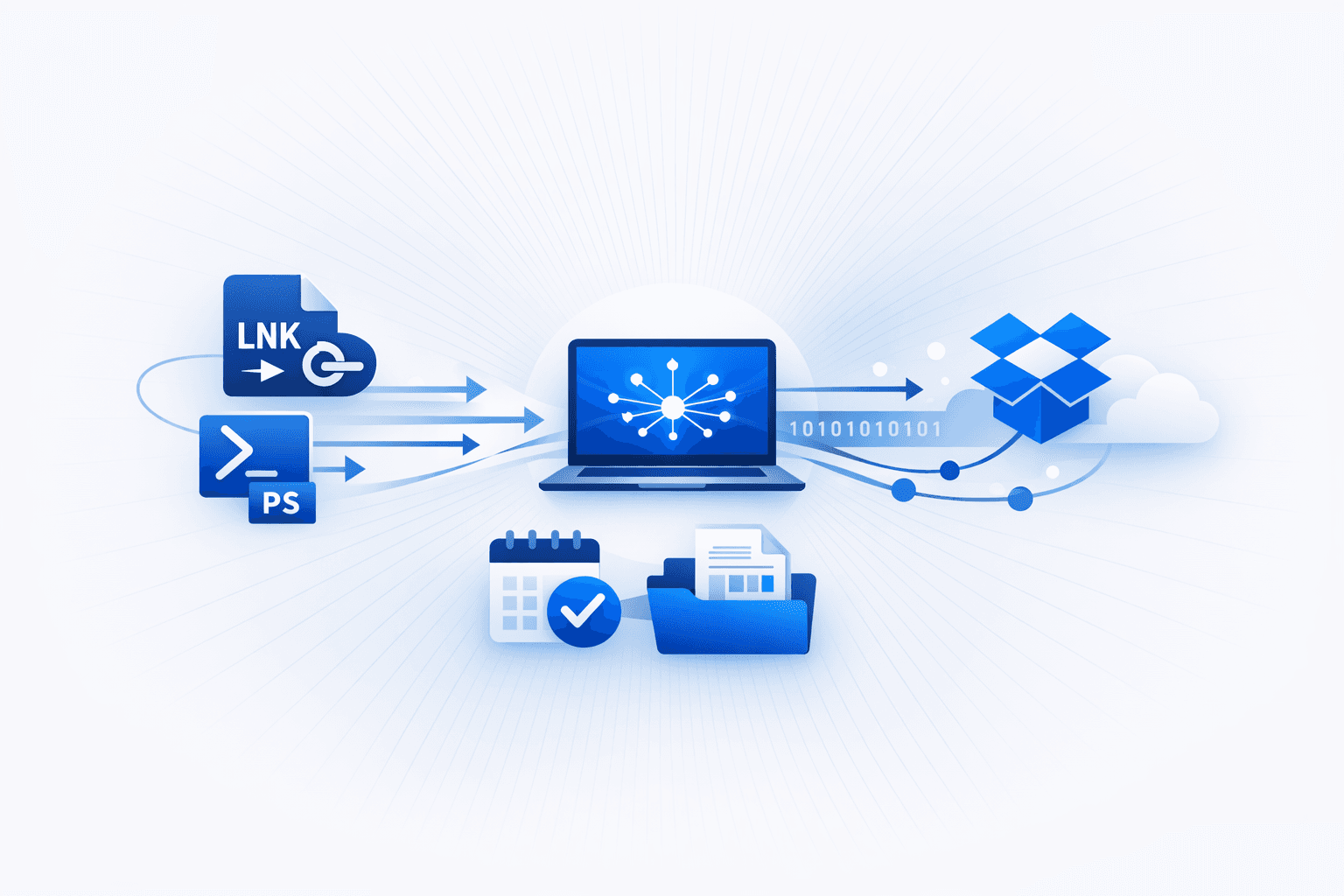
Kimsuky-linked malware delivered through malicious LNK files was observed targeting likely South Korean users, using shortcut execution to unpack a PowerShell-based implant, establish persistence via Task Scheduler, collect host information, and communicate through the Dropbox API. IIJ reported that the LNK extracts files into C:\PerfLog, deploys www.ps1 and a VBScript launcher, creates a scheduled task named P, and drops a decoy document in a Hancom Office format. The malware generates a client ID from the victim MAC address, gathers system details including domain, username, OS version, process lists, and external IP address, then uploads the data to attacker-controlled Dropbox folders before attempting to download and run a follow-on batch payload.
AhnLab's February 2026 APT trend reporting for South Korea provides broader context showing that spear phishing remained the dominant delivery method and that LNK-based attacks were the most prevalent format observed, including campaigns that used PowerShell to fetch additional components and register persistence. While AhnLab's report is a monthly trend overview rather than a dedicated write-up on the Dropbox variant, it aligns with IIJ's assessment that the malware shares substantial TTP overlap with previously reported Kimsuky activity. The reporting indicates continued abuse of legitimate cloud services such as Dropbox and, more broadly, GitHub and similar platforms to blend command-and-control and payload staging into normal network traffic.


Mallory correlates global threat intelligence with your attack surface — know if you’re exposed before adversaries strike.
5 events from the most recent confirmed update back to the earliest known activity.
A malware campaign disguised as the Korean Institute for Military Affairs publication "Monthly KIMA Military and Security" was identified using legitimate cloud services including Dropbox and GitHub to download and execute additional payloads. In its final stage, it established persistence by registering the initial VBE file as a scheduled task and collected reconnaissance data such as system information, Downloads folder contents, and running processes.
Researchers reported that Kimsuky launched a targeted campaign against prescription pharmaceutical companies using a malicious LNK file disguised as an Excel document. The multi-stage chain used XML, JavaScript, and PowerShell, established persistence via a fake Avast Secure Browser scheduled task, and used Dropbox API communications to exfiltrate host data and stage follow-on commands.
ASEC reported that Kimsuky updated its malicious LNK infection flow to add XML, VBS, and PowerShell stages while still delivering Python-based malware. The campaign used Dropbox for host-data exfiltration and follow-on BAT retrieval, and the deployed Python backdoor communicated with 45.95.186[.]232:8080 and supported command execution, file transfer, and payload execution.
IIJ Security Diary reported on Kimsuky malware that used the Dropbox API as part of its operation. No earlier event date is provided in the reference, so the publication date is used as the best estimate.
AhnLab reported that most APT attacks detected against South Korean targets in February 2026 were delivered through spear phishing, with LNK-based attacks the most common and CHM-based attacks also observed. The report described two LNK infection chains, including PowerShell-delivered AutoIt malware with Task Scheduler persistence and curl.exe retrieval of malicious HTA files from GitHub or Google Drive that deployed infostealer, keylogger, and backdoor loader components.
Vulnerabilities, threat actors, malware, products, organizations, and breaches Mallory has linked to this story.
8 references tracked. Mallory keeps watching after this page renders.
hauri.co.kr
Open sourcecybersecuritynews.com
Open sourcemedium.com
Open sourcecybersecuritynews.com
Open sourceasec.ahnlab.com
Open sourcesect.iij.ad.jp
Open sourceMap indicators from this story to your assets and identify affected systems in minutes.
Every observed campaign, victim, and pivot linked to actors named in this story.
Malware, exploits, and IOCs connected to the activity described here.
YARA, Sigma, and Snort rules deployed to your SIEM as soon as they’re published.
Get matching new stories delivered to your team as they break — not the next morning.
Ask questions about this story and take action on the answers.