
Loading story…
An Iran-linked threat group tracked as Screening Serpens—also known as UNC1549, Smoke Sandstorm, and Iranian Dream Job—ran coordinated cyberespionage operations against organizations in the United States, Israel, the United Arab Emirates, and likely two additional Middle Eastern targets. The activity, observed between February and April 2026, relied on highly tailored recruitment- and meeting-themed social engineering aimed largely at technology-sector professionals as regional tensions escalated in the Middle East.
Researchers said the group deployed six new remote-access trojan variants across two malware families, MiniUpdate and MiniJunk V2, using DLL sideloading and Azure-hosted command-and-control infrastructure dedicated to individual targets or malware variants. A notable shift in tradecraft was the use of AppDomainManager hijacking in .NET applications, allowing the attackers to disable ETW and other security controls through legitimate configuration files before the host application launched. MiniUpdate supported command execution, DLL loading, process control, file theft, UAC elevation, and scheduled-task persistence, while MiniJunk V2 used staged loaders, junk padding, and heavy obfuscation to hinder analysis and detection.

TTPs, infrastructure, and targeting history in one profile.
10 events from the most recent confirmed update back to the earliest known activity.
Nextron attributed a campaign to Nimbus Manticore in which attackers impersonated an Ebix recruiter on LinkedIn and directed aerospace and defense professionals in the Middle East and Europe to a fake hiring portal at ebix[.]recruitment-flow[.]com. Victims were prompted to download a fake two-factor authentication app that launched a multi-stage sideloading chain using AppDomain hijacking, Azure-hosted C2, scheduled-task persistence, and a native implant with anti-analysis and data-exfiltration capabilities.
Check Point Research reported that the IRGC-affiliated actor Nimbus Manticore, also tracked as UNC1549, resurfaced during the 2026 Iranian conflict with upgraded operations targeting aviation and software-sector victims in the United States, Europe, and the Middle East. The report said the actor introduced a new backdoor called MiniFast to replace the previously documented MiniJunk family and used delivery methods including SEO poisoning, a trojanized Zoom installer, fake job lures, and malicious download sites.
Palo Alto Networks Unit 42 publicly reported on the February-April 2026 espionage campaigns, linking them to Screening Serpens and describing the group's increased technical sophistication and operational resilience. The report advised defenders to prioritize detection of DLL sideloading and AppDomainManager hijacking over reliance on known indicators alone.
Unit 42 reported that the group evolved its tradecraft by using AppDomainManager hijacking in .NET applications. This let the malware disable ETW and other security mechanisms through legitimate configuration files before the host application started.
During the 2026 campaigns, researchers identified six new RAT variants grouped into the MiniUpdate and MiniJunk V2 malware families. The malware used DLL sideloading and dedicated Azure-hosted command-and-control infrastructure for each target or variant.
Between February and April 2026, the Iran-linked group Screening Serpens targeted entities in the United States, Israel, the United Arab Emirates, and likely two additional Middle Eastern organizations. The campaigns primarily used tailored recruitment- and meeting-themed social engineering lures aimed at technology-sector professionals.
Unit 42 said Screening Serpens' 2026 espionage activity aligned with the onset of a regional Middle East conflict. The conflict began on Feb. 28, 2026 and provided the broader context for the campaigns that followed.
Kaspersky attributed the previously undocumented cross-platform NodeRabbit and PollCat RATs, delivered through recruiter-themed coding challenges targeting Middle East and African software engineers, to Iranian-aligned Nimbus Manticore. The assessment links the tooling to the actor's MiniFast/MiniUpdate backdoor and Azure- and Cloudflare-based C2 patterns, identifying a shift toward cross-platform scripting malware.
Mirage Kitten conducted a cyberespionage campaign targeting fintech, aviation, and aerospace developer workstations across the Middle East and Africa, with confirmed NodeRabbit infections in Afghanistan, Egypt, and Ethiopia. The operators used fake recruiter accounts and trojanized coding challenges to deliver the new cross-platform Node.js/JavaScript RATs NodeRabbit and PollCat, including VS Code-extension and Git-hook persistence in a NodeRabbit variant.
Google Chronicle released Emerging Threats detection rules for Enterprise+ customers and made IOCs available through Applied Threat Intelligence in connection with suspected Iranian actor UNC1549 targeting Israeli and Middle Eastern aerospace and defense sectors. The published indicators included numerous Azure Websites and Azure CloudApp hostnames.
Vulnerabilities, threat actors, malware, products, organizations, breaches, and observables Mallory has linked to this story. Indicator values are masked here and available in full in the app.
Indicator values are masked on this page. View all 88 in Mallory Domains, IPs, hashes, and URLs are exportable to your SIEM.
See this adversary's TTPs, infrastructure, and targeting history, correlated against your exposure.
13 references tracked. Mallory keeps watching after this page renders.
thehackernews.com
Open sourcetherecord.media
Open sourcemalware.news
Open sourcesecurelist.com
Open sourcecybersecuritynews.com
Open sourceresearch.checkpoint.com
Open sourceunit42.paloaltonetworks.com
Open sourcecloud.google.com
Open sourceMap indicators from this story to your assets and identify affected systems in minutes.
Every observed campaign, victim, and pivot linked to actors named in this story.
Malware, exploits, and IOCs connected to the activity described here.
YARA, Sigma, and Snort rules deployed to your SIEM as soon as they’re published.
Get matching new stories delivered to your team as they break — not the next morning.
Ask questions about this story and take action on the answers.
Other stories Mallory is tracking that overlap on entities, sources, or topic labels.
Security researchers documented multiple Iran-linked intrusion campaigns that used spearphishing and staged malware delivery to target governments, industrial organizations, and Syrian opposition figures. Palo Alto Networks traced the **Infy** malware family to a long-running espionage operation active from 2007 through at least 2016, using malicious Word and PowerPoint files to install keyloggers, steal browser credentials, collect documents, and exfiltrate data from victims including government-related entities in Israel, the United States, and Denmark. Citizen Lab separately described **Group5**, an Iran-nexus operation that targeted Syrian opposition members with politically themed phishing emails and a watering-hole site, exploiting `CVE-2014-4114` to deliver **NanoCore**, **njRAT**, and an Android **DroidJack** implant. The campaigns combined custom tooling, commodity remote-access trojans, and operational infrastructure that pointed back to Iran. In the Group5 case, researchers tied the activity to an Iranian hosting provider, observed operator access from Iranian IP space, and found Persian-language development artifacts and crypter links, while the Infy operation was connected through shared infrastructure, malware strings, and a distinctive encoding scheme across more than 40 variants, including the more capable **Infy M** branch. Together, the reports show sustained espionage activity built on low-volume, highly targeted phishing, multi-stage malware chains, and surveillance-focused payloads aimed at credential theft, device monitoring, and data exfiltration.
Aug 15, 2026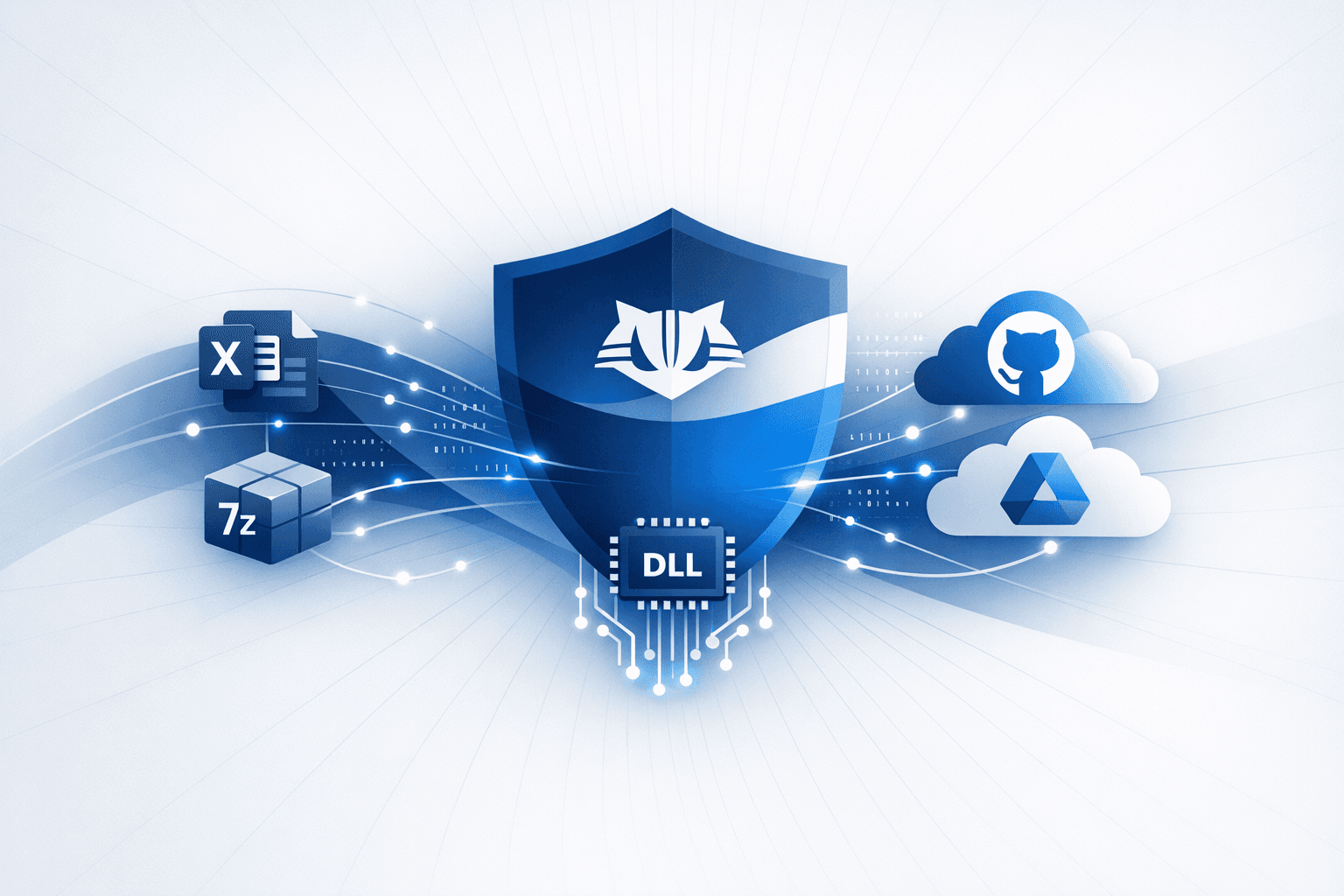
Reporting describes two separate **Iran-linked espionage** efforts. HarfangLab detailed a campaign dubbed **RedKitten** targeting human-rights NGOs and individuals documenting abuses, using a lure delivered as a Farsi-named `7z` archive containing macro-enabled Excel (`.xlsm`) files. When victims enable the malicious VBA, it drops a C# implant (`AppVStreamingUX_Multi_User.dll`) via **AppDomainManager injection**; the operation uses **GitHub** and **Google Drive** for configuration/payload retrieval and **Telegram** for command-and-control, and researchers noted code characteristics consistent with **LLM-assisted** development. Separately, Pulsedive research (as summarized) attributed a PowerShell backdoor called **TAMECAT** to **APT42**, describing social-engineering via impersonated WhatsApp contacts and links abusing the `search-ms` URI handler, followed by VBScript-based staging and delivery mechanisms including WebDAV-hosted LNKs disguised as PDFs. TAMECAT was reported to steal credentials from **Microsoft Edge** and **Chrome**, establish persistence (e.g., logon scripts and registry run keys), and use multiple C2 channels (including **Telegram**, Discord, Firebase, and Cloudflare Workers). Other items in the set cover unrelated events: a supply-chain compromise of *eScan* antivirus update infrastructure distributing a backdoor, and Fortinet’s reporting on **Interlock** ransomware activity affecting primarily UK/US organizations (not Iran-linked).
Jun 29, 2026
An Iranian state-sponsored threat group tracked as UNC1549, also known as Nimbus Manticore or Subtle Snail, has intensified its cyber-espionage operations against aerospace, aviation, and defense sectors across the Middle East, Israel, the US, and several European countries. The group, believed to have ties to the Iranian Revolutionary Guard Corps (IRGC), has leveraged sophisticated initial access techniques, including spear-phishing, abuse of third-party relationships, and exploitation of remote access software such as Citrix, VMWare, and Azure Virtual Desktop. UNC1549 has demonstrated a strategic focus on supply chain attacks, often infiltrating less-secure third-party partners to pivot into their primary targets, and has broadened its operational scope to include technology, hospitality, and transportation sectors as stepping stones to ultimate targets. Recent investigations by Google-owned Mandiant and corroborated by multiple security sources have revealed that UNC1549 has developed and deployed a suite of custom malware backdoors, including TWOSTROKE, DEEPROOT, Crashpad, Dcsyncer.slick, Ghostline, Pollblend, and Sightgrab. These tools are used to establish persistent access and exfiltrate sensitive data, with each post-exploitation payload observed having a unique hash, indicating a high level of operational security. The group’s activities since mid-2024 reflect a significant leap in sophistication, with a marked increase in espionage aligned with Iranian state interests, particularly targeting Israel and expanding to other strategic regions.
Jun 29, 2026