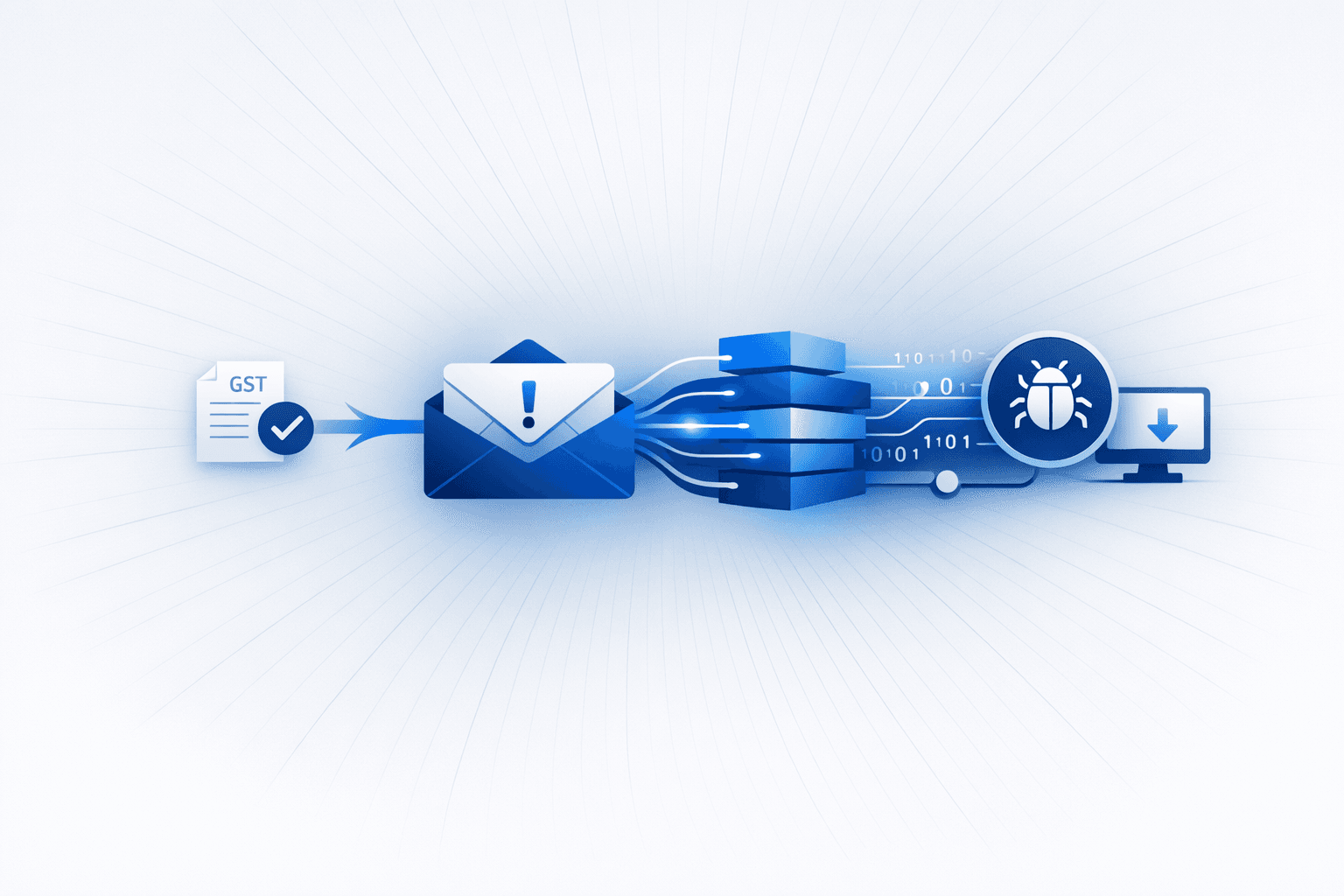
Phishing GST Debit Note Campaign Deploys Remcos RAT via Steganographic Loader
Social Engineering & Fraud · 5 sources · Updated 4mo ago · First seen Jun 22, 2026

Researchers reported an active phishing campaign targeting users in India with archive attachments disguised as GST debit notes, including files such as GST Debit Note Apr_26.com, to deliver Remcos RAT. The infection chain relies on a multi-stage, largely memory-only loader that uses embedded steganographic payloads, multiple .NET stages, in-memory DLL execution, and process hollowing to evade traditional defenses. Analysis indicates the operation may be part of a loader-as-a-service ecosystem, as related infrastructure has also been linked to payloads including Agent Tesla, RedLine Stealer, Formbook, XWorm, Dark Cloud, Phantom Stealer, MassLogger, and Snake keyloggers.
Once installed, Remcos establishes persistence through Run registry keys and Winlogon/Userinit mechanisms, performs anti-sandbox and anti-VM checks, and attempts UAC bypass via eventviewer.exe. The malware steals browser credentials and cookies, captures user activity, and can record audio and webcam feeds before storing data in logs.dat and exfiltrating it to command-and-control infrastructure including 62.102.148.212:37393. Filenames referencing NEFT, RTGS, IMPS, and GST further indicate the campaign was tailored to Indian financial and business workflows.
Why it matters
Impact assessment
This story describes two distinct active threats with immediate enterprise relevance: a phishing campaign in India delivering Remcos RAT and a malicious npm supply-chain campaign targeting Windows developers. The phishing activity is targeted and likely focused on Indian business and finance workflows, while the npm campaign has broader exposure because it abuses a trusted public package ecosystem used by developer workstations.
Operational impact is high for infected endpoints because both payloads provide remote access, credential theft, and data exfiltration. Affected organizations face theft of browser credentials, cookies, developer tokens, extension data, user activity, and potentially audio/webcam capture, creating risk of account compromise, follow-on intrusion, fraud, reputational damage, and developer environment compromise.
Affected populations
- Indian business users and finance-adjacent staff receiving phishing lures themed as GST debit notes, NEFT, RTGS, and IMPS.
- Windows endpoints executing archive attachments such as
GST Debit Note Apr_26.com. - Windows developers and engineering workstations installing npm packages from the public registry.
- Organizations using PostCSS-related tooling in CI/CD or local development environments.
- Chrome and Firefox users on infected systems due to browser credential and cookie theft.
Severity and scope
- Severity is high at the endpoint level due to full RAT capability, persistence, credential theft, and remote command execution.
- The GST/Remcos campaign appears targeted, with lures aligned to Indian tax and payment workflows.
- The npm campaign has potentially wider exposure because it abuses typosquatted packages in a high-trust software supply chain.
- The Remcos infrastructure appears reusable across multiple commodity malware families, increasing the likelihood of payload switching and repeat targeting.
Known in-the-wild activity
- K7 Security Labs reported active phishing exploitation delivering Remcos RAT in the wild.
- JFrog reported malicious npm packages were still live on the npm registry at the time of publication.
- Fortinet previously documented in-the-wild Remcos delivery via phishing and fileless execution, reinforcing that Remcos campaigns are operationally mature and actively exploited.