
Loading story…
Security researchers and email threat monitors reported continued activity from the PureCoder malware ecosystem, with campaigns distributing credential-stealing and remote-access payloads including PureLogs, PureRAT, and PureHVNC. An analysis of the broader Pure malware family described it as a growing threat, while Italian malspam telemetry later showed PureHVNC appearing alongside AgentTesla, FormBook, and Remcos in business-themed phishing lures tied to bank transfers, orders, offers, and requests. Script files were the most common attachment type in those campaigns, followed by Office documents and MSIL binaries.
Researchers also warned that industry naming around this malware remains inconsistent, especially the use of zgRAT to describe different PureCoder families. Netresec said the label is being applied to both PureLogs, a .NET infostealer focused on credential and data theft, and PureRAT, a .NET RAT that supports capabilities such as HVNC, webcam and microphone access, keylogging, reverse proxying, and code injection. The report said this overlap affects Suricata and TLS-certificate-based detections, creating false positives and family-level misclassification, and urged defenders to use precise names such as PureLogs or PureRAT when attribution is clear.

Pull IOCs and campaign context straight into your stack.
3 events from the most recent confirmed update back to the earliest known activity.
Netresec published research arguing that the zgRAT label is misleading because it is inconsistently applied to two distinct PureCoder malware families: PureLogs and PureRAT. The post also noted that existing detections using labels such as zgRAT, PureHVNC, and ResolverRAT contribute to false positives and family-level misclassification.
TG Soft's CRAM reported that during the week of 2026-07-20 to 2026-07-26, monitored malspam campaigns in Italy prominently involved password stealers and RATs including PureHVNC, AgentTesla, FormBook, and Remcos. The report counted 70 total campaigns, 12 in Italian targeting Italy, with the highest activity on Monday 2026-07-20.
ANY.RUN published an analysis describing the Pure malware family as a unique and growing threat. The reference indicates this analysis was released on 2024-01-16.
Vulnerabilities, threat actors, malware, products, organizations, breaches, and observables Mallory has linked to this story. Indicator values are masked here and available in full in the app.
Indicator values are masked on this page. View all 12 in Mallory Domains, IPs, hashes, and URLs are exportable to your SIEM.
Pull the IOCs, campaigns, and victimology behind this family, ready to push into your SIEM and EDR.
4 references tracked. Mallory keeps watching after this page renders.
netresec.com
Open sourcenetresec.com
Open sourcetgsoft.it
Open sourceany.run
Open sourceMap indicators from this story to your assets and identify affected systems in minutes.
Every observed campaign, victim, and pivot linked to actors named in this story.
Malware, exploits, and IOCs connected to the activity described here.
YARA, Sigma, and Snort rules deployed to your SIEM as soon as they’re published.
Get matching new stories delivered to your team as they break — not the next morning.
Ask questions about this story and take action on the answers.
Other stories Mallory is tracking that overlap on entities, sources, or topic labels.

Multiple campaigns are using phishing emails and archive-based lures to deliver remote access malware through stealthy, multi-stage infection chains. Point Wild documented **Remcos RAT**, **DesckVB RAT**, and a Rust-based **COVERT RAT** being delivered through ZIP attachments, weaponized `LNK` files, obfuscated JavaScript droppers, and hidden PowerShell execution, often with decoy documents to mask activity. The payloads were loaded filelessly through .NET reflection and in-memory execution, with operators abusing legitimate binaries and services such as `aspnet_compiler.exe`, GitHub, and paste or web-hosting platforms to stage malware while evading detection. Reported command-and-control infrastructure included `192.3.27.141:8087`, `172.245.246.77:8080`, and `181.231.253.69:4444`, while observed artifacts included `C:\ProgramData\remcos\logs.dat`, `C:\ProgramData\colors\logs.dat`, and payload names such as `ALTERNATE.dll`, `ClassLibrary3.dll`, `Keylogger.dll`, and `msedge_proxy.exe`. Separate reporting showed the same tradecraft extending beyond custom RATs to commodity remote-access software and credential theft. A campaign targeting Russian aerospace and aviation organizations used invoice-themed phishing and spoofed domains to install a portable **AnyDesk** instance for unattended access, maintain persistence with a scheduled task, minimize visibility with Tray Minimizer, and exfiltrate configuration data through a command-line SMTP mailer; Seqrite linked the activity to **Rare Werewolf (Librarian Ghouls)**. Securonix research cited by Trojan Killer described **VEIL#DROP** using fake document-style JavaScript files, Blogspot-hosted staging, PowerShell download cradles, XOR decoding, and in-memory .NET loading to deploy **PureLog Stealer**, which targets browser credentials, cookies, session tokens, wallet data, and host information. Across the campaigns, the common pattern is phishing-led initial access followed by LOLBins, PowerShell, staged downloads, persistence, and covert data theft or long-term remote control.
Jul 12, 2026
Two recruitment-themed malware campaigns use decoy job documents to deliver multi-stage, memory-resident implants after a single click. One campaign distributes a ZIP archive containing a renamed `WinWord.exe` that DLL-side-loads a malicious component to deploy **PureRAT/ResolverRAT**; researchers assess its infrastructure and tradecraft as overlapping with the Vietnam-nexus PXA Stealer criminal cluster. The other disguises an LNK shortcut as a PDF, invokes `mshta.exe`, and retrieves a custom native implant that decrypts and reflectively maps its DLL payload in memory. The second operation has not been attributed to a known threat actor. Both chains reduce Windows telemetry and analysis visibility through sandbox-evasion measures and Task Scheduler COM-based persistence rather than `schtasks.exe`, while providing attackers remote-access capability. The PureRAT campaign adds scheduled tasks, WMI event subscriptions, COM hijacking, and mirrored staging directories that can restore removed artifacts. The activity follows prior reporting on job-offer social engineering used to deploy Pure-family malware, including PureHVNC and PureRAT-linked tooling, and shows the continued use of this ecosystem alongside heavily obfuscated loaders and persistence mechanisms.
Sep 10, 2026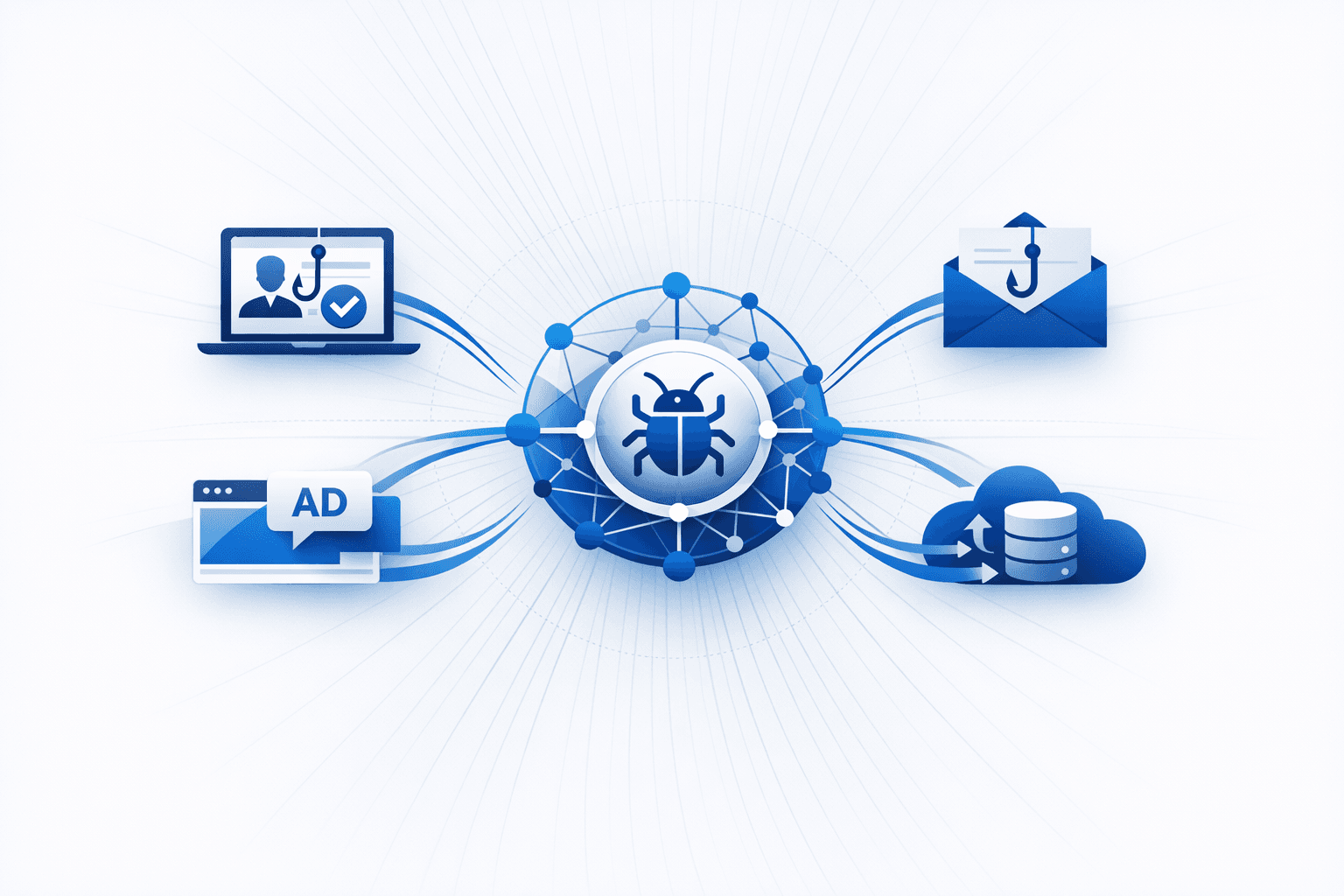
Multiple reports detail **social-engineering-driven malware delivery** that results in **remote access trojans (RATs)** and credential theft. Infoblox described observing an affiliate push-notification ad network after exploiting misconfigured DNS delegations (“**Sitting Ducks**”/lame name server delegation) to take over abandoned threat-actor domains, allowing collection of **~57M logs** over two weeks and visibility into widespread **scams and brand impersonation** delivered via push ads. Nextron Systems separately reported recurring **malvertising** chains where “free converter” tools (e.g., document/image converters) downloaded from ads on legitimate sites function as advertised while covertly installing **persistent RATs**, with common artifacts such as Windows **Mark-of-the-Web** (`ZoneId=3`) indicating internet origin. Other activity in the set reflects different initial-access lures but the same general outcome—RAT-style access and data theft. Fortinet analyzed a **phishing** campaign using a fake Vietnam shipping document: a Word attachment leads to an RTF stage that exploits an RTF-related vulnerability, then uses **VBScript/PowerShell** to load a **fileless .NET module**, ultimately downloading and injecting a **Remcos** variant (including process hollowing) to provide full remote control. Separately, reporting on North Korea’s **“Contagious Interview”** campaign described fake recruiter outreach (e.g., via LinkedIn) that tricks developers into opening malicious code repositories; execution can be triggered via a hidden **VS Code `tasks` configuration**, server-side logic hooks, or a malicious npm dependency to steal credentials/crypto wallets and establish persistence—this is thematically similar (social engineering leading to remote access) but is a distinct operation from the malvertising/push-ad and Remcos phishing activity.
Jun 29, 2026