
Loading story…
AI-enabled drones and loitering munitions are increasingly being designed to continue attacks autonomously after losing contact with human operators, creating a widening accountability gap in lethal strikes. The reported pattern involves systems launched under human supervision that can switch to autonomous terminal engagement when communications are disrupted by jamming, spoofing, range limits, or tether failure. Examples cited include the Shahed-136 lineage, including a reported Shahed-136 MS variant with cameras and an Nvidia Jetson processor, Russia’s Geran-2, the U.S. LUCAS program, and the earlier STM Kargu-2 case in Libya referenced in UN reporting.

Track how attackers are adapting to this technology.
8 events from the most recent confirmed update back to the earliest known activity.
A June 2026 Human Rights Watch briefing said AI targeting systems were operating in live conflicts before meeting validation standards required by international humanitarian law. The article cites this as evidence that deployment is outpacing governance.
The United States said it reverse-engineered a captured Shahed-136 to develop the low-cost loitering munition LUCAS. The articles state that LUCAS was deployed with U.S. Central Command from December 2025.
A December 2025 resolution mandating further Geneva exchanges on autonomous weapons was opposed by both the United States and Russia. The references present this as a sign that treaty negotiations remained stalled.
A recovered Shahed-136 MS variant in 2025 reportedly carried thermal and visible-spectrum cameras plus an Nvidia Jetson AI processor. Ukrainian military analysis assessed it as capable of autonomous visual target recognition and terminal acquisition.
A UN General Assembly resolution on autonomous weapons passed by a vote of 166 to 3 in December 2024. The articles cite it as evidence of broad state support for new international action on the issue.
The references state that Iran used Shahed drones directly against Israel in 2024 and again in 2025. They also describe Shahed use against Gulf air defenses in saturation attacks.
In a March 2021 report, the UN Panel of Experts on Libya described the Kargu-2 incident and said the munition had been programmed to strike without a data link. This became an early public precedent in debates over autonomous lethal action.
A UN Panel of Experts later reported that a Turkish-made STM Kargu-2 loitering munition tracked and struck retreating fighters in Libya in the previous year. The panel said the system was programmed to strike without any data link between operator and munition.
Follow how adversaries are adapting to this technology, and where it touches your stack today.
3 references tracked. Mallory keeps watching after this page renders.
Map indicators from this story to your assets and identify affected systems in minutes.
Every observed campaign, victim, and pivot linked to actors named in this story.
Malware, exploits, and IOCs connected to the activity described here.
YARA, Sigma, and Snort rules deployed to your SIEM as soon as they’re published.
Get matching new stories delivered to your team as they break — not the next morning.
Ask questions about this story and take action on the answers.
Other stories Mallory is tracking that overlap on entities, sources, or topic labels.

Ukraine is advancing its use of **AI-enabled and increasingly autonomous drone systems** as part of a broader effort to scale battlefield effects, with analysts highlighting both current capabilities and a longer-term vision for autonomous warfare. One prominent example cited is **Operation Spider’s Web**, a June 2025 drone strike on Russian airbases that has become a reference point for how software-driven targeting, coordination, and terminal guidance can expand operational reach while reducing direct human control over each engagement decision. Legal and policy experts warn that these systems create a growing **accountability gap** even though international humanitarian law and the law of armed conflict still apply. The main concerns include unclear legal application, unpredictable software behavior, responsibility spread across commanders, developers, and operators, and the difficulty of anticipating swarm behavior at deployment; experts say the degree of autonomy in a swarm’s architecture directly affects where liability can be assigned, and they call for weapons reviews, explicit human decision points, and reliable records of system behavior and input-data integrity before such systems are fielded.
Jul 24, 2026
A Lieber Institute analysis examines a hypothetical U.S. strike during a Russian attack on the Suwałki Gap, a strategically vital corridor between Poland and Lithuania covered by NATO’s collective-defense framework. In the scenario, adversary deception causes an AI-enabled Federated Front targeting system to wrongly identify a hospital as a Russian command-and-control site, killing 50 civilians. The analysis argues that the legality of the strike and possible commander liability under the UCMJ must be judged on information reasonably available at the time, consistent with the *Hostage* case’s Rendulic Rule, rather than through hindsight. It warns that commanders may struggle to justify reliance on opaque AI models and recommends explainable “Glass Box” systems, legally reviewed and certified operating parameters, bounded continuous learning, continuing JAG and technical oversight, and training on feasible law-of-armed-conflict precautions.
Sep 11, 2026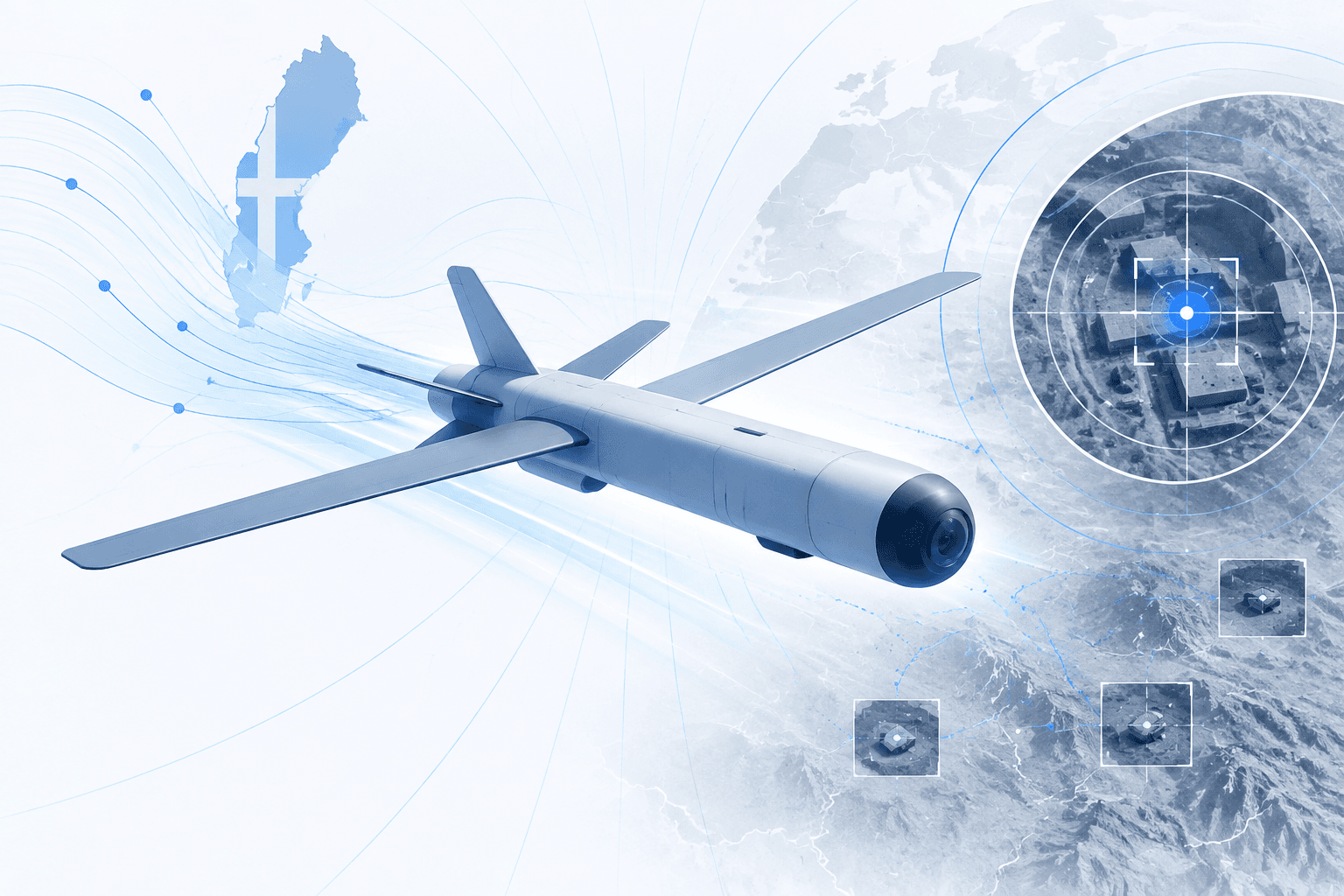
Swedish startup Scaleout Systems and BAE Systems Bofors demonstrated an **Affordable Loitering Modular Ammunition (ALMA)** drone that used onboard AI to detect, identify, geolocate, prioritize, and engage a mission-defined target. The low-cost loitering munition reportedly completed reconnaissance and strike functions without external communications, using compact AI models and computer vision to remain operational in electronically contested environments; human operator control remains available. Scaleout also tested its distributed edge-AI architecture in cold-weather exercises and at a Swedish Air Force base in Uppsala, where a disconnected forward node continued local inference, active learning, and logging before later synchronizing with a central system. The company says federated learning could enable model collaboration across dispersed forces, potentially including NATO members, although no NATO procurement or confirmed combat deployment has been disclosed and legal debates continue over meaningful human control of lethal force.
Sep 20, 2026