
Loading story…
Developers working on secure federation are advancing a plan to bring end-to-end encryption to ActivityPub-based platforms by building on Messaging Layer Security (MLS), standardized in RFC 9420. The effort aims to support encrypted direct messages, attachments, and group conversations at Fediverse scale, while addressing long-standing concerns that current ActivityPub direct messages are typically stored in plaintext on instance servers. Advocates say that leaves users exposed and also creates legal, privacy, and abuse-handling risks for server operators who can be compelled to disclose message contents.
The roadmap pairs MLS-based group encryption with a decentralized authenticity layer so clients can verify long-term signing keys without relying on a central authority. Proposed next steps include broader MLS library support, agreement on ciphersuites, handling metadata, ordering, backups, and multi-device use, plus adoption of mechanisms such as multiple signing keys per actor and support for ML-DSA-44 in HTTP Message Signatures tooling. Supporters argue that modern group-encryption designs such as TreeKEM can scale to large Discord-like communities, but warn that deployment will still require audits, penetration testing, source review, funding, and wider ecosystem participation before secure ActivityPub messaging is ready for broad use.

Track how attackers are adapting to this technology.
12 events from the most recent confirmed update back to the earliest known activity.
A July 2026 roadmap described a three-part plan for bringing end-to-end encryption to the Fediverse using MLS, authenticated KeyPackages, and decentralized key transparency for signing keys.
A technical specification for the Fediverse-oriented Public Key Directory was published, defining the PKD transparency-log architecture, REST APIs, witness co-signatures, HPKE message handling, replication, and recovery features such as BurnDown and RevokeKeyThirdParty. The document formalized how PKD servers, mirrors, witnesses, and clients verify key history and detect tampering.
A February 2026 essay argued that end-to-end encryption remains necessary for viable Discord alternatives and that TreeKEM in RFC 9420 can scale to very large groups.
In a year-end retrospective, the author said they planned to begin work on a realistic MLS-based end-to-end encryption proposal for ActivityPub-enabled software and were already discussing key transparency with W3C-affiliated participants.
The author announced that the COCKTAIL-DKG specification was live at version 0.1.0, with test vectors available and reference implementations still in progress.
In a November 2024 post, the author described a Public Key Directory design for Fediverse E2EE that reconciles transparency logging with GDPR Article 17 by logging ciphertext and deleting decryption keys on valid erasure requests. The post also introduced a plaintext commitment scheme using Argon2id so clients can detect if a directory serves false plaintext for logged ciphertext.
The Public Key Directory project had been in development since June 2024, according to the retrospective describing later Fediverse key transparency work.
The IETF Messaging Layer Security protocol was published as RFC 9420, providing the standardized group messaging protocol later referenced for ActivityPub end-to-end encryption work.
The IETF Hybrid Public Key Encryption (HPKE) standard was published as RFC 9180, defining the encryption scheme later referenced by the Public Key Directory specification for message handling and related cryptographic operations.
After the author's criticism of Session for removing forward secrecy, the retrospective says Session was updating its protocol to restore forward secrecy.
The author reported finding and disclosing vulnerabilities in FreeSWITCH. At the time of the retrospective, the project had still not tagged a release containing the fix.
The retrospective states that a reference implementation for the Public Key Directory had been made immediately available prior to the post, marking a concrete implementation milestone for the key transparency effort.
Vulnerabilities, threat actors, malware, products, organizations, and breaches Mallory has linked to this story.
Follow how adversaries are adapting to this technology, and where it touches your stack today.
10 references tracked. Mallory keeps watching after this page renders.
github.com
Open sourcesoatok.blog
Open sourcegithub.com
Open sourcegithub.com
Open sourcesoatok.blog
Open sourcerfc-editor.org
Open sourcedatatracker.ietf.org
Open sourcepublickey.directory
Open sourceMap indicators from this story to your assets and identify affected systems in minutes.
Every observed campaign, victim, and pivot linked to actors named in this story.
Malware, exploits, and IOCs connected to the activity described here.
YARA, Sigma, and Snort rules deployed to your SIEM as soon as they’re published.
Get matching new stories delivered to your team as they break — not the next morning.
Ask questions about this story and take action on the answers.
Other stories Mallory is tracking that overlap on entities, sources, or topic labels.

Security commentary highlighted that **end-to-end encryption (E2EE)** has materially improved privacy in mainstream messaging, but important gaps remain—especially where plaintext or recoverable ciphertext is reintroduced via **cloud backups** and multi-party backup chains. The discussion pointed to Apple’s iMessage ecosystem as an example where E2EE can be undermined if device backups are not protected with *Advanced Data Protection (ADP)*, and noted uneven progress across platforms on **post-quantum** resilience (e.g., Signal and Apple cited as having post-quantum protections, while Android messaging protocols were described as not yet upgraded). Separate industry perspective argued organizations should accelerate **post-quantum cryptography (PQC)** planning due to the long lead time required for migration and the risk of “**harvest now, decrypt later**” collection by sophisticated adversaries. It emphasized that guidance from **NIST** and **CISA** has shifted toward urgency, warned that widely used public-key cryptography (e.g., **RSA/ECC**) faces future quantum risk, and described practical blockers such as building a usable cryptographic inventory at scale—where common discovery approaches (like certificate scanning) miss embedded and non-obvious cryptographic dependencies.
Jun 29, 2026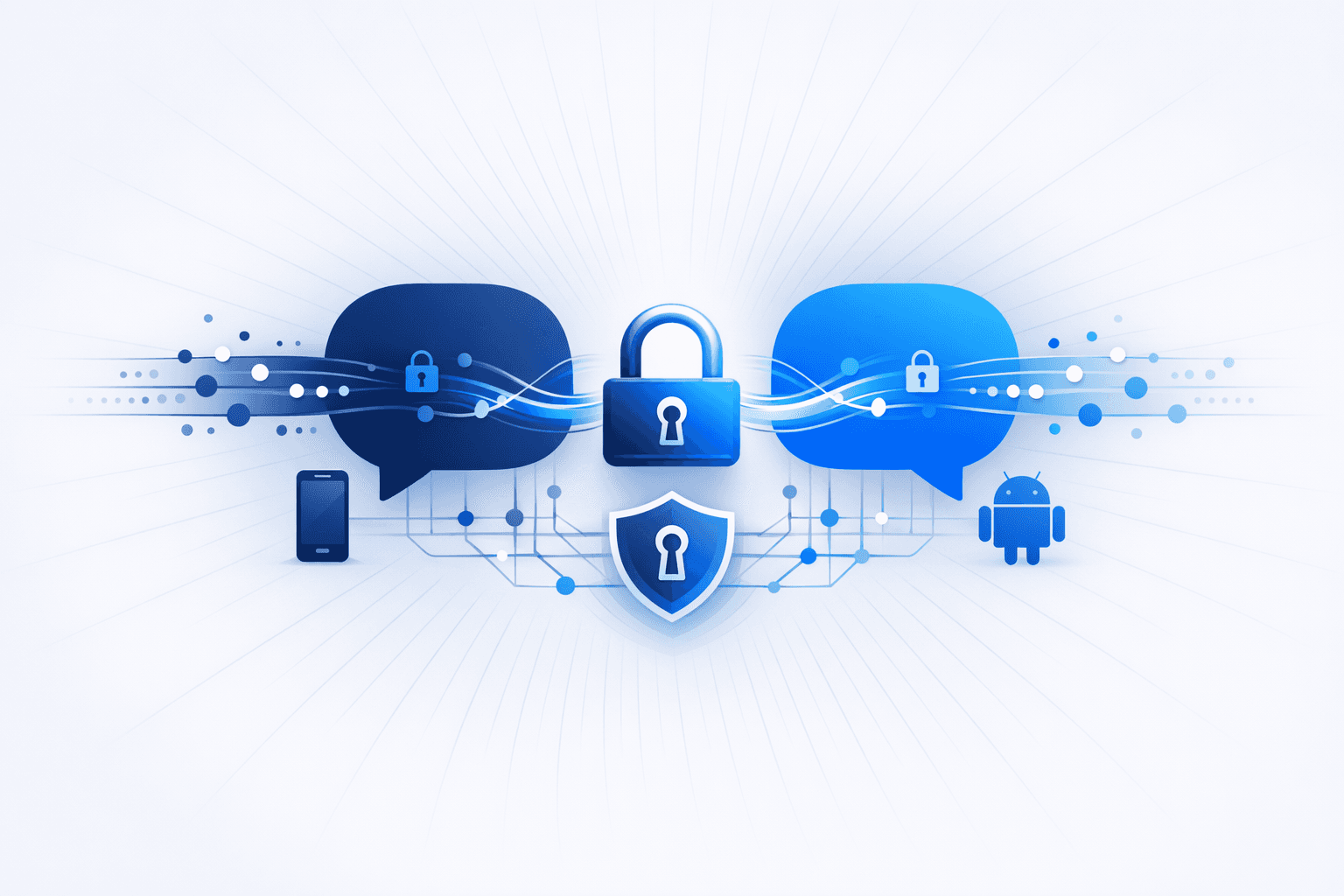
Apple and Google have begun rolling out **end-to-end encrypted** Rich Communication Services (**RCS**) messaging for cross-platform chats between iPhone and Android users, bringing stronger privacy protections to a protocol intended to replace traditional SMS. The beta rollout applies to iPhones running **iOS 26.5** on supported carriers and Android devices using the latest **Google Messages**, with encryption enabled by default and expanding over time to new and existing RCS conversations. The feature is based on **GSMA RCS Universal Profile 3.0** and uses the **Messaging Layer Security (`MLS`)** protocol, which is designed to prevent Apple, Google, and carriers from reading message contents while they are in transit. Availability still depends on carrier support and updated client software, so encrypted RCS will not reach all users immediately, and privacy advocates noted that metadata may still be exposed and cloud backups may remain unencrypted unless users enable additional protections such as Apple **Advanced Data Protection**.
Jul 22, 2026
The European Union has revived the interim **“Chat Control 1.0”** framework, preserving a legal basis for online services to voluntarily scan private communications for child sexual abuse material and grooming activity. After a European Parliament vote failed to secure the absolute majority needed to block the measure, Regulation **(EU) 2021/1232** remained in force, allowing participating email, chat, gaming, and social networking platforms to detect, report, and remove suspected abuse-related content without a separate warrant for each account. The renewed regime is set to remain valid until 2028 or until a permanent successor, widely referred to as **Chat Control 2.0**, is adopted. The move has reignited a broader fight over end-to-end encryption and lawful access, as researchers and security experts warn that many government proposals to limit encrypted services misunderstand how encryption is deployed in practice. A newly highlighted academic paper argues that end-to-end encryption is not confined to messaging apps but is embedded throughout modern infrastructure, including **TLS**, **SSH**, **VPNs**, and Zero Trust architectures, and says broad restrictions would carry significant consequences for cybersecurity, commerce, and government operations. While the current EU framework does not extend to end-to-end encrypted services such as Signal, critics say it normalizes surveillance of private communications and could strengthen pressure for wider access mandates.
Jul 23, 2026