
Loading story…
Researchers reconstructed the Nazar malware family from artifacts tied to the Shadow Brokers' Lost in Translation leak and the Equation Group's leaked Territorial Dispute (TeDi) signatures, concluding that Nazar had previously been misidentified and was likely active from roughly 2008 to 2012. Check Point linked TeDi signature 37, which searched for Godown.dll, to Nazar, while additional reporting and archival material revisited the malware as a largely forgotten espionage tool that nonetheless appeared on the Equation Group's conflict-avoidance watchlist.
The recovered execution chain showed gpUpdates.exe launching Distribute.exe and the EYService svchost.exe service, which then deployed modules for keylogging, screenshots, audio recording, file enumeration, and system shutdown. Nazar's communications stood out for using local UDP sniffing rather than a hard-coded command-and-control server: it accepted commands on destination port 1234 and replied on port 4000 or a port derived from the IP identification field. Despite that unusual design, researchers described the malware as technically unsophisticated and heavily dependent on open-source components including Packet Sniffer SDK, LAME, KeyDLL3, and BMGLib.

TTPs, infrastructure, and targeting history in one profile.
7 events from the most recent confirmed update back to the earliest known activity.
On May 5, 2020, Check Point Research published a detailed reconstruction of Nazar's execution chain, modules, and UDP-based command handling. The report concluded the malware was technically unsophisticated and heavily built from open-source components despite appearing in Equation Group conflict-avoidance signatures.
An antivirus signature database from 2015 reportedly detected the Nazar artifact Godown.dll and referenced additional Nazar artifacts. This indicates some vendors had detections for the malware before later public reconstruction of the family.
Check Point Research assessed that the latest known Nazar samples were created in 2012, marking the end of the malware family's known active period. The activity window described in the report spans roughly 2008 to 2012.
The report states that older Nazar svchost.exe variants from 2010 supported commands 211, 212, and 213 to register Godown.dll, ViewScreen.dll, and Filesystem.dll via regsvr32. This functionality was later moved into Distribute.exe.
Check Point Research assessed that the Nazar malware family and associated threat activity began around 2008. The report reconstructed the malware family from later artifacts and historical clues.
Security researcher Juan Andres Guerrero-Saade linked TeDi signature 37, which searches for Godown.dll, to a previously unknown threat group he named Nazar. Earlier analysis had initially considered the malware Chinese before later assessment suggested a possible Iranian connection.
The Shadow Brokers' "Lost in Translation" leak exposed Equation Group operational records and tooling, including the Territorial Dispute (TeDi) component. TeDi contained 45 signatures used to detect artifacts associated with other threat groups on compromised systems.
Vulnerabilities, threat actors, malware, products, organizations, breaches, and observables Mallory has linked to this story. Indicator values are masked here and available in full in the app.
Indicator values are masked on this page. View all 16 in Mallory Domains, IPs, hashes, and URLs are exportable to your SIEM.
See this adversary's TTPs, infrastructure, and targeting history, correlated against your exposure.
3 references tracked. Mallory keeps watching after this page renders.
Map indicators from this story to your assets and identify affected systems in minutes.
Every observed campaign, victim, and pivot linked to actors named in this story.
Malware, exploits, and IOCs connected to the activity described here.
YARA, Sigma, and Snort rules deployed to your SIEM as soon as they’re published.
Get matching new stories delivered to your team as they break — not the next morning.
Ask questions about this story and take action on the answers.
Other stories Mallory is tracking that overlap on entities, sources, or topic labels.

Researchers detailed two separate malware chains that rely on deeply layered staging, DLL sideloading, and trusted signed software to conceal execution. One campaign, dubbed **Eimeria**, starts from a `RAR5` archive containing the signed `dsclock.exe`, a malicious `zlibwapi.dll`, and an encrypted payload that decrypts into an IExpress package and then an AutoIt-based RunPE loader. The chain restores `ntdll.dll` to evade EDR hooks, decrypts later stages with `AES-128-CBC`, `RC4`, and `LZNT1`, hollows `explorer.exe`, `svchost.exe`, or `taskhostw.exe`, and injects a small .NET RAT that beacons over WebSocket to `94.26.90.139:3006`. It also sets persistence through a Run key and scheduled task and uses delays, sleep checks, and CPU and memory stress tests to frustrate analysis. A second intrusion set tied to **UAC-0184 / MB-0007** used Ukraine-themed lures and messenger delivery to target Ukrainian Defense Forces personnel, beginning with `LNK` files that called `bitsadmin` to fetch `HTA` content from `169.40.135.35` for execution via `mshta`. The downloaded archive abused legitimate Plane9 components for sideloading through `Cluster-Overlay64.exe`, `Plane9Engine.dll`, and `openvr_api.dll`, then decoded `kernel-diag.lib` into `evr.dll` and unpacked `filter.bin` by rebuilding `IDAT` chunks, XOR-decoding with key `0x227E9BDE`, and decompressing with `LZNT1`. The final bundle included signed utilities such as Microsoft-signed `VSLauncher.exe` and a renamed PassMark Endpoint DLL, indicating the actor likely repurposed a signed network stack and dump-capable tooling for covert internal communications, with controller details possibly discovered dynamically over multicast `224.0.0.255:31339` and TCP `31339` rather than a fixed external C2.
Jun 29, 2026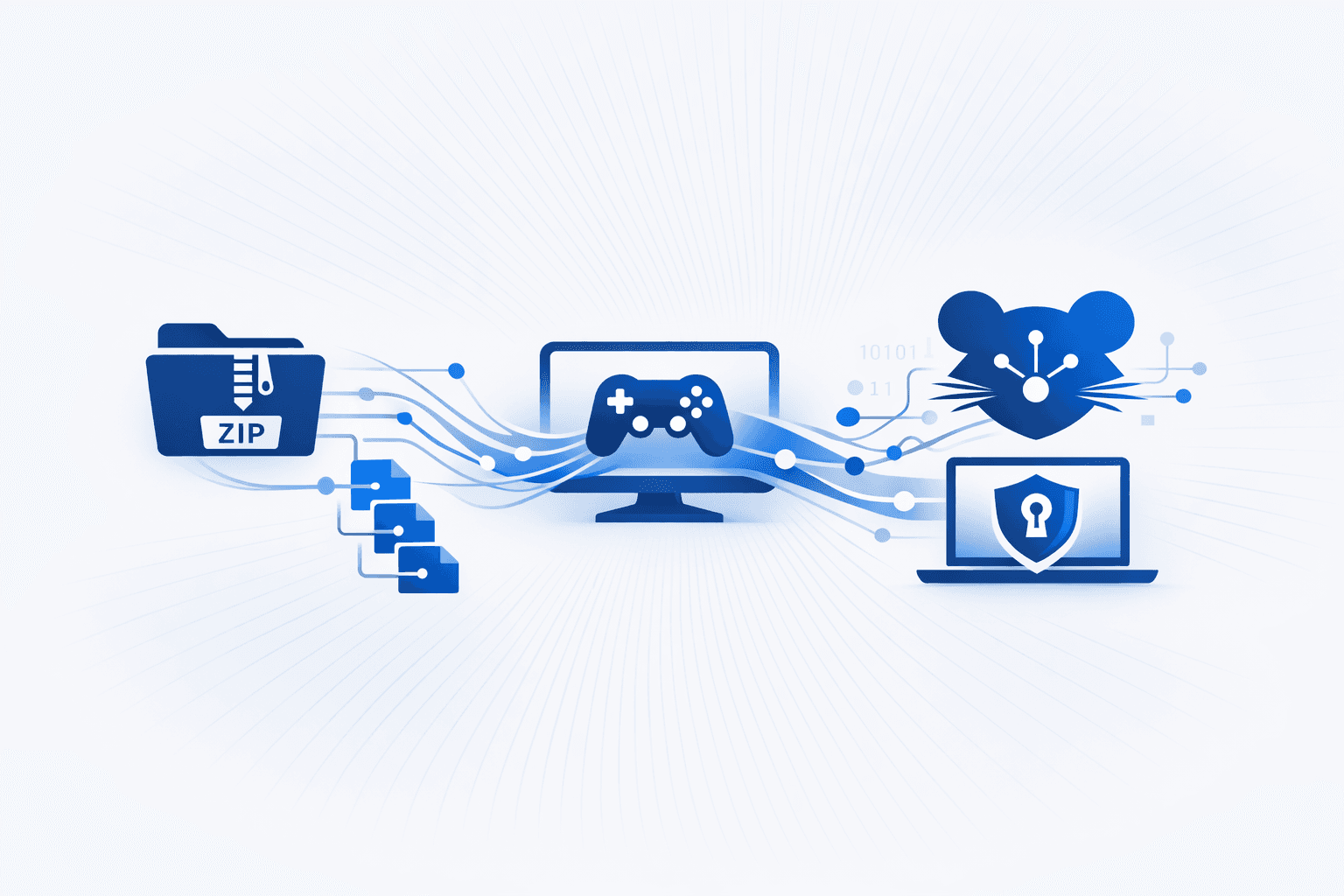
Recent reporting highlights multiple **social-engineering-driven malware delivery** efforts that culminate in remote access and persistent compromise. In South Korea, attackers distributed **counterfeit adult games** via popular “webhard” file-sharing services; victims received a ZIP containing a decoy `Game.exe` launcher that stages additional components (`Data1.Pak`, `Data2.Pak`, `Data3.Pak`) and ultimately injects **QuasarRAT** (aka **xRAT**), enabling host profiling, keylogging, and unauthorized file transfer. The execution chain included masqueraded artifacts such as `GoogleUpdate.exe` and `WinUpdate.db`, with AES used to decrypt/extract shellcode prior to privilege escalation and RAT injection. Separately, a spear-phishing campaign weaponized news about a purported **Nicolás Maduro arrest** to deliver a **backdoor**: emails carried a ZIP with a lure executable (`Maduro to be taken to New York.exe`) alongside a malicious DLL (`kuguo.dll`) that abuses a legitimate KuGuo binary for execution. Post-run behavior included replication to `C:\ProgramData\Technology360NB`, persistence via an auto-start renamed binary (`DataTechnology.exe`), and C2 beaconing for tasking and configuration updates; researchers noted tradecraft consistent with **Mustang Panda** but said attribution was not yet confirmed. A separate research note described **GravityRAT** reemerging as a multi-platform RAT with expanded **Android** targeting (in addition to Windows/macOS), emphasizing mobile endpoints as increasingly high-value targets for data theft and persistent access, though it did not describe the same specific campaigns as the Windows-focused lures above.
Jun 29, 2026
Researchers documented two separate but related **LNK-driven intrusion chains** that used shortcut files as the initial lure to fetch additional malware from attacker-controlled infrastructure. In one campaign targeting organizations in the **Arabian Gulf region**, a China-nexus threat actor used a Middle East conflict-themed ZIP archive containing an LNK file that downloaded a malicious CHM file and ultimately deployed a **PlugX** backdoor. The infection chain progressed through a second LNK, a TAR archive, DLL sideloading, and a shellcode loader before installing PlugX with persistence under a fake Microsoft Display Broker path and service name. The malware used RC4-encrypted components, API hooking, reflective DLL loading, corrupted PE headers, and support for **TCP, HTTPS, UDP, and DoH** communications, with a decrypted command-and-control endpoint at `91.193.17[.]117:443` and plugins for keylogging, shell access, screen capture, registry, service, and network operations. A second investigation exposed a live **LNK-to-DLL-to-.NET RAT** operation staged from an open Apache directory on `wildishadventure[.]com/secure9/` and `171.22.182[.]231/secure9/`, where researchers recovered weaponized LNK files, custom DLL downloaders, backup files, and a final payload named `RemoteMgmt.Agent.exe`. That chain abused the legacy `ActiveXObject('htmlfile')` technique to force Windows to retrieve DLLs over UNC paths, then delivered a custom .NET 4.8 remote access trojan that supported command execution, token-based authentication, JSON-over-raw-TCP C2 over port 443, reconnect-based persistence, and logging to `%TEMP%\rmgmt_agent.log`. Operational security failures including exposed directory indexing, `.old` backups, test builds, and unstripped internal names allowed investigators to reconstruct the malware’s development workflow and identify infrastructure spanning **BlueVPS**, **Namecheap**, and **Cloudflare**.
Jun 29, 2026