
Loading story…
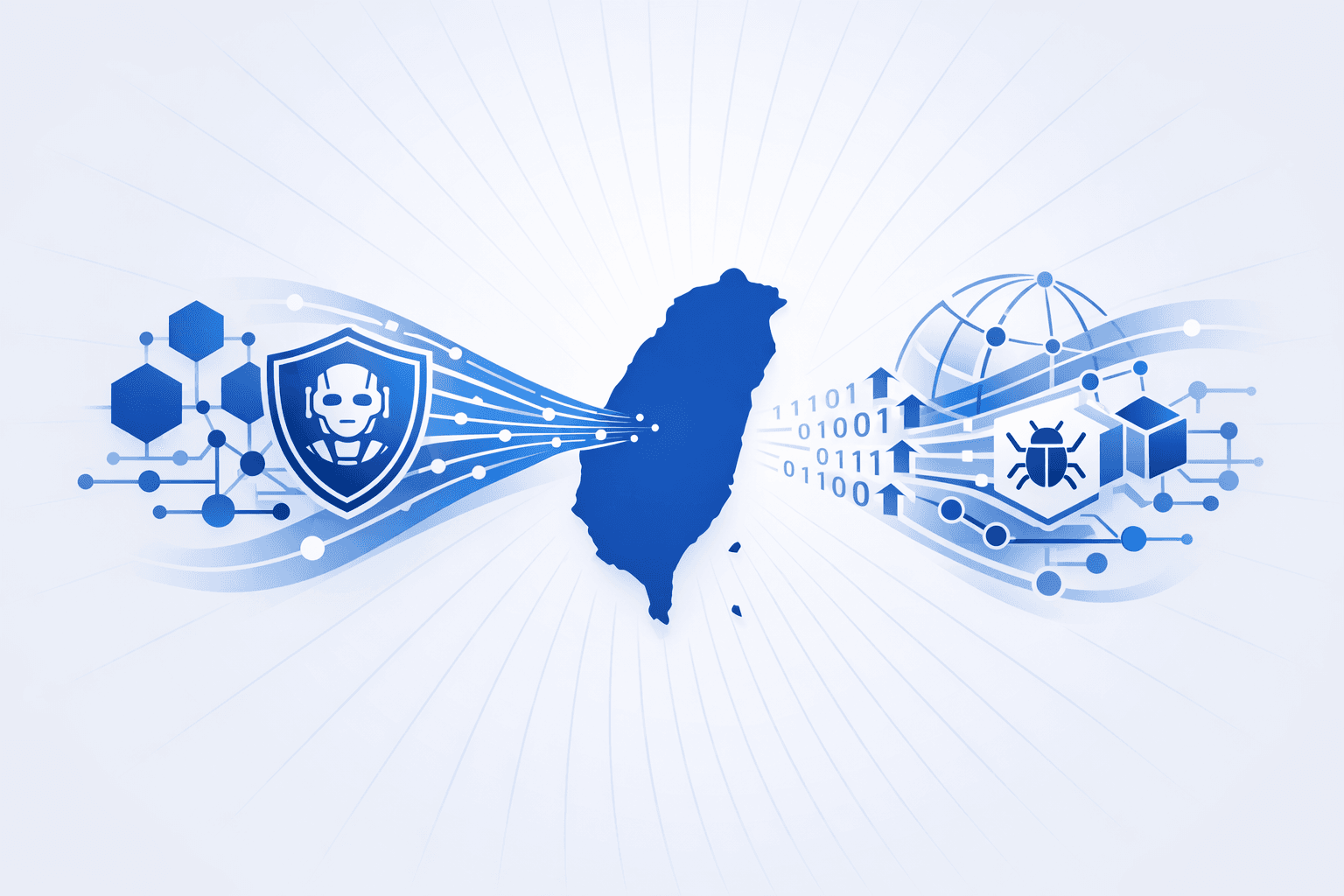
Researchers and government officials said a China-linked operation used open-source AI agent frameworks to conduct a near-autonomous intrusion campaign against Taiwan government and critical-sector organizations. The activity reportedly combined up to eight sub-agents built on OpenClaw and Hermes to automate reconnaissance, API enumeration, credential theft, vulnerability validation, lateral movement, persistence, and data exfiltration across 12 attack waves. Taiwan’s Ministry of Digital Affairs disclosed abnormal attacks with overseas origins, while reporting tied the campaign to compromises of 85 employee accounts, theft of roughly 2,500 personnel records, and targeting of agencies and suppliers including energy companies, a government email system, IT supply-chain vendors, and the nuclear safety sector.
Separate reporting showed the same AI agent ecosystem is also being abused as a malware and credential-theft supply chain. In the ClawHavoc campaign, attackers poisoned more than 350 OpenClaw ClawHub skills disguised as legitimate tools, then used ClickFix-style lures and a fake AuthTool requirement to push infostealers and steal crypto wallets. Security researchers warned that autonomous agents can pair stolen credentials and session cookies with shared malicious skills, black-market exchanges, and prompt-injection techniques to bypass MFA, move laterally, and even deploy ransomware, turning widely available agent frameworks into a fast-scaling offensive platform and a new software supply-chain risk.
Track how attackers are adapting to this technology.
7 events from the most recent confirmed update back to the earliest known activity.
By August 13, 2026, Taiwan’s Ministry of Digital Affairs had completed its investigation into the July attacks and publicly linked them to a hybrid model combining human hackers with AI agents such as OpenClaw. Separate reporting said Taiwan confirmed the campaign that day.
On August 12, 2026, Dream published research describing a near-autonomous AI-enabled cyberattack against government entities in Asia. The report said attackers bypassed frontier-model guardrails through social engineering and did not need zero-day exploits.
On July 20, 2026, Taiwan’s Ministry of Digital Affairs and the National Institute of Cyber Security issued alerts and launched investigations into abnormal cyberattacks on government agencies. Officials said the activity showed clear characteristics of overseas origins.
Dream said its research team first identified signs of the intrusion on July 2, 2026, during the four-day campaign. The firm later analyzed more than 160 MB of operational data and 1,395 files tied to the activity.
From July 1 to July 4, 2026, a Chinese-language operator used a near-autonomous attack framework built on OpenClaw and Hermes against government targets in Asia-Pacific, likely Taiwan. Dream said the operation used up to eight AI subagents across 12 attack waves for reconnaissance, credential theft, exploitation, exfiltration, and persistence.
On February 1, 2026, Hudson Rock published a report describing OpenClaw, Moltbook, and Molt Road as a "Lethal Trifecta" enabling autonomous intrusion, credential abuse, lateral movement, and ransomware operations.
Trellix identified the ClawHavoc campaign abusing OpenClaw’s ClawHub marketplace with more than 350 poisoned skills disguised as legitimate tools. The campaign used ClickFix-style social engineering and fake "AuthTool" prompts to trick users into installing malware, including NovaStealer v2 on macOS and Linux.
Vulnerabilities, threat actors, malware, products, organizations, breaches, and observables Mallory has linked to this story. Indicator values are masked here and available in full in the app.
Indicator values are masked on this page. See the values in Mallory Domains, IPs, hashes, and URLs are exportable to your SIEM.
Follow how adversaries are adapting to this technology, and where it touches your stack today.
4 references tracked. Mallory keeps watching after this page renders.
scworld.com
Open sourcecybersecuritynews.com
Open sourcedarkreading.com
Open sourcehudsonrock.com
Open sourceMap indicators from this story to your assets and identify affected systems in minutes.
Every observed campaign, victim, and pivot linked to actors named in this story.
Malware, exploits, and IOCs connected to the activity described here.
YARA, Sigma, and Snort rules deployed to your SIEM as soon as they’re published.
Get matching new stories delivered to your team as they break — not the next morning.
Ask questions about this story and take action on the answers.
Other stories Mallory is tracking that overlap on entities, sources, or topic labels.

Security researchers reported that suspected China-linked operators used open-source AI agent frameworks and multiple large language models to automate cyber intrusions against internet-exposed targets in Taiwan and elsewhere in Asia. Palo Alto Networks Unit 42 said a Chinese-speaking actor tracked as **"knaithe"** and **"KnYuan"** used **Hermes Agent** connected to a **DeepSeek** model to perform reconnaissance, vulnerability research, and parts of exploitation, while also falling back to manual exploitation when autonomous attempts failed. The actor also tested other Chinese and Western models, including **Qwen**, **GLM**, **Kimi**, **MiniMax**, **Claude Code**, and **OpenAI Codex**, indicating active evaluation of AI tooling for offensive operations. Dream said a related campaign in early July used a platform built from the open-source **Hermes** and **OpenClaw** frameworks to carry out what it described as the first observed end-to-end autonomous cyberattack on a government target in Taiwan. According to the firm, the operation ran for four days, deployed up to eight agents in parallel, mapped 21 government systems, compromised at least 85 user accounts, and stole more than 2,500 personnel records before expanding to Taiwan’s nuclear safety agency, at least seven energy companies, government suppliers, and other government systems. Researchers said the activity showed AI agents can continuously adapt attack paths in real time and materially increase the speed and scale of intrusion activity, even without custom malware or highly specialized operators.
Aug 14, 2026
Multiple reports describe threat actors abusing *AI-adjacent* and open-source distribution channels to deliver malware or manipulate automated agents. Straiker STAR Labs reported a **SmartLoader** campaign that trojanized a legitimate-looking **Model Context Protocol (MCP)** server tied to *Oura* by cloning the project, fabricating GitHub credibility (fake forks/contributors), and getting the poisoned server listed in MCP registries; the payload ultimately deployed **StealC** to steal credentials and crypto-wallet data. Separately, researchers observed attackers using trusted platforms and SaaS reputations for delivery and monetization: a fake Android “antivirus” (*TrustBastion*) was hosted via **Hugging Face** repositories to distribute banking/credential-stealing malware, and Trend Micro documented spam/phishing that abused **Atlassian Jira Cloud** email reputation and **Keitaro TDS** redirects to funnel targets (including government/corporate users across multiple language groups) into investment scams and online casinos. In parallel, research highlights emerging risks where **AI agents and AI-enabled workflows become the target or the transport layer**. Check Point demonstrated “**AI as a proxy**,” where web-enabled assistants (e.g., *Grok*, *Microsoft Copilot*) can be coerced into acting as covert **C2 relays**, blending attacker traffic into commonly allowed enterprise destinations, and outlined a trajectory toward prompt-driven, adaptive malware behavior. OpenClaw featured in two distinct security developments: an OpenClaw advisory described a **log-poisoning / indirect prompt-injection** weakness (unsanitized WebSocket headers written to logs that may later be ingested as trusted context), while Hudson Rock reported an infostealer incident that exfiltrated sensitive **OpenClaw configuration artifacts** (e.g., `openclaw.json` tokens, `device.json` keys, and “memory/soul” files), signaling that infostealer operators are beginning to harvest AI-agent identities and automation secrets in addition to browser credentials.
Jun 29, 2026
Dream reported that attackers used the open-source AI agent frameworks **Hermes** and **OpenClaw** to conduct a near-autonomous intrusion against government entities in Asia, compromising **85 employee accounts** and stealing at least **2,500 personnel records**. The campaign unfolded in **12 attack waves** and used up to **eight parallel sub-agents** to automate reconnaissance, credential attacks, API testing, data collection, and lateral movement at machine speed. The attackers reportedly mapped **21 connected government systems** and exploited multiple server-side weaknesses, including unauthenticated APIs, insecure authentication endpoints, weak token validation, and acceptance of JWTs using the `none` algorithm. Dream said the operation harvested employee identifiers from exposed APIs, used OCR-assisted password spraying, and then reused compromised credentials through an SSO bridge to reach internal systems; an archive linked to the campaign also contained internal network ranges, **seven SSO client secrets**, and **six database credentials**. The operator was not identified, but Dream observed Chinese-language indicators in the activity, while public reporting linked the targets to Taiwan.
Aug 25, 2026