
Loading story…
A financially motivated cargo-theft and freight-fraud operation has expanded to U.S. state, local, tribal, and territorial government networks through phishing emails impersonating legitimate Google Drive sharing notifications. The campaign delivers a custom PowerShell WebSocket remote-access trojan (RAT), giving operators interactive access before deploying both ConnectWise ScreenConnect and Pulseway remote monitoring and management (RMM) tools for redundant persistence.
Attackers host lures and payloads in Google Cloud Storage, use Unicode homoglyphs to disguise content, and generate VBS droppers in the victim’s browser to evade security controls. CIS linked the activity to the cargo-theft campaign documented by Proofpoint through an identical Pulseway installer hash as well as overlapping infrastructure and tradecraft; observed variants include encrypted WebSocket command-and-control, UAC-bypass capabilities, and randomized payload builds, while beacons from additional government networks indicate continued expansion beyond transportation and logistics victims.

Pull IOCs and campaign context straight into your stack.
5 events from the most recent confirmed update back to the earliest known activity.
CIS analyzed four delivery variants that used VBS or MSI-based droppers, in-memory RAT execution, scheduled-task persistence, and subsequent deployment of ScreenConnect and Pulseway. The newest variant added encrypted WebSocket C2, a COM elevation-moniker UAC bypass, multistage Google Cloud Storage retrieval, and randomized payload components.
CIS identified connections to confirmed campaign infrastructure from multiple additional SLTT member networks through Albert Network Monitoring and Management sensor data and MDBR data. It assessed that the operators were broadening beyond transportation and logistics targets.
CIS assessed with near certainty that the SLTT phishing activity was a new wave of the cargo-theft and freight-fraud operation previously reported by Proofpoint. The assessment was supported by an exact Pulseway installer SHA-256 match and overlapping infrastructure, delivery methods, and dual-RMM tradecraft.
CIS identified an active phishing campaign targeting multiple U.S. state, local, tribal, and territorial government networks. The campaign used Google Drive-sharing notifications and Google Cloud Storage-hosted lures to deliver a custom PowerShell WebSocket RAT, followed by ScreenConnect and Pulseway for persistent access.
Proofpoint Threat Research documented a financially motivated campaign involving cargo theft and freight fraud during February and March 2026. The operators were observed seeking access to banking portals, payment platforms, and accounting software after establishing persistence.
Vulnerabilities, threat actors, malware, products, organizations, breaches, and observables Mallory has linked to this story. Indicator values are masked here and available in full in the app.
Indicator values are masked on this page. View all 11 in Mallory Domains, IPs, hashes, and URLs are exportable to your SIEM.
Pull the IOCs, campaigns, and victimology behind this family, ready to push into your SIEM and EDR.
2 references tracked. Mallory keeps watching after this page renders.
Map indicators from this story to your assets and identify affected systems in minutes.
Every observed campaign, victim, and pivot linked to actors named in this story.
Malware, exploits, and IOCs connected to the activity described here.
YARA, Sigma, and Snort rules deployed to your SIEM as soon as they’re published.
Get matching new stories delivered to your team as they break — not the next morning.
Ask questions about this story and take action on the answers.
Other stories Mallory is tracking that overlap on entities, sources, or topic labels.

Multiple campaigns are using phishing emails and archive-based lures to deliver remote access malware through stealthy, multi-stage infection chains. Point Wild documented **Remcos RAT**, **DesckVB RAT**, and a Rust-based **COVERT RAT** being delivered through ZIP attachments, weaponized `LNK` files, obfuscated JavaScript droppers, and hidden PowerShell execution, often with decoy documents to mask activity. The payloads were loaded filelessly through .NET reflection and in-memory execution, with operators abusing legitimate binaries and services such as `aspnet_compiler.exe`, GitHub, and paste or web-hosting platforms to stage malware while evading detection. Reported command-and-control infrastructure included `192.3.27.141:8087`, `172.245.246.77:8080`, and `181.231.253.69:4444`, while observed artifacts included `C:\ProgramData\remcos\logs.dat`, `C:\ProgramData\colors\logs.dat`, and payload names such as `ALTERNATE.dll`, `ClassLibrary3.dll`, `Keylogger.dll`, and `msedge_proxy.exe`. Separate reporting showed the same tradecraft extending beyond custom RATs to commodity remote-access software and credential theft. A campaign targeting Russian aerospace and aviation organizations used invoice-themed phishing and spoofed domains to install a portable **AnyDesk** instance for unattended access, maintain persistence with a scheduled task, minimize visibility with Tray Minimizer, and exfiltrate configuration data through a command-line SMTP mailer; Seqrite linked the activity to **Rare Werewolf (Librarian Ghouls)**. Securonix research cited by Trojan Killer described **VEIL#DROP** using fake document-style JavaScript files, Blogspot-hosted staging, PowerShell download cradles, XOR decoding, and in-memory .NET loading to deploy **PureLog Stealer**, which targets browser credentials, cookies, session tokens, wallet data, and host information. Across the campaigns, the common pattern is phishing-led initial access followed by LOLBins, PowerShell, staged downloads, persistence, and covert data theft or long-term remote control.
Jul 12, 2026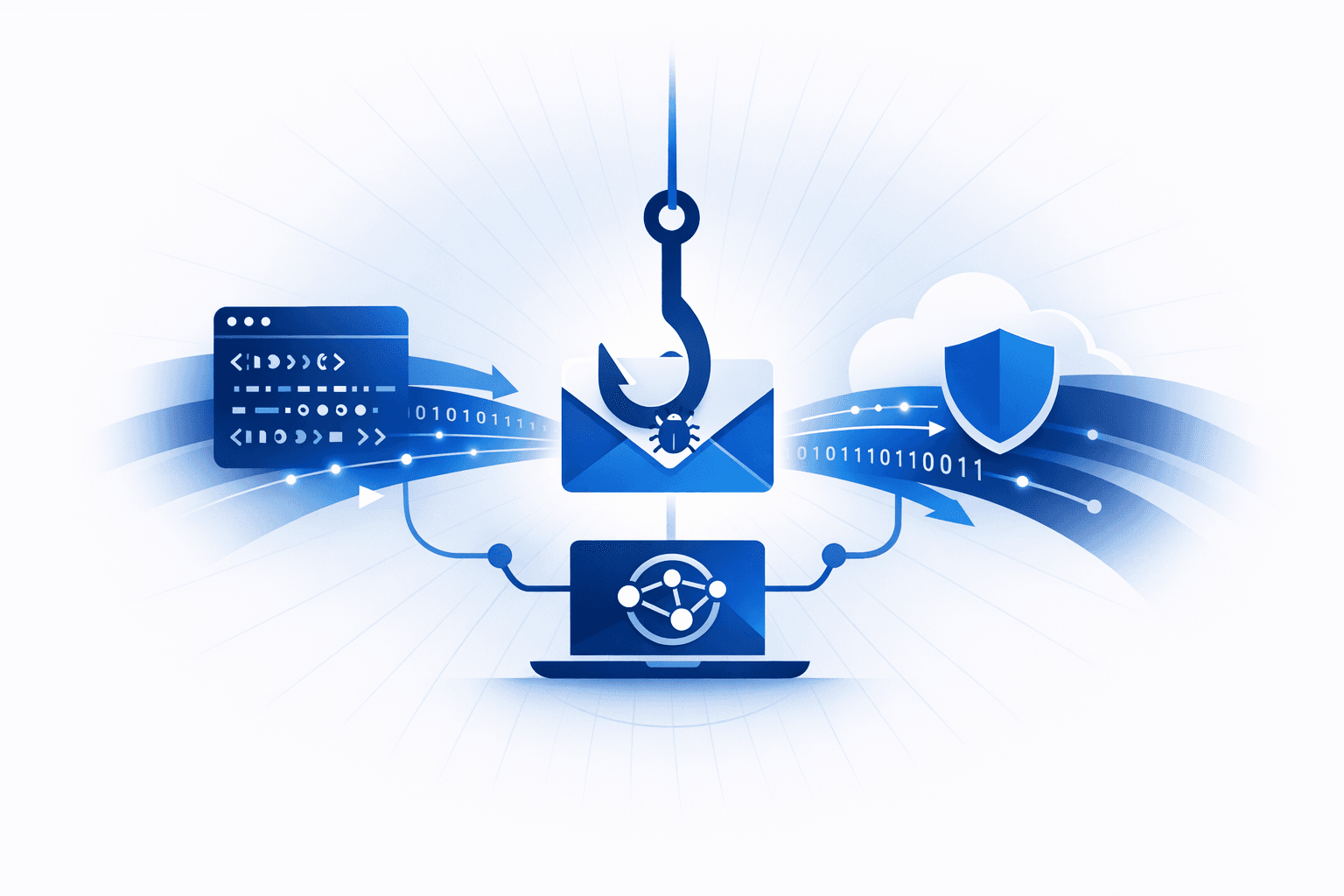
Researchers reported multiple **Remcos RAT** campaigns using phishing emails and trusted infrastructure to infect victims while evading detection. In one intrusion chain, a ZIP attachment named `MV MERKET COOPER SPECIFICATION.zip` delivered an obfuscated JavaScript file that fetched a PowerShell loader from `almacensantangel[.]com`; the loader then reconstructed and decrypted payloads in memory, including `ALTERNATE.dll` and `Cqeqpvzeia.exe`. The malware injected into the legitimate Microsoft .NET utility `aspnet_compiler.exe`, communicated with `192[.]3[.]27[.]141:8087`, and stored captured keystrokes and other data in `C:\ProgramData\remcos\logs.dat`, leaving few disk artifacts. A separate campaign used phishing emails that linked to a fake Google Drive sharing page hosted through **Google Cloud Storage** and the trusted `googleapis.com` domain, helping the attack bypass email and web filtering. After user interaction, the infection chain used staged JavaScript redirects or downloads, followed by VBScript or PowerShell execution to retrieve the final Remcos payload, which was then injected into a legitimate Windows process through **process hollowing**, persisted via Windows Registry entries, and opened encrypted command-and-control channels. The activity underscores how attackers are combining living-off-the-land techniques, trusted cloud services, obfuscated scripting, and legitimate Windows binaries to deploy Remcos for surveillance and data theft.
Jun 29, 2026
Threat researchers reported multiple phishing-driven intrusions in which attackers impersonate trusted brands and agencies to trick victims into installing legitimate remote monitoring and management (RMM) software for persistent access. In **Operation DoppelBrand**, financially motivated actor **GS7** spoofed Fortune 500 financial and technology brands (including **Wells Fargo** and **USAA**) using more than **150** lookalike domains to harvest credentials and exfiltrate data via attacker-controlled **Telegram bots**; researchers also identified nearly **200** additional domains with short registration terms, automated SSL, wildcard DNS, and brand-specific subdomains supporting the campaign. Separately, Forcepoint X-Labs described a wave of emails impersonating the **U.S. Social Security Administration** that delivers an attached `.cmd` script to weaken Windows defenses and enable silent installation of **ConnectWise ScreenConnect**. The script checks/elevates privileges, disables **Windows SmartScreen** via registry changes, removes **Mark-of-the-Web**, and uses **Alternate Data Streams (ADS)** for stealth before installing an MSI and configuring ScreenConnect (via `System.config`) to beacon to an attacker-controlled server (reported as `dof-connecttop` on port `8041`). Both activity sets highlight a recurring tradecraft pattern: **brand impersonation + scripted defense evasion + abuse of legitimate RMM tooling** (e.g., *LogMeIn Resolve*, *ScreenConnect*) to gain remote control and facilitate follow-on theft or persistence.
Jun 29, 2026