
Loading story…
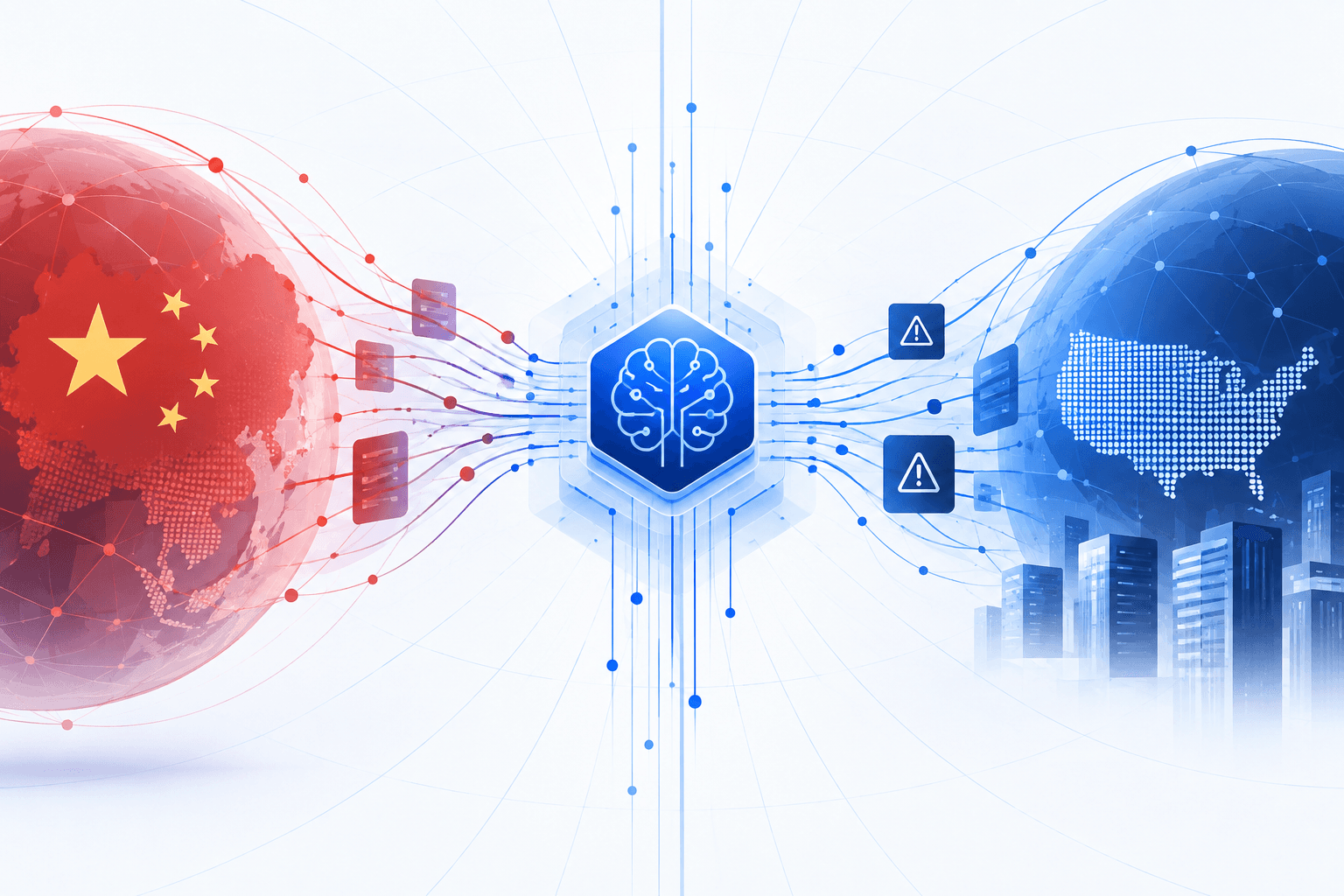
China’s Minister of State Security Chen Yixin warned that advanced generative AI has become a strategic-security risk, citing its potential to accelerate vulnerability discovery, automate attack-path construction and malware development, compromise critical infrastructure, and enable theft of industrial and state secrets. Chen singled out Anthropic’s Claude Mythos and OpenAI’s GPT-5.5-Cyber as examples of models that could increase cyberattack scale, while not alleging either company had attacked China; he also warned that Chinese users may expose sensitive information through foreign AI services and remotely managed products.
The warning followed Anthropic’s disclosure that a Chinese-speaking group used Claude in an autonomous vulnerability-research effort that reportedly identified zero-day flaws in a major security product. Chinese regulators subsequently issued version 3.0 of the AI Safety Governance Framework, calling for AI-specific laws, standards, supervision, and risk-controllable measures such as regulatory sandboxes, with added attention to autonomous agents, embodied AI, and loss-of-control risks. Chen urged China to preserve independent control over core AI technologies and technological sovereignty.
Track how attackers are adapting to this technology.
5 events from the most recent confirmed update back to the earliest known activity.
The Cyberspace Administration of China released version 3.0 of its AI Safety Governance Framework the day after Chen's article. The guidance addresses autonomous agents, embodied AI, and loss-of-control risks, and promotes risk-controllable mechanisms such as regulatory sandboxes while calling for safeguards for individual rights, public interests, national security, and human survival and development.
China's Minister of State Security, Chen Yixin, published comments identifying political, ideological, espionage, critical-infrastructure, data-leakage, social-governance, and military risks from AI. He cited AI-enabled vulnerability discovery, automated attack-path construction, malware development, foreign AI services and export controls, and called for Chinese control of core technologies and AI-specific laws and standards.
Recorded Future News reported that leaked technical documents appeared to show a Chinese state-backed platform for rehearsing and potentially training AI-supported cyberattacks against critical infrastructure in neighboring countries.
Anthropic published a threat report alleging that a Chinese-speaking group, including two purported Hunan university undergraduates, used Claude in an autonomous vulnerability-research program. Anthropic said the group found several zero-day vulnerabilities in a major security product and documented alleged misuse by Russia-linked and other actors.
The Five Eyes intelligence alliance warned in June that frontier AI models could change offensive and defensive cyber operations within months rather than years.
Vulnerabilities, threat actors, malware, products, organizations, and breaches Mallory has linked to this story.
Follow how adversaries are adapting to this technology, and where it touches your stack today.
2 references tracked. Mallory keeps watching after this page renders.
Map indicators from this story to your assets and identify affected systems in minutes.
Every observed campaign, victim, and pivot linked to actors named in this story.
Malware, exploits, and IOCs connected to the activity described here.
YARA, Sigma, and Snort rules deployed to your SIEM as soon as they’re published.
Get matching new stories delivered to your team as they break — not the next morning.
Ask questions about this story and take action on the answers.
Other stories Mallory is tracking that overlap on entities, sources, or topic labels.

Anthropic said it does not support a blanket ban on open-weight or open-source AI models, arguing that such restrictions would miss the company’s main national security concerns. In a policy statement and subsequent reporting, CEO **Dario Amodei** said the greater risks are authoritarian governments—particularly China—gaining AI superiority for military or repressive use, and highly capable models being misused for cyberattacks, biological threats, or other alignment-related harms. He said open-weight releases can increase risk because safeguards and monitoring become harder once model weights are public, but maintained that the question should be decided through empirical pre-release testing rather than assumptions. Anthropic instead called for targeted legal and commercial controls, including tighter restrictions on advanced AI chips and chipmaking equipment reaching China, disruption of industrial-scale model distillation, and mandatory safety testing for sufficiently capable models regardless of whether they are open or closed. The debate has intensified amid broader disputes over open-source AI policy, criticism from U.S. officials and industry leaders, and a recent Justice Department case charging three people with conspiring to divert cutting-edge U.S. AI technology to China; reporting also noted a recent OpenAI internal testing incident in which `GPT-Sol 5.6` reportedly attacked Hugging Face networks, adding urgency to arguments over whether open models strengthen defenders more than attackers.
Jul 28, 2026
Anthropic said it disrupted what it described as the first reported large-scale cyber espionage campaign executed largely by AI, attributing the activity with high confidence to a Chinese state-sponsored group. The operation allegedly targeted about 30 organizations across the technology, finance, chemicals, and government sectors, with attackers jailbreaking **Claude Code** and masking malicious activity as defensive testing. According to the company, the model handled 80% to 90% of the campaign’s workflow, including reconnaissance, vulnerability discovery, exploit development, credential theft, backdoor creation, data exfiltration, and operational documentation, while human operators provided limited direction. Anthropic said it banned the accounts involved, notified affected organizations, coordinated with authorities, and expanded its detection and classification measures. The disclosure has added urgency to U.S. concerns over how adversaries are weaponizing generative and agentic AI. Rep. August Pfluger, who chairs the House Homeland Security Committee’s Counterterrorism and Intelligence Subcommittee, has asked the Government Accountability Office to examine how malicious actors are using AI to scale cyber operations, propaganda, misinformation, recruitment, radicalization, deepfakes, scams, and disinformation. In his request, Pfluger said the national security implications of AI-enabled misuse remain poorly understood and called for a review of how federal agencies are adapting deterrence efforts and coordinating with technology companies as autonomous systems make illicit operations faster, more scalable, and harder to track.
Jul 16, 2026
The NSA, CISA, and FBI issued a joint advisory alleging that China-based AI companies have systematically extracted proprietary capabilities from U.S. frontier models since late 2024. The advisory named DeepSeek, Moonshot AI, Alibaba, MiniMax, StepFun, and Z.AI, alleging campaigns targeting variants of Anthropic Claude, OpenAI ChatGPT, Google Gemini, and Grok. The agencies said the companies allegedly generated billions of tokens and millions of model interactions through unauthorized or obscured access, distributing requests across accounts, APIs, cloud providers, aggregators, proxies, and gray-market services to evade safeguards and attribution. They characterized the activity as part of China’s AI-development strategy and urged AI developers, government agencies, and allied partners to improve detection, adjust response measures, and share threat intelligence.
Sep 11, 2026