
Loading story…
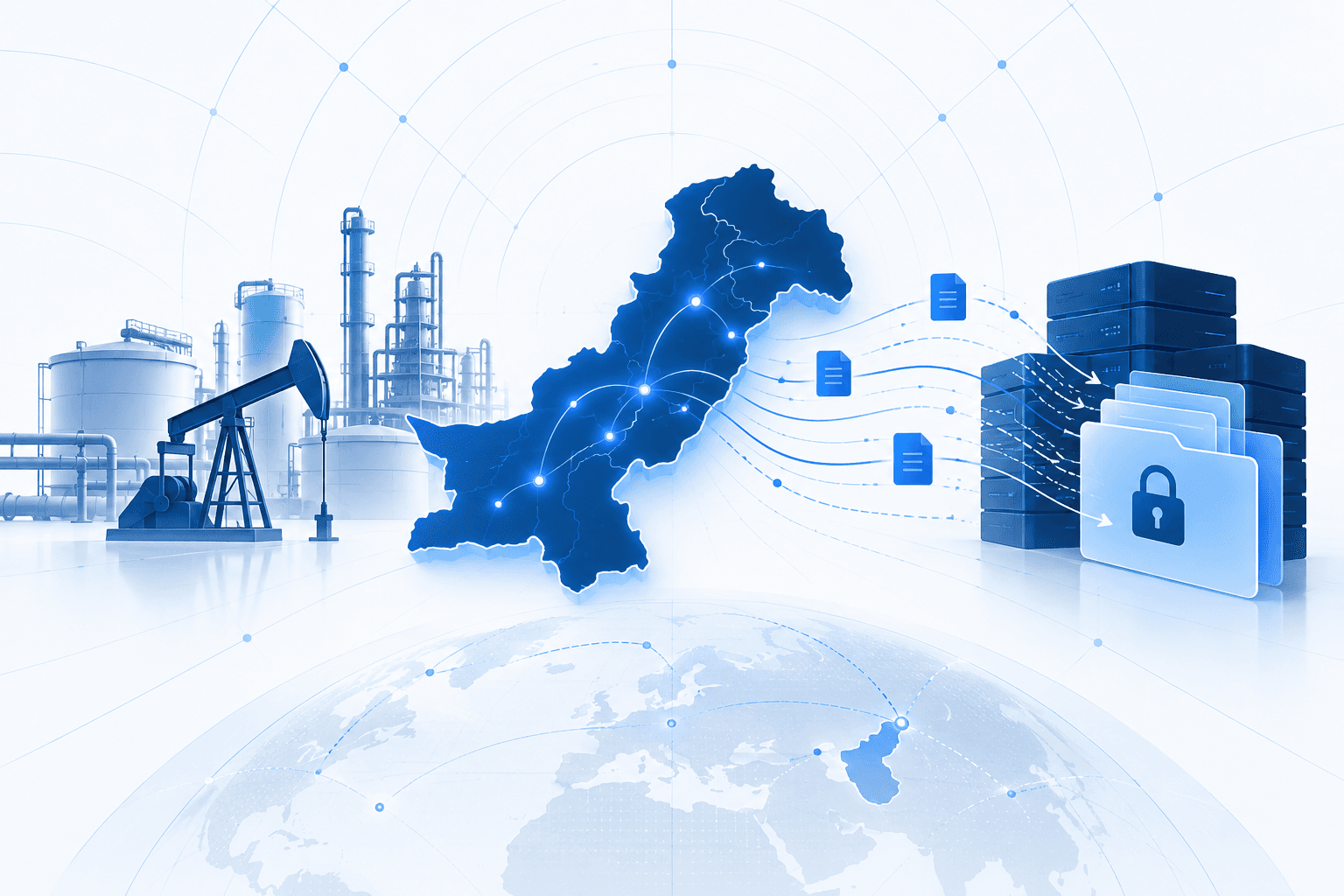
Blue Locker ransomware resurfaced after an attack on Pakistan Petroleum Limited (PPL), Pakistan’s second-largest oil and gas producer, reportedly encrypting servers and virtual machines, deleting backups, and disrupting financial operations for two days. The operators claimed to have exfiltrated roughly 1 TB of data, a claim PPL disputed. Pakistan’s National CERT subsequently issued an emergency advisory to 39 government ministries and institutions; PPL remains the only publicly confirmed victim in the reporting.
First observed in 2021 and circulating broadly by early 2022, Blue Locker has been distributed through phishing, social engineering, trojanized remote-access software, and malicious torrent or peer-to-peer downloads. It appends the .blue extension, leaves ransom notes directing victims to ProtonMail, and is associated with a double-extortion chain involving PowerShell loaders, privilege escalation, security-tool impairment, data theft, shadow-copy deletion, and service termination. Attribution is unresolved: artifacts have been linked to the likely Iranian-associated Proton ransomware family and the public MemeCryptor codebase, while Chinese-language strings are assessed as likely false flags. Microsoft Defender detects the threat as Ransom:Win32/BlueLocker.MK!MTB, and ReversingLabs has published a YARA rule for pre-encryption detection.
TTPs, infrastructure, and targeting history in one profile.
8 events from the most recent confirmed update back to the earliest known activity.
Blue Locker attacked Pakistan Petroleum Limited, reportedly encrypting servers and virtual machines, deleting backups, and disrupting financial operations for two days. The operators claimed to have exfiltrated about 1 TB of business and employee data, while PPL denied sensitive data had been compromised.
The Proton ransomware family, to which Resecurity assessed Blue Locker as related, was first observed in March 2023 and has been assessed as probably Iranian in origin.
Blue Locker was identified circulating by early 2022, using phishing and social-engineering lures, including trojan remote-access tools disguised as legitimate software.
Microsoft published its Defender threat entry for Ransom:Win32/BlueLocker.MK!MTB, which detects and removes the ransomware-classified threat.
Blue Locker was first observed in the wild around November 2021; Elastio recorded a first-seen date of November 1, 2021.
Technical analysis documented Blue Locker's PowerShell loader, Registry Run-key persistence, shadow-copy deletion, AES/RSA encryption, Chrome-process termination and credential-database targeting, and double-extortion ransom-note behavior. The report linked the malware by code lineage or functionality to Proton-family variants such as Shinra, Limba, and Zola, while stating that reused code does not establish attribution.
Following the PPL attack, Pakistan's National CERT distributed a critical Blue Locker advisory to 39 government ministries and institutions. The recipients were warned of the threat but were not publicly confirmed as Blue Locker victims.
ReversingLabs released the open-source Win32.Ransomware.BlueLocker.yara rule to identify Blue Locker infections before ransomware execution.
Vulnerabilities, threat actors, malware, products, organizations, breaches, and observables Mallory has linked to this story. Indicator values are masked here and available in full in the app.
Indicator values are masked on this page. View all 24 in Mallory Domains, IPs, hashes, and URLs are exportable to your SIEM.
See this adversary's TTPs, infrastructure, and targeting history, correlated against your exposure.
5 references tracked. Mallory keeps watching after this page renders.
malware.news
Open sourceresecurity.com
Open sourceelastio.com
Open sourcereversinglabs.com
Open sourcemicrosoft.com
Open sourceMap indicators from this story to your assets and identify affected systems in minutes.
Every observed campaign, victim, and pivot linked to actors named in this story.
Malware, exploits, and IOCs connected to the activity described here.
YARA, Sigma, and Snort rules deployed to your SIEM as soon as they’re published.
Get matching new stories delivered to your team as they break — not the next morning.
Ask questions about this story and take action on the answers.
Other stories Mallory is tracking that overlap on entities, sources, or topic labels.

The Blue Locker ransomware operation encrypted servers and virtual machines at Pakistan Petroleum Limited (PPL), Pakistan’s second-largest oil and gas producer, disrupting financial operations for two days. The attackers reportedly deleted backups and claimed to have exfiltrated roughly 1 TB of data, although PPL denied that sensitive information was affected; Pakistan’s National CERT subsequently issued an emergency advisory to 39 government ministries and institutions. First observed in late 2021, Blue Locker employs double extortion, pairing encryption with data theft and private ransom negotiations via ProtonMail, Jabber, and Tox. Attribution remains unresolved: Resecurity has associated the operation with the likely Iranian-origin Proton ransomware family, while other researchers have linked the `.blue` extension and `restore_file.txt` ransom-note artifacts to the publicly available MemeCryptor codebase.
Sep 25, 2026
Attackers brute-forced the `sa` account on an internet-facing Microsoft SQL Server and escalated a compromise into a full BlueSky ransomware deployment in about 32 minutes. After access was obtained, they enabled `xp_cmdshell`, launched PowerShell payloads, established a Cobalt Strike beacon, and used Tor2Mine tooling to disable antivirus, create persistence, and install an XMRig-based Monero miner. The intrusion then expanded through remote service creation and SMB activity toward domain controllers and file shares before the ransomware binary, masquerading as `vmware.exe`, was executed on the initial host. Files were encrypted with the `.bluesky` extension and a ransom note named `# DECRYPT FILES BLUESKY #.txt` was dropped, while investigators reported no evidence of data exfiltration. BlueSky is a Windows-focused ransomware family observed since 2022 that has been distributed through phishing emails, phishing sites, and trojanized downloads in addition to direct server compromise. Technical analysis shows the malware adjusts privileges, hides threads from debuggers, creates a mutex, and selectively skips some system-related files and directories while targeting user and database data. It accelerates encryption across local and network resources using multithreading and Windows I/O completion ports, stores recovery-related data in the Windows registry, terminates selected processes before encryption, appends the `.bluesky` extension to locked files, and generates ransom notes in both TXT and HTML formats.
Aug 14, 2026
Researchers detailed **BlueSky**, an emerging Windows ransomware family that rapidly encrypts files through a multithreaded design and uses anti-analysis features plus a staged PowerShell infection chain. The malware was observed being delivered from `kmsauto[.]us` via `start.ps1` and `stage.ps1`, then saved locally as `javaw.exe`. It attempts privilege escalation with **JuicyPotato** on older Windows systems and uses exploits for `CVE-2020-0796` and `CVE-2021-1732` on newer hosts before encrypting files, appending the `.bluesky` extension, and dropping ransom notes named `# DECRYPT FILES BLUESKY #.txt` and `# DECRYPT FILES BLUESKY #.html`. Technical analysis found BlueSky shares strong code similarities with **Conti v3**, particularly in its multithreaded architecture and network share enumeration, while its cryptography aligns more closely with **Babuk** through the use of **ChaCha20** for file encryption and **Curve25519** for key generation. The ransomware excludes selected extensions and directories, creates host-specific identifiers, and stores encryption-state artifacts including a mutex and `HKCU\Software\<32-byte ID>` registry entries. Investigators also found **RedLine**-related samples hosted on the same domain, indicating possible infrastructure overlap or operational ties even though no direct code overlap was identified.
Aug 14, 2026