Mallory
← Back to News
actively-exploited-vulnerabilityrapid-weaponizationinternet-facing-service-vulnerabilityopen-source-dependency-vulnerability

React2Shell RCE Fuels Mass Exploitation, Cryptomining and Botnet Deployment

Active Exploitation · 13 sources · Updated 2mo ago · First seen Feb 2, 2026
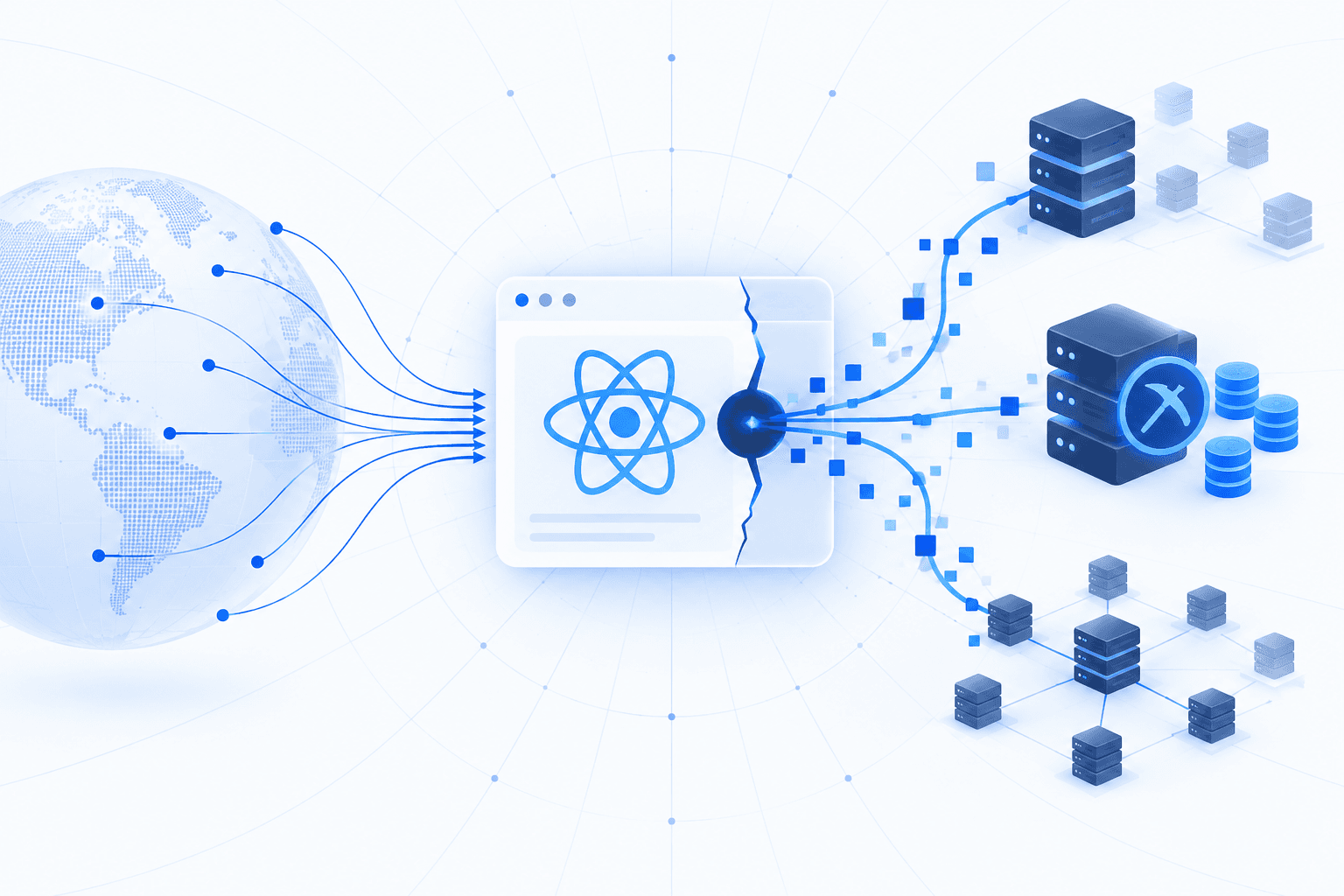
React2Shell RCE Fuels Mass Exploitation, Cryptomining and Botnet Deployment

React2Shell (CVE-2025-55182), a CVSS 10.0 unauthenticated remote code execution vulnerability affecting React Server Components and applications using them, including Next.js, triggered widespread exploitation after its December 3, 2025 disclosure. The flaw involves unsafe handling of serialized input and can be exploited with a single HTTP POST request. Honeypots recorded attempts within approximately 20 hours, and CrowdSec subsequently observed daily attacking IPs rise from roughly 500 to more than 10,000 at the December 11 peak. Researchers documented reverse shells, persistent XMRig cryptocurrency miners, Mirai botnet payloads and activity associated with suspected China-linked operators. Targeting expanded from banks and healthcare organizations to smaller websites and exposed development servers. The Next.js-specific identifier CVE-2025-66478 was rejected as a duplicate of CVE-2025-55182.

Exploitation later concentrated around a smaller set of high-volume sources: GreyNoise recorded 1,419,718 attempts during January 26–February 2, 2026, with two IP addresses generating 56% of activity and delivering distinct reverse-shell and cryptomining payloads. An April WhoisXML API report identified the previously undocumented ILOVEPOOP toolkit, linking nine scanner nodes through shared exploit headers, payload structures and reconnaissance patterns. These infrastructure associations and potential-target lists do not establish successful compromise, exfiltration or common ownership, and some threat-actor connections remain unconfirmed. Organizations should inventory affected applications across cloud and on-premises environments, patch React Server Components and affected frameworks, and restrict internet exposure of development servers. Where patching is unavailable, disable affected server-component functionality if feasible. Investigations should review historical ingress logs for suspicious headers and serialized payloads, unexpected child processes spawned by Node.js, outbound command-and-control connections and unauthorized persistent services; WAF rules and IP blocking are supplementary controls, not substitutes for remediation.

Why it matters

React2Shell enables unauthenticated takeover of vulnerable React Server Components applications, including affected Next.js deployments, across production, cloud, and development environments. Reporting documents successful compromises involving cryptocurrency mining, persistence, remote-access payloads, and botnet deployment; application-accessible data, credentials, and connected services are also exposed. Exploitation is widespread and automated, with some targeted activity, but the supplied telemetry does not establish current attack volumes as of October 13, 2026.

  • Affected populations: Enterprises, government and education organizations, financial services, healthcare, small websites, and personal blogs using affected server-side components. Client-only React usage is not the exposure described here.
  • Operational consequences: Compute consumption and cloud costs from XMRig, persistent unauthorized access, repeated infection, and potential participation in DDoS attacks. Data theft, ransomware, and lateral movement are possible consequences, not established outcomes across the reported campaigns.
  • Historical scale: December 2025 estimates ranged from approximately 60,000 to more than 77,000 exposed vulnerable servers. CrowdSec recorded more than 10,000 attacking IPs at its December 11 peak; GreyNoise recorded 1,419,718 attempts during January 26–February 2, 2026. These are separate measurements, not a cumulative victim count.
  • Evidence limits: Named potential targets, multipart-boundary search matches, and NetFlow associations do not demonstrate compromise or exfiltration. Suspected China-linked activity and inferred infrastructure relationships do not establish common ownership of all observed sources.
This is being exploited nowSee which actors are running it and whether you're in range.
Check your exposure
Event timeline

How this story unfolded

Events from the most recent confirmed update back to the earliest known activity.

31 events · Dec 3, 2025 – Feb 2, 2026
  1. Reported Apr 6, 20268mo ago

    ILOVEPOOP node sends React2Shell-shaped payload to a POP3 sensor

    Niihama captured 195.3.222[.]78 probing an IMAP sensor and sending an HTTP-shaped React2Shell Server Actions payload to a POP3 sensor. Researchers interpreted the payload as an RSC deserialization attempt but did not demonstrate execution through POP3.

    To Cache A Predator: ILOVEPOOP Toolkit Discovery, Global Traffic & Honeypot Observations Exploiting React2Shell (CVE-2025-55182) | WhoisXML API
  2. Reported Apr 6, 20268mo ago

    Researchers identify the previously undocumented ILOVEPOOP toolkit

    WXA IASC identified the ILOVEPOOP React2Shell toolkit and linked 672 exploit attempts across nine scanner nodes over a 30-day observation period. Shared headers, payload structure, route enumeration, and User-Agent rotation supported an inferred common operator, not proof of successful compromise.

    To Cache A Predator: ILOVEPOOP Toolkit Discovery, Global Traffic & Honeypot Observations Exploiting React2Shell (CVE-2025-55182) | WhoisXML API
  3. Reported Mar 19, 20268mo ago

    ELLIO reports custom Go Layer 7 DDoS botnet with Cloudflare bypass

    ELLIO reported a custom Go-based Layer 7 DDoS botnet with Cloudflare bypass capabilities in a React2Shell update. The supplied reference does not provide details about victims or deployment.

    React2Shell Update: Custom Go L7 DDoS Botnet with Cloudflare Bypass | ELLIO Blog
  4. Feb 2, 202610mo ago

    ILOVEPOOP activates another Netherlands scanner node

    During February 2–6, 2026, 2.58.56[.]147 became the active Netherlands node in the ILOVEPOOP infrastructure rotation.

    To Cache A Predator: ILOVEPOOP Toolkit Discovery, Global Traffic & Honeypot Observations Exploiting React2Shell (CVE-2025-55182) | WhoisXML API
  5. Jan 26, 202610mo ago

    Two IPs account for 56% of GreyNoise React2Shell exploitation traffic

    Over January 26–February 2, 2026, GreyNoise recorded 1,419,718 exploitation attempts from 1,083 source IPs. Addresses 193.142.147[.]209 and 87.121.84[.]24 accounted for 56%, delivering reverse shells and XMRig payloads respectively.

    React Server Components Exploitation Consolidates as Two IPs Generate Majority of Attack Traffic
  6. Jan 20, 202610mo ago

    React2Shell-associated node sends a burst of DNP3 connections

    Niihama recorded 58 DNP3 connections from 87.121.84[.]24 in a 30-minute burst on January 20, 2026. The same node also generated HTTP events across four React2Shell attack waves.

    To Cache A Predator: ILOVEPOOP Toolkit Discovery, Global Traffic & Honeypot Observations Exploiting React2Shell (CVE-2025-55182) | WhoisXML API
  7. Jan 20, 202610mo ago

    ILOVEPOOP shifts its primary scanner to 195.178.110[.]25

    The ILOVEPOOP infrastructure rotated to 195.178.110[.]25 as its primary scanner during January 20–23, 2026.

    To Cache A Predator: ILOVEPOOP Toolkit Discovery, Global Traffic & Honeypot Observations Exploiting React2Shell (CVE-2025-55182) | WhoisXML API
  8. Jan 8, 202611mo ago

    ILOVEPOOP campaign uses main and backup scanner nodes

    During January 8–21, 2026, the ILOVEPOOP cluster used 95.214.55[.]246 as a main node and 87.121.84[.]24 as a backup. Researchers linked the cluster through shared exploit headers, multipart payloads, route sweeps, and rotating User-Agents.

    To Cache A Predator: ILOVEPOOP Toolkit Discovery, Global Traffic & Honeypot Observations Exploiting React2Shell (CVE-2025-55182) | WhoisXML API
  9. Jan 5, 202611mo ago

    Next.js reconnaissance continues across cloud and hosting infrastructure

    Between January 5 and February 6, 2026, Niihama recorded 894 React2Shell/Next.js-related requests from 43 scanner IPs. Activity included static-bundle enumeration, data-route and build-directory probing, and requests for environment files and source maps.

    To Cache A Predator: ILOVEPOOP Toolkit Discovery, Global Traffic & Honeypot Observations Exploiting React2Shell (CVE-2025-55182) | WhoisXML API
  10. Dec 27, 202511mo ago

    Infrastructure-linked sources conduct multi-protocol and credential attacks

    During December 27, 2025–February 4, 2026, Niihama recorded attacks from 669 source IPs that also communicated with two central React2Shell-associated nodes. Activity included SMB, RDP, SSH, and Telnet interactions; a credential-abuse subset generated 25,192 attempts, without establishing common ownership of all sources.

    To Cache A Predator: ILOVEPOOP Toolkit Discovery, Global Traffic & Honeypot Observations Exploiting React2Shell (CVE-2025-55182) | WhoisXML API
  11. Reported Dec 15, 20251y ago

    Attackers shift from high-value targets to automated mining campaigns

    CrowdSec reported that early bespoke attacks against banks and healthcare institutions gave way to indiscriminate exploitation of smaller websites and personal blogs. Later exploit kits embedded cryptocurrency miners, with potential botnet recruitment also identified as an objective.

    CVE-2025-55182: React2Shell Attacks Surge 25× in Days
  12. Reported Dec 12, 20251y ago

    Exposed reconnaissance directory reveals hundreds of potential targets

    The Raven File researcher discovered an exposed directory at 154.61.77.105:8082 containing React2Shell tooling, 35,423 domains, and 596 potential-target URLs. Named organizations included Starbucks, Lululemon, Porsche, and OpenAI, but inclusion did not establish vulnerability or compromise.

    REACT2SHELL: EXPLOITATION IN THE WILD - THE RAVEN FILE
  13. Dec 11, 20251y ago

    CrowdSec records more than 10,000 attacking IPs at the December 11 peak

    CrowdSec observed more than 10,000 distinct attacking IPs exploiting React2Shell at the December 11 peak, compared with approximately 500 per day in its earlier report. It characterized the increase over several days as roughly 25-fold.

    CVE-2025-55182: React2Shell Attacks Surge 25× in Days
  14. Reported Dec 9, 20251y ago

    Duplicate Next.js CVE identifier is rejected

    CVE-2025-66478, originally assigned to the Next.js manifestation, was officially rejected as a duplicate. CVE-2025-55182 covers both the React and Next.js manifestations.

    React2Shell (CVE-2025-55182): Active exploitation notice | Expel
  15. Reported Dec 8, 20251y ago

    Mirai-variant distribution leads to observed DDoS tasking

    Researchers identified a separate script at 209.141.49[.]251 distributing multi-architecture Mirai-variant payloads to enroll machines into a botnet. The malware connected to 205.185.121[.]141:23, and researchers intercepted DDoS commands.

    React2Shell (CVE-2025-55182) actively exploited by threat actors - Ctrl-Alt-Intel
  16. Reported Dec 8, 20251y ago

    Cryptojacking campaigns install persistent XMRig miners

    Researchers observed attackers exploiting Next.js servers and distributing XMRig 6.24.0 through sex.sh scripts hosted on compromised sites. Scripts attempted persistence through a system-update-service systemd unit configured to run the miner as root and restart automatically.

    React2Shell (CVE-2025-55182) actively exploited by threat actors - Ctrl-Alt-Intel
  17. Reported Dec 8, 20251y ago

    Healthcare-targeting exploit script found alongside MeshAgent infrastructure

    Researchers found a React2Shell proof-of-concept at 86.54.42[.]146:8080 targeting a redacted online healthcare organization and requesting a callback after command execution. The same address hosted a MeshAgent server, but the exposed script did not establish that the healthcare organization was compromised.

    React2Shell (CVE-2025-55182) actively exploited by threat actors - Ctrl-Alt-Intel
  18. Reported Dec 8, 20251y ago

    Second suspected Chinese actor exposes Brazilian scanning and RAT infrastructure

    An exposed directory and shell history at 47.89.245[.]170 revealed React2Shell scanning, Brazilian target lists, and VShell loader infrastructure. The directory also contained a ValleyRAT DLL-hijacking chain using legitimate Bitdefender binaries, not evidence of a Bitdefender breach.

    React2Shell (CVE-2025-55182) actively exploited by threat actors - Ctrl-Alt-Intel
  19. Reported Dec 8, 20251y ago

    Suspected Chinese actor scans Vietnamese targets and hosts VShell loaders

    Researchers identified an exposed directory at 180.210.220[.]54 containing Nuclei React2Shell scanning results indicating Vietnamese targeting and Linux VShell loaders. The activity included government and education domains, but earlier university compromises were not established as React2Shell victimization.

    React2Shell (CVE-2025-55182) actively exploited by threat actors - Ctrl-Alt-Intel
  20. Reported Dec 7, 20251y ago

    Attackers deploy Turnt through React2Shell exploitation

    Defused researchers observed an associated attacker IP deploying Turnt during exploitation. The tool tunnels interactive command-and-control traffic through legitimate TURN servers, including infrastructure operated by providers such as Zoom.

    React2Shell Exploitation: A Short Summary of Honeypot Activity
  21. Reported Dec 7, 20251y ago

    AWS publishes indicators connecting exploitation to China-nexus groups

    AWS published indicators connecting React2Shell exploitation to China-nexus threat groups. Defused researchers correlated those indicators with honeypot attacks originating from China, Hong Kong, and Taiwan.

    React2Shell Exploitation: A Short Summary of Honeypot Activity
  22. Dec 5, 20251y ago

    CrowdSec detects Leakix scanning for React2Shell

    CrowdSec first observed Leakix scanning for React2Shell on December 5, approximately 12 hours after its first attack detection. BinaryEdge and Shadowserver scanning was observed subsequently.

    CVE-2025-55182: React2Shell Attacks Surge 25× in Days
  23. Dec 5, 20251y ago

    Nuclei receives a working React2Shell detection rule

    The open-source Nuclei scanner received a working React2Shell detection rule, enabling automated identification of vulnerable applications.

    CVE-2025-55182: React2Shell Attacks Surge 25× in Days
  24. Dec 5, 20251y ago

    Bulgarian scanner begins a wave of honeypot exploitation attempts

    Niihama recorded more than 90 React2Shell exploitation attempts from 85.11.167[.]3 during December 5–8, 2025. Requests targeted multiple login and React/Next.js protocol routes using multipart POST payloads and the Next-Action header.

    To Cache A Predator: ILOVEPOOP Toolkit Discovery, Global Traffic & Honeypot Observations Exploiting React2Shell (CVE-2025-55182) | WhoisXML API
  25. Dec 5, 20251y ago

    Mass exploitation reaches internet-exposed React and Next.js servers

    Expel observed working exploit proof-of-concepts being used against publicly exposed servers by December 5, and GreyNoise first detected exploitation that day. Defused researchers reported mass exploitation with commodity malware and cryptocurrency miners underway by Friday.

    React2Shell (CVE-2025-55182): Active exploitation notice | Expel
  26. Dec 4, 20251y ago

    AssetNote releases a React2Shell scanner

    AssetNote released React2Shell Scanner to identify unpatched servers. The Raven File subsequently reported that cybercriminals adopted the public tool for target discovery.

    REACT2SHELL: EXPLOITATION IN THE WILD - THE RAVEN FILE
  27. Dec 4, 20251y ago

    CrowdSec adds a React2Shell virtual patch to its WAF

    CrowdSec’s security team added a virtual patching rule for CVE-2025-55182 to CrowdSec WAF on December 4, 2025, at 11:00 UTC.

    React2Shell (CVE-2025-55182): The Frontend Flaw Enabling Backend Access
  28. Dec 3, 20251y ago

    Earth Lamia and Jackpot Panda exploit React2Shell within hours

    AWS reported that China state-nexus groups Earth Lamia and Jackpot Panda exploited React2Shell for initial access within hours of public disclosure.

    React2Shell (CVE-2025-55182) actively exploited by threat actors - Ctrl-Alt-Intel
  29. Dec 3, 20251y ago

    AWS, Akamai, and Cloudflare implement disclosure-time mitigations

    AWS, Akamai, and Cloudflare implemented mitigations at the time React2Shell was disclosed.

    React2Shell (CVE-2025-55182): Active exploitation notice | Expel
  30. Dec 3, 20251y ago

    React2Shell vulnerability publicly disclosed

    CVE-2025-55182 was disclosed as a critical unauthenticated remote-code-execution vulnerability affecting React Server Components and frameworks including Next.js. Expel and GreyNoise date disclosure to December 3, 2025; the later WhoisXML API report instead gives December 4.

    React2Shell (CVE-2025-55182): Active exploitation notice | Expel
  31. Date unknown

    Public Metasploit exploitation module becomes available

    A public Metasploit module for CVE-2025-55182 was published shortly after disclosure, making exploitation through a single HTTP POST request readily accessible.

    React Server Components Exploitation Consolidates as Two IPs Generate Majority of Attack Traffic
Linked entities

Related entities

Vulnerabilities, threat actors, malware, products, organizations, breaches, and observables Mallory has linked to this story. Indicator values are masked here and available in full in the app.

Open in app →

Threat actors

3 linked

Affected products

2 linked
ReactNext.Js

Observables

135 linked

Indicator values are masked on this page. View all 135 in Mallory Domains, IPs, hashes, and URLs are exportable to your SIEM.

Do you run this?Correlate live exploitation activity against the software you actually run, and see where you're exposed.
See Who's Exploiting This
Mallory platform

See the full picture, correlated to your attack surface.

This page covers what’s public. Mallory adds the parts that aren’t: which of your assets are affected, which threat actors are using it right now, and what to deploy next.

Exposure mappingMap indicators from this story to your assets and identify affected systems in minutes.
Threat actor evidenceEvery observed campaign, victim, and pivot linked to actors named in this story.
Associated malwareMalware, exploits, and IOCs connected to the activity described here.
Detection signaturesYARA, Sigma, and Snort rules deployed to your SIEM as soon as they’re published.
Scheduled alertsGet matching new stories delivered to your team as they break, not the next morning.
AI threadsAsk questions about this story and take action on the answers.