
Loading story…
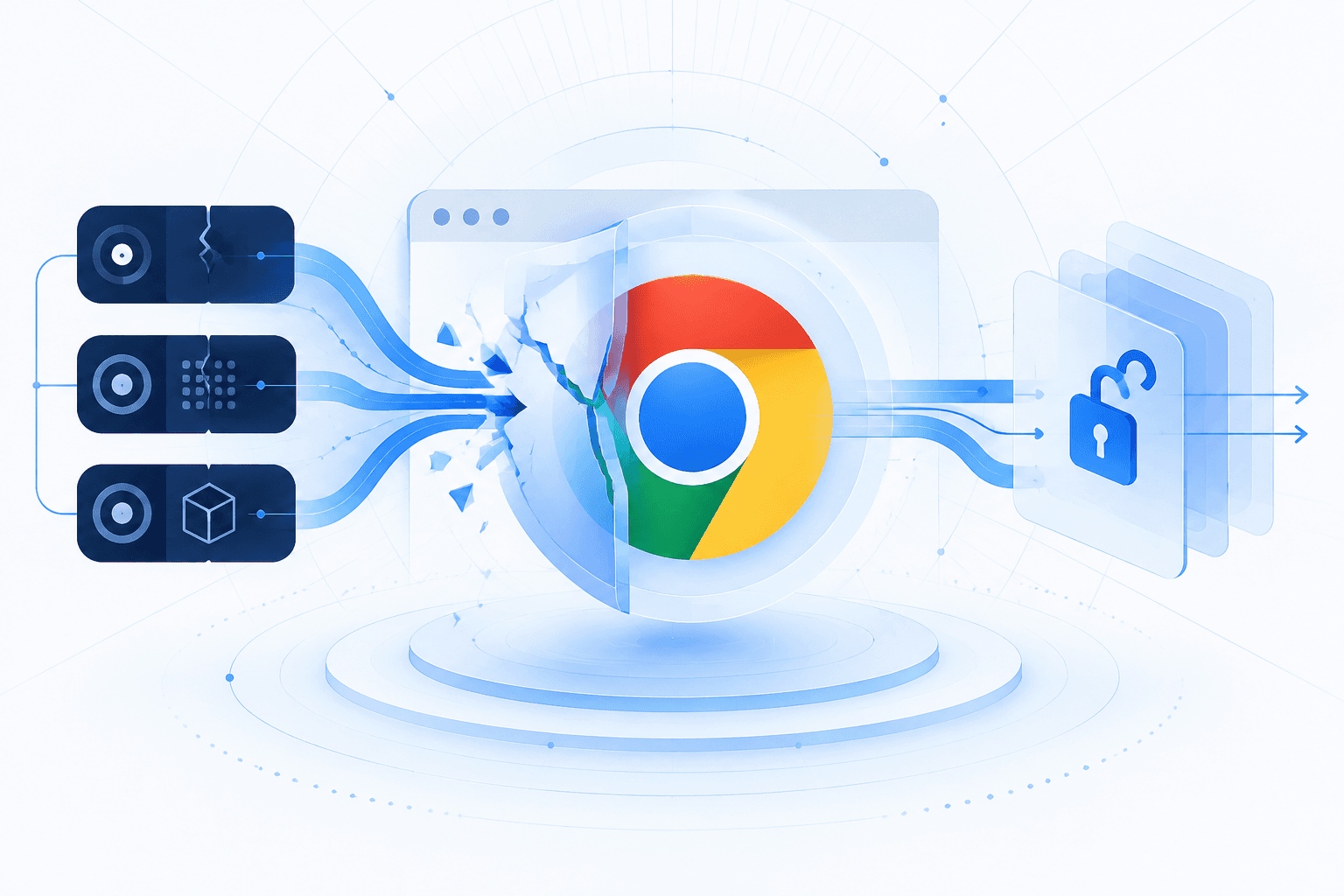
XBOW disclosed an AI-assisted exploit that chained three previously unknown Google Chrome vulnerabilities to execute code outside the browser’s sandbox on Windows when a user loaded a crafted web page. The chain combined flaws in V8’s Maglev compiler, animated WebP decoding, and Crashpad to cross both Chrome sandbox boundaries. Google confirmed and fixed all three vulnerabilities and awarded XBOW a $250,000 bounty. XBOW said the exploit was never used against Chrome users.
A researcher working with AI agents running OpenAI’s publicly available GPT-5.6 Sol model built the final chain in six days, following months of earlier research, with approximately $40,000 in AI computing costs and human guidance. The demonstration highlights the potential for publicly available models to accelerate complex exploit development, rather than establishing fully autonomous discovery. Organizations should update and relaunch Chrome and verify version 152.0.7977.82 or later, as recommended in the reporting; the WebP flaw’s public vulnerability identifier remains unconfirmed.
See affected versions and whether adversaries are exploiting it.
9 events from the most recent confirmed update back to the earliest known activity.
XBOW disclosed its three-vulnerability Chrome exploit, six-day AI-assisted development effort, and $250,000 Google reward. The company said Google had fixed all three flaws and that they had never been used against Chrome users.
Google fixed the high-severity V8 vulnerability CVE-2026-85045 in Chrome 152.0.7977.82. The flaw supplied memory control inside the JavaScript engine for the exploit's first stage.
Google fixed CVE-2026-78952 in Chrome 152.0.7977.65. The high-severity Crashpad flaw enabled the exploit chain to turn a memory write into code execution outside the sandbox on Windows.
Between August 2 and August 7, 2026, XBOW built the awarded exploit using OpenAI's GPT-5.6 Sol model with human guidance, at approximately $40,000 in computing costs. The chain combined V8, animated-WebP decoding, and Crashpad flaws to execute code outside Chrome's renderer sandbox on Windows from a crafted web page.
Google awarded XBOW $250,000 for its full-chain Chrome exploit report. XBOW described the payment as the first full-chain award under Google's updated 2026 reward rules.
Google fixed the animated-WebP decoding flaw during the Chrome 152 release cycle; no specific patch date or confirmed public identifier was provided. The flaw enabled the chain to escape V8's inner sandbox.
XBOW replaced a component of an early exploit chain after learning that Google already knew about the underlying vulnerability. The chain's modular design and backup vulnerabilities supported the substitution.
XBOW completed its first full Chrome exploit chain after two months of work, preceding the later six-day development sprint.
XBOW established a Chrome exploitation challenge at a January staff meeting in Malta. The source does not specify the year of that meeting.
Vulnerabilities, threat actors, malware, products, organizations, and breaches Mallory has linked to this story.
See whether adversaries are exploiting this yet, and where the affected versions run in your environment.
4 references tracked. Mallory keeps watching after this page renders.
theregister.com
Open sourcethehackernews.com
Open sourcecybersecuritynews.com
Open sourcexbow.com
Open sourceMap indicators from this story to your assets and identify affected systems in minutes.
Every observed campaign, victim, and pivot linked to actors named in this story.
Malware, exploits, and IOCs connected to the activity described here.
YARA, Sigma, and Snort rules deployed to your SIEM as soon as they’re published.
Get matching new stories delivered to your team as they break — not the next morning.
Ask questions about this story and take action on the answers.
Other stories Mallory is tracking that overlap on entities, sources, or topic labels.

Google Chrome addressed three **use-after-free** vulnerabilities tracked as `CVE-2026-7347`, `CVE-2026-7363`, and `CVE-2026-7344` in versions prior to `147.0.7727.138`. The bugs affect the **Chromoting**, **Canvas**, and **Accessibility** components, respectively, and all were classified under `CWE-416`. Two of the flaws were rated **critical**: `CVE-2026-7363` allows a remote attacker to execute arbitrary code inside the browser sandbox on Linux and ChromeOS by luring a user to a crafted HTML page, while `CVE-2026-7344` could let an attacker escape Chrome's sandbox on Windows after compromising the renderer process via crafted web content. The third issue, `CVE-2026-7347`, was rated **high severity** and affects Chromoting, where malicious network traffic could enable arbitrary code execution without privileges or user interaction. CVSS data added to the records shows network-based exploitation with high impact to confidentiality, integrity, and availability, with `CVE-2026-7363` and `CVE-2026-7344` carrying the vector `AV:N/AC:L/PR:N/UI:R/S:U/C:H/I:H/A:H`. The vulnerabilities were documented in Chrome and Chromium tracking references, underscoring the need for organizations to move affected browsers to `147.0.7727.138` or later.
Jun 29, 2026
Google said expanded use of AI across Chrome’s security workflow helped it identify and remediate **1,072 security bugs** in Chrome 149 and Chrome 150, a total that exceeded the number fixed across the prior 23 Chrome milestones combined. The company said large language models and Gemini-based systems are now being used for vulnerability discovery, reproduction, severity assessment, bug routing, patch generation, test creation, code review, and update delivery. Google also said AI-assisted analysis uncovered a **sandbox escape** flaw that had existed for more than 13 years and could have allowed a compromised renderer to access local files. Google attributed the spike in fixes to improved detection rather than a decline in Chrome security, describing AI as a way to scale vulnerability hunting and preemptive remediation across a massive codebase. To shorten the window between patch creation and user protection, the company is piloting twice-weekly security releases and developing dynamic patching and less disruptive automatic restart mechanisms. Google also said it is expanding memory-safety efforts such as **MiraclePtr**, moving new components to **Rust**, scanning code changes with AI before merge, and improving third-party component update pipelines.
Aug 6, 2026
Google released Chrome fixes for multiple high-severity vulnerabilities in the V8 JavaScript engine, including `CVE-2025-10891`, `CVE-2025-10892`, and `CVE-2025-9864`, that could be triggered when a user visits a malicious web page. The flaws include integer overflows and a use-after-free condition that can cause heap corruption in the browser renderer and potentially lead to arbitrary code execution. A related bulletin also lists `CVE-2025-10890`, a V8 side-channel information disclosure issue, alongside the two integer overflow bugs, warning that successful exploitation could expose sensitive data or enable full system compromise. Google said the affected Chrome builds were patched across Windows, macOS, and Linux in the `140.0.7339` release line, with fixes landing in versions including `140.0.7339.80/.81` and later `140.0.7339.207/.208` depending on the flaw and platform. Several of the vulnerabilities were reportedly identified by Google’s AI-based Big Sleep system, and no public proof-of-concept exploits were cited in the referenced reports. Organizations using Chrome or Chromium-based browsers were urged to deploy the vendor updates promptly because the bugs are reachable through routine web browsing and may also affect downstream browsers that have not yet incorporated the upstream patches.
Jun 29, 2026