Loading story…

SOCRadar’s Threat Research Unit discovered seven exposed adversary-controlled servers supporting AI-assisted intrusions associated with affiliates of INC Ransomware and The Gentlemen. The servers contained the Phantom framework, credentials, victim records, 8,257 AI messages across 133 sessions, and 46 customized INC encryptor builds prepared for six victims. Operators used commercial AI models to plan and support intrusion steps under human approval. Records named 62 organizations at stages ranging from reconnaissance to public extortion, including 36 in the United States.
Operator records claimed large-scale exploitation of FortiClient EMS, SimpleHelp and cPanel vulnerabilities, but those exploitation counts were not independently verified. A September 30 screenshot showed live victim encryption; three ransomware packages prepared for an October 1 deployment did not establish that the planned wave occurred. SOCRadar assessed a shared operational environment with moderate-to-high confidence, favoring a common tooling provider serving multiple ransomware partners over a formal alliance between the brands. The findings highlight AI-assisted, human-directed ransomware workflows and reinforce the need to prioritize remediation of exposed management platforms and remote-support systems.

TTPs, infrastructure, and targeting history in one profile.
18 events from the most recent confirmed update back to the earliest known activity.
An October 5 check identified two active paid OpenRouter accounts associated with the operation. One account showed $23,920 in recorded spending.
A September 30 SimpleHelp screenshot showed encryption running on a victim workstation. This evidence did not establish execution of the separately planned October 1 ransomware wave.
Operators packed three victim-specific ransomware packages on September 30 for a planned October 1 deployment, which remained unconfirmed. The recovered arsenal contained 46 customized Windows and Linux INC encryptor builds prepared for six victims.
STRU discovered publicly accessible directories on 45.227.254[.]43 containing Phantom source code, credentials, victim workspaces and AI session histories. Recovered configurations and logs led investigators to six additional adversary-controlled servers.
Recovered records documented Ghost C2 activity in mid-July 2026, the earliest activity in the operational timeline reconstructed by SOCRadar Threat Research Unit (STRU).
STRU assessed a shared operational environment involving INC and The Gentlemen with moderate-to-high confidence, but a formal alliance with low confidence. It identified a dedicated tooling and infrastructure provider supporting multiple ransomware partners as the most plausible explanation.
STRU reported analyzing 8,257 messages across 133 OpenCode sessions, revealing human-approved AI assistance for intrusion planning, command generation, stolen-data analysis and extortion drafting. The recovered environment included Phantom, 32 MCP servers and records naming 62 organizations at stages ranging from reconnaissance to public extortion.
Recovered materials for an unnamed healthcare network specified a 24-hour extortion deadline and an AUD 3 million to AUD 8 million payment range.
Operators used trulitesupport[.]com to pressure Trulite Glass & Aluminum Solutions through customer-facing breach notices linked to an INC leak post.
Leo Schachter Diamonds appeared on The Gentlemen's leak blog, providing additional evidence connecting the recovered operational environment to that ransomware brand.
The recovered Leo Schachter Diamonds case contained a four-message extortion sequence signed The Gentlemen and a vishing plan.
Aidon subsequently appeared on INC's leak site. Investigators did not establish a connection between that listing and the recovered extortion contact.
Recovered Aidon case records showed an initial EUR 15 million demand reduced to EUR 4 million or EUR 2.5 million after the operator identified an incorrect assumption about the company's parent organization.
A separate delivery service recorded an internal self-test involving capabilities for malicious Word templates, HTML smuggling and persistence through the RealtekAudioSvc scheduled task. Investigators found no other recorded campaign for that service.
Operators evaluated Ivanti, Citrix, SonicWall and OpenVPN gateways and recorded three compromises across those categories. Other recovered exploit attempts included failures and attempts without confirmed code execution.
Unverified records claimed roughly 49 or more cPanel/WHM breaches through CVE-2026-41940, enabling access toward hosted email systems. The report also described follow-on exploitation of Roundcube vulnerability CVE-2025-49113.
Records claimed that scanning 4,922 SimpleHelp servers for CVE-2024-57727 yielded 427 administrator passwords and affected 242 unique IP addresses. Stolen MSP technician credentials reportedly enabled access to managed customers; STRU did not independently verify the counts.
Unverified operator records claimed exploitation of CVE-2026-35616 against 2,236 FortiClient EMS targets, creation of 108 administrator accounts and access to 4,140 managed endpoints. Operators reportedly maintained access through unauthorized administrators and modified VPN connection scripts.
Vulnerabilities, threat actors, malware, products, organizations, breaches, and observables Mallory has linked to this story. Indicator values are masked here and available in full in the app.
Indicator values are masked on this page. View all 32 in Mallory Domains, IPs, hashes, and URLs are exportable to your SIEM.
See this adversary's TTPs, infrastructure, and targeting history, correlated against your exposure.
2 references tracked. Mallory keeps watching after this page renders.
Map indicators from this story to your assets and identify affected systems in minutes.
Every observed campaign, victim, and pivot linked to actors named in this story.
Malware, exploits, and IOCs connected to the activity described here.
YARA, Sigma, and Snort rules deployed to your SIEM as soon as they’re published.
Get matching new stories delivered to your team as they break — not the next morning.
Ask questions about this story and take action on the answers.
Other stories Mallory is tracking that overlap on entities, sources, or topic labels.
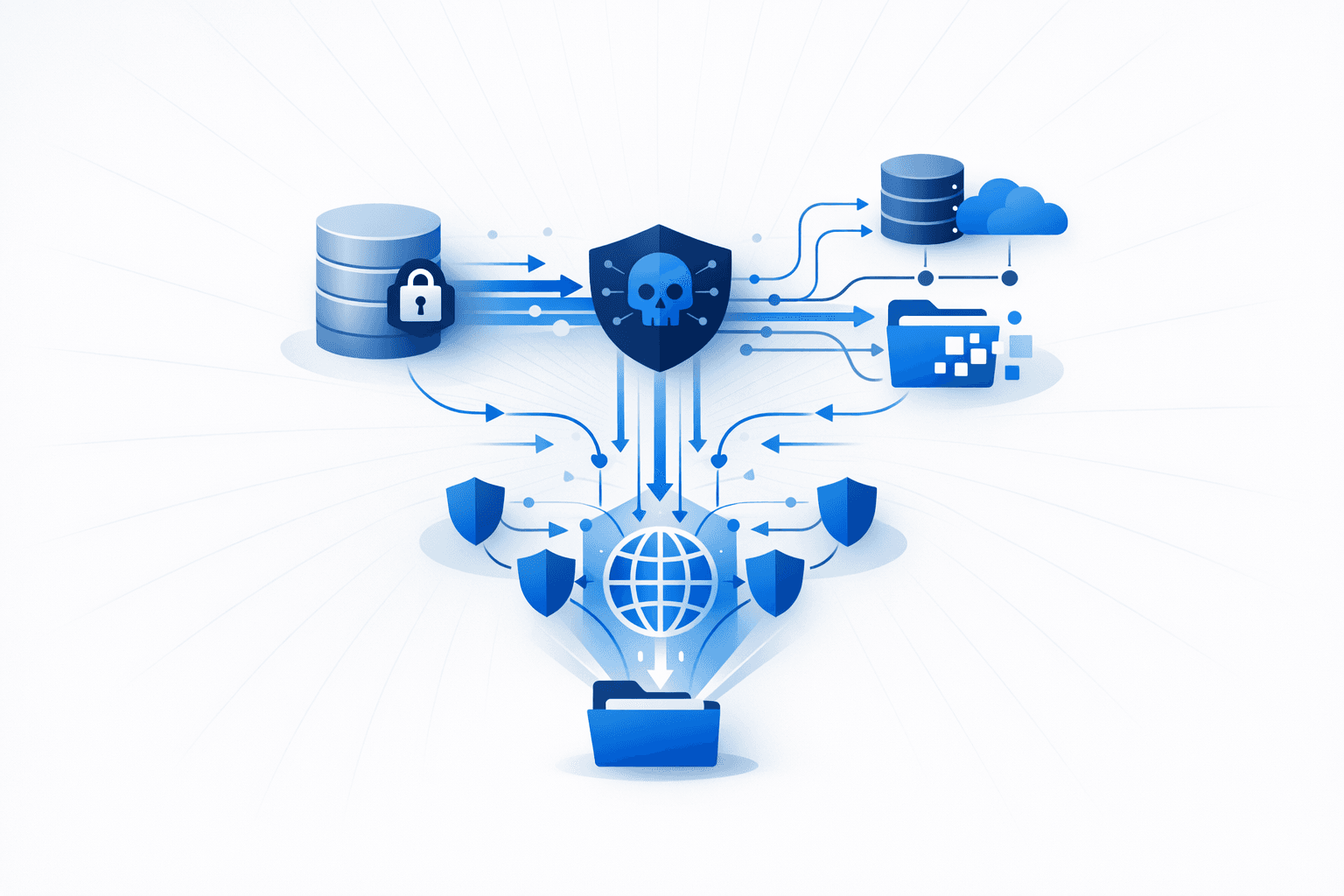
A reported operational security failure by the **INC ransomware** group enabled incident responders to identify attacker infrastructure and recover data stolen from **12 U.S. organizations**. A forensic review of artifacts from an intrusion—initially detected when ransomware encryption activity hit a production **SQL Server**—revealed infrastructure that stored exfiltrated victim data beyond the single investigated case, allowing broader recovery efforts. Cyber Centaurs (DFIR) traced the intrusion to a *RainINC* ransomware variant staged and executed from the Windows `PerfLogs` directory, a location increasingly abused by threat actors for staging. Investigators found renamed binaries (e.g., `winupdate.exe`) and PowerShell tooling, including a script (`new.ps1`) containing Base64-encoded *Restic* commands and hardcoded environment variables (e.g., access keys, repository paths, and S3 passwords) tied to encrypted repositories; although *Restic* was not used in the specific attack, these remnants shifted the work from incident response to infrastructure analysis and ultimately exposed reusable attacker storage repositories linked to multiple victims.
Jun 29, 2026
INC ransomware has grown into one of the most active **ransomware-as-a-service** operations, with researchers attributing its rise to aggressive affiliate expansion, broad victim targeting, and effective use of established intrusion methods rather than novel exploits. The group, active since 2023 and linked to more than **800 claimed victims**, uses **double extortion** by encrypting systems and threatening to leak stolen data, with early concentration on healthcare and other high-pressure sectors now expanding into education, legal, manufacturing, construction, and technology organizations. Researchers said INC has upgraded both its **Windows** and **Linux/ESXi** encryptors by rewriting them in **Rust**, improving cross-platform operations and resilience while affiliates continue to rely on spearphishing, stolen credentials, and exploitation of known flaws including **Citrix Bleed 2**, **Citrix NetScaler**, **SimpleHelp RMM**, and **Fortinet EMS** vulnerabilities. Post-compromise activity has included abuse of legitimate remote administration tools, credential theft from **Veeam** environments, living-off-the-land lateral movement, use of EDR killers, and cloud-based exfiltration with tools such as **rclone**; analysts also linked INC code to related strains including **Lynx**, **Sinobi**, and **Knoba** after the group’s source code was reportedly sold to multiple parties.
Jul 23, 2026
Australia’s Cyber Security Centre, CERT Tonga, and New Zealand’s National Cyber Security Centre issued a joint advisory warning that **INC Ransom’s ransomware-as-a-service affiliate model** is enabling attacks on critical networks, particularly healthcare. The group, active since mid-2023 and also tracked as Tarnished Scorpion and GOLD IONIC, steals data and encrypts systems before threatening publication on a Tor-based leak site. ACSC handled 11 related incidents in Australia between July 2024 and December 2025; the advisory also details a disruptive attack on Tonga’s Ministry of Health in June 2025 and a New Zealand health-sector incident in May 2025 that resulted in leaked data. More than 200 alleged victims appeared on INC’s leak site by mid-2025, according to accompanying reporting, which also identified healthcare and government targets beyond the region. Affiliates typically obtain access through spear-phishing, unpatched internet-facing systems, or compromised credentials, including credentials purchased through initial access brokers. They then escalate privileges, move laterally, and exfiltrate data using common tools before deploying ransomware. The advisory maps observed activity to MITRE ATT&CK and urges organizations to **prioritize vulnerability remediation, phishing-resistant MFA, hardened remote access, and privileged access controls**. Tested backups, network segmentation and traffic restrictions, limits on remote management tools, and centralized logging are key measures to reduce disruption and detect abuse. Reporting also highlights affiliate movement between ransomware brands and links between INC and Lynx ransomware, reinforcing the need to track attacker behaviors rather than rely solely on group names.
Oct 11, 2026