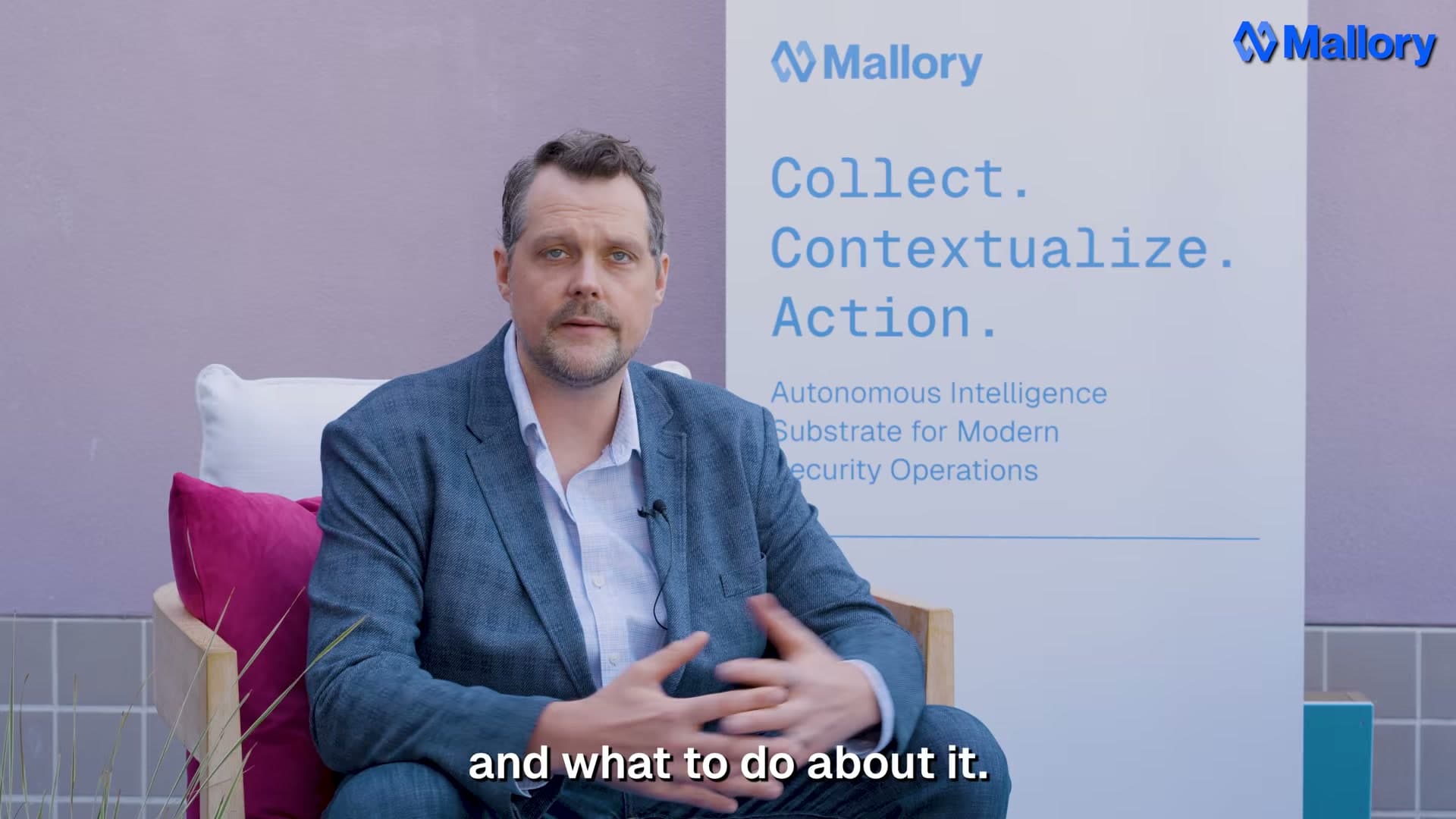

I've joined Mallory as Founding Marketing Lead. I've built marketing functions at scale and from zero. Both are demanding in different ways. I've been sprinting since week one here, which tells you something: building a function inside a company that's still defining its category, at the exact moment AI is rewriting how security teams operate, is the harder version of the job. It's also the version worth doing.
A team I trust
I trust this team, and not the version of "trust" you write for an about page. I've worked with a lot of these engineers before, on other teams, under real deadlines. They're top notch. Mallory's bench comes out of the places that shaped how the industry thinks about threat intelligence and exposure in the first place: Google, Mandiant, Kenna Security, and more. This team has already lived the problem it's building the answer to.
They're also, and this matters more than people give it credit for, extremely kind, and they have the drive to work at the pace this category needs right now. Talented and fast is common. Talented, fast, and decent to work with is not.
That depth is why Mallory was built AI-native from the outset, rather than retrofitted onto an older architecture. The team understood early where the category was headed, not just where it had been.
Exposure management means something different now
Here's my read on the category, and part of why I took this job.
I've been following this category since the beginning, and I can see where AI has the potential to take it. The large platform players and the hyperscalers caught on too. Their messaging adapted fast. Their product didn't. They bolted capabilities onto architectures that were never built to hold them, and called it exposure management anyway.
AI has expanded what adversaries can target, and how fast. The market is responding accordingly: capital and product expectations are shifting toward platforms that unify live adversary activity with an organization's actual attack surface and turn that into prioritized, routed action, not platforms that hand a team another report or another dashboard to check.
Mallory was built for this moment, not retrofitted for it
Mallory wasn't assembled through acquisition to check category boxes after the fact. It was designed to sit upstream: correlating live adversary activity against your attack surface through the Intelligence Graph, with the Mallory Agent doing the reasoning work an analyst would otherwise spend hours on, then routing prioritized work into the tools a team already runs. That's a materially different starting point than the one the rest of the category is now retrofitting toward.
The bigger opportunity is the one AI opens up for the builders: the security teams and vendors who recognize this moment for what it is, a chance to re-envision the security stack rather than patch the old one. That future looks like an agentic harness that operates with real security expertise and context baked in, not a chatbot bolted onto a dashboard. Mallory's job is to be the threat intelligence and exposure expertise underneath that harness, the foundational context layer the next generation of security architecture gets built on.
This team is actually AI-native, marketing included. Everything we do runs on that same agentic harness. Small tangent, because I can't help myself: the marketing program here operates like an engineering org, not a department bolted onto one. We scope campaigns in Linear tickets. Work ships in increments, gets tracked, gets revisited. Nobody's waiting on a quarterly plan to find out if something worked.
Built for any team, any stack
Mallory works with nearly any tech stack. That's not a talking point, it's the architecture: built to integrate rather than dictate, so it flexes to how a team actually runs instead of forcing a workflow onto them. It's designed for threat-led SOC, Exposure Management, and CTI teams specifically, and even knowing that, I've been surprised by the range of team structures and sizes we're already working with.
A resource-constrained three-person security team and a well-funded enterprise SOC shouldn't need two different vendors to get adversary-anchored prioritization. Neither should a team running a modern, cloud-native security architecture, or a managed service provider securing exposure across a dozen clients at once. That's the versatility that turns Mallory into the platform a team keeps rather than replaces in eighteen months.
Building the function
There's no universal playbook for building a marketing function, and there wasn't one at my last company either. The mandate here is to move quickly and bring structure to a function that doesn't have any yet: define what a campaign means inside this organization, align sales and marketing on shared definitions from day one, and set expectations early for how the function will need to grow as the company does.
Three things sit at the center of that mandate. The first is brand awareness in a category most buyers still can't define cleanly, which means the work starts with a clear, consistent point of view on what an intelligent security organization looks like, not only what Mallory sells. The second is demand generation that reflects how security teams actually evaluate vendors now: fewer gated forms and generic outbound, more proof, more product in front of the right practitioner earlier in the process. The third, and the one that ties the other two together, is proving out fit in the new segments we're expanding into. That's not a task marketing owns alone, but it's one marketing has to instrument and report on honestly, because a function that can't tell the difference between pipeline and noise isn't earning its seat at the table.
Why this bet
I trust the team because they've already lived the problem Mallory is solving, across the companies that shaped this category in the first place. I trust the category thesis because I spent two years watching the rest of the market patch this problem together after the fact, and I can see exactly where they're still catching up to what Mallory already built. And I trust the mandate itself: there's no more consequential marketing problem right now than defining a category correctly, from inside a platform built for where that category is headed rather than where it's been.
Mallory isn't retrofitting its way to this moment. It built for it from day one, product and marketing both, and that's the bet I'm sprinting on.
-Alexa
Build an intelligent security organization
See what a platform that was never bolted together looks like for your stack.
Start Free Trial