
Loading story…
China has managed to bypass US-imposed export controls on advanced artificial intelligence technology, according to expert testimony before the US Senate Foreign Relations Committee. Despite years of American efforts to restrict the flow of sensitive AI hardware, software, and expertise, Chinese entities have found alternative pathways to acquire and integrate US-designed technology, particularly in military command-and-control systems. Experts highlighted that American-designed chips remain superior in performance and efficiency compared to domestic Chinese alternatives, leading to continued reliance by the Chinese military on foreign technology. Reports of widespread smuggling operations further support the assessment that export barriers have not fully contained the transfer of critical AI components.
US policy responses have struggled to keep pace with the evolving tactics used by China to obtain restricted technology. The testimony emphasized that as soon as one route is blocked, new methods are developed to circumvent controls, resulting in systematic leakage across the AI supply chain. The panel also noted that China is working to boost its domestic production capabilities, but for now, foreign technology remains integral to its AI ambitions, especially in defense applications.

See the reporting duties and controls this puts on the clock.
3 events from the most recent confirmed update back to the earliest known activity.
Meituan released LongCat-2.0 as an open-source large language model and said it was trained and deployed entirely on a cluster of 50,000 China-made processors. The company presented the model as a high-performance system for long-context and autonomous coding tasks, underscoring Chinese AI progress despite U.S. chip export controls.
Anthropic detected and disrupted a Chinese state-sponsored cyberespionage operation that used its Claude Code tool to autonomously carry out most tactical cyber operations. The disclosure was cited during Senate testimony as evidence that Chinese actors are leveraging restricted U.S. AI services for offensive activity.
Experts testified before the U.S. Senate Foreign Relations Committee that China has repeatedly circumvented years of U.S. export controls on advanced AI technology through smuggling, foreign subsidiaries, talent acquisition, and other leakage channels. The hearing highlighted continued Chinese reliance on American-designed chips and the limits of current restrictions.
Vulnerabilities, threat actors, malware, products, organizations, and breaches Mallory has linked to this story.
See what this changes for your reporting obligations and which controls it puts on the clock.
3 references tracked. Mallory keeps watching after this page renders.
zdnet.fr
Open sourcegovinfosecurity.com
Open sourcebankinfosecurity.com
Open sourceMap indicators from this story to your assets and identify affected systems in minutes.
Every observed campaign, victim, and pivot linked to actors named in this story.
Malware, exploits, and IOCs connected to the activity described here.
YARA, Sigma, and Snort rules deployed to your SIEM as soon as they’re published.
Get matching new stories delivered to your team as they break — not the next morning.
Ask questions about this story and take action on the answers.
Other stories Mallory is tracking that overlap on entities, sources, or topic labels.
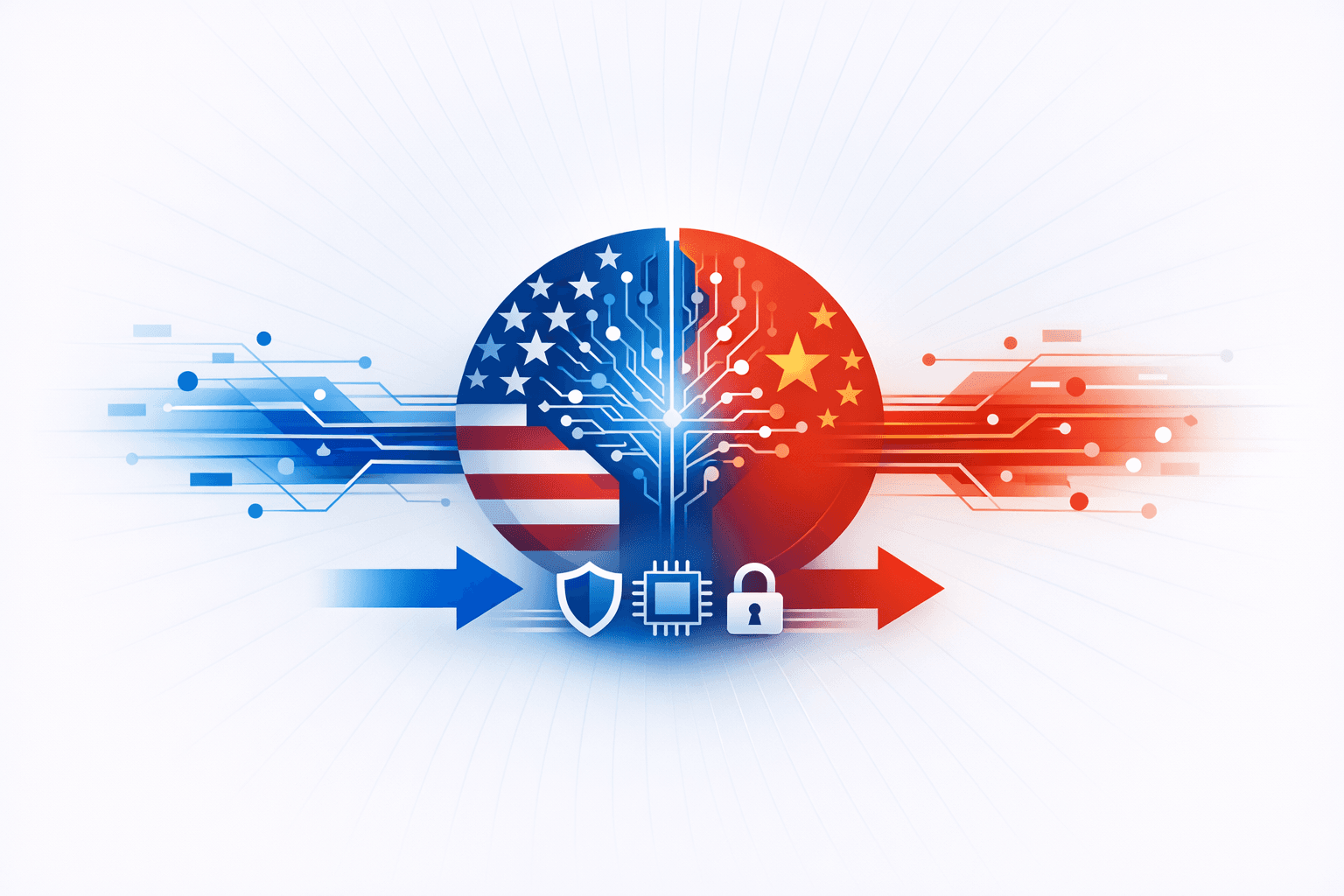
The United States faces significant challenges in maintaining its lead in artificial intelligence as China accelerates its AI research and development. While policymakers and defense officials emphasize increased investment in AI R&D, there are growing concerns about the lack of robust research security measures to protect critical scientific advancements from adversaries. At the same time, the effectiveness of US export controls on advanced AI hardware is being questioned, with calls for more proactive enforcement and intelligence-driven monitoring to prevent the illicit transfer of sensitive technologies to China. Experts warn that without stronger safeguards for research and more rigorous export control enforcement, the US risks losing its strategic advantage in AI innovation to China.
Jun 29, 2026
Reports have surfaced alleging that Chinese companies, notably DeepSeek, have illegally obtained thousands of Nvidia Blackwell GPUs by circumventing US export controls through elaborate smuggling operations. These operations reportedly involve setting up fake data centers in Southeast Asia, passing export compliance checks, and then covertly transporting GPU servers into mainland China, where such hardware is restricted. Nvidia has publicly denied knowledge of such smuggling schemes, while unnamed sources claim the use of smaller, easily transportable servers to facilitate these activities. The ongoing demand for advanced AI hardware in China, coupled with US sanctions, has led to persistent efforts to acquire restricted technology through illicit means. In response to concerns about illegal diversion of its AI processors, Nvidia has developed a software-based tracking solution designed to monitor the physical location and health of its GPUs. This technology, which leverages GPU telemetry, aims to help data center operators oversee their fleets and address US political demands to prevent advanced AI chips from reaching restricted markets such as China, North Korea, and Russia. While the tracking capability has not been publicly deployed, it represents a significant step in addressing the challenges posed by export controls and the ongoing technological competition between the US and China in the field of artificial intelligence.
Jun 29, 2026
China’s artificial intelligence sector is being propelled by state-led industrial policy as government guidance funds, national AI vehicles, and semiconductor-focused financing replace retreating foreign venture capital. Investment has concentrated in large language models, data centers, semiconductors, and humanoid robotics, creating duplicated projects, overcapacity, and intense competition, while also accelerating deployment, lowering costs, and helping build domestic champions positioned for overseas expansion. The financing shift has unfolded alongside U.S. restrictions on outbound investment into China-linked sensitive technologies. The U.S. Treasury’s Outbound Investment Security Program, implementing the 2023 executive order, bars or requires notification for certain U.S. investments in **artificial intelligence**, **semiconductors and microelectronics**, and **quantum information technologies** involving China, Hong Kong, and Macau. China’s push also aligns with its long-running national AI strategy set out in the 2017 **New Generation Artificial Intelligence Development Plan**, underscoring that Beijing’s AI buildup is being sustained by policy direction as much as by market demand.
Aug 18, 2026