
Loading story…
China’s artificial intelligence sector is being propelled by state-led industrial policy as government guidance funds, national AI vehicles, and semiconductor-focused financing replace retreating foreign venture capital. Investment has concentrated in large language models, data centers, semiconductors, and humanoid robotics, creating duplicated projects, overcapacity, and intense competition, while also accelerating deployment, lowering costs, and helping build domestic champions positioned for overseas expansion.
The financing shift has unfolded alongside U.S. restrictions on outbound investment into China-linked sensitive technologies. The U.S. Treasury’s Outbound Investment Security Program, implementing the 2023 executive order, bars or requires notification for certain U.S. investments in artificial intelligence, semiconductors and microelectronics, and quantum information technologies involving China, Hong Kong, and Macau. China’s push also aligns with its long-running national AI strategy set out in the 2017 New Generation Artificial Intelligence Development Plan, underscoring that Beijing’s AI buildup is being sustained by policy direction as much as by market demand.
See the reporting duties and controls this puts on the clock.
18 events from the most recent confirmed update back to the earliest known activity.
The U.S. Treasury Department published a notice on January 17, 2025 adjusting the maximum civil monetary penalty under the outbound investment rules. The notice updated enforcement-related penalty levels for the program.
The U.S. outbound investment security program took effect on January 2, 2025. The rules implemented restrictions and notification requirements for certain U.S. investments involving Chinese AI, semiconductor, and quantum sectors.
In the first nine months of 2025, Chinese embodied-intelligence startups attracted 610 funding rounds worth roughly 50 billion yuan. The surge followed the November 2023 humanoid robotics guidelines.
Less than a year after the January 2025 AI fund, the National Development and Reform Commission and Ministry of Finance launched another 100 billion yuan national venture capital guidance fund. The vehicle created three regional sub-funds in the Beijing-Tianjin-Hebei region, the Yangtze River Delta, and the Greater Bay Area.
By early 2025, dollar-denominated funds accounted for barely 1% of China's venture capital fundraising, down from nearly 14% in 2021. The shift underscored the collapse of foreign-currency fundraising in the market.
In January 2025, China's Ministry of Industry and Information Technology and Ministry of Finance established a 60 billion yuan National AI Industry Investment Fund. The fund targeted early-stage ventures across the AI supply chain, including compute, data, embodied intelligence, and autonomous vehicles.
On October 28, 2024, the U.S. Treasury Department issued the final rule implementing the August 2023 outbound investment executive order. The rule formalized the program's restrictions and notification requirements.
China renewed the Big Fund again in 2024 with 344 billion yuan to expand chip and AI-related production. The move reinforced state-led financing for strategic technology sectors.
By 2024, venture capital fundraising in China had dropped to its lowest level in almost a decade. During the same period, state-owned capital accounted for 82% of all new limited partner contributions in Chinese venture capital.
China's Ministry of Industry and Information Technology issued humanoid robotics guidelines in November 2023. The guidance helped spur a later surge of investment into embodied-intelligence startups.
On August 9, 2023, President Biden signed an executive order directing Treasury to prohibit or require notification for certain U.S. investments in Chinese AI, semiconductor, and quantum-related entities. The order declared a national emergency tied to national security risks from countries of concern.
By mid-2023, China had at least 130 large language models, representing roughly 40% of the global total. The figure illustrated rapid concentration of investment into the LLM segment.
The share of Chinese venture capital deal value involving foreign investors fell from 54.8% in 2018 to about 20% in 2023. The decline reflected the retreat of foreign capital from China's technology sector.
Chinese regulators opened a cybersecurity probe into DiDi during its New York IPO process, removed its apps from app stores, and forced the company to delist. The action further reduced the appeal of U.S. listings for Chinese firms.
Beijing's 2021 tech crackdown began with a record 18.2 billion yuan antitrust fine against Alibaba and later expanded to other major internet firms including Tencent and Meituan. The campaign weakened confidence in China's private tech sector.
China renewed the National Integrated Circuit Industry Investment Fund, or 'Big Fund,' with 204 billion yuan to continue backing semiconductor production. The fund had previously supported firms including SMIC, YMTC, NAURA, and Piotech.
China introduced asset management rules that restricted wealth-management structures that had been an important source of domestic private funding. The change contributed to tighter financing conditions for Chinese startups and investors.
China released its 'New Generation Artificial Intelligence Development Plan,' establishing AI as a national strategic priority. The plan is cited as an early anchor for Beijing's state-backed promotion of the AI sector.
Vulnerabilities, threat actors, malware, products, organizations, and breaches Mallory has linked to this story.
See what this changes for your reporting obligations and which controls it puts on the clock.
3 references tracked. Mallory keeps watching after this page renders.
chinatalk.media
Open sourcehome.treasury.gov
Open sourcedigichina.stanford.edu
Open sourceMap indicators from this story to your assets and identify affected systems in minutes.
Every observed campaign, victim, and pivot linked to actors named in this story.
Malware, exploits, and IOCs connected to the activity described here.
YARA, Sigma, and Snort rules deployed to your SIEM as soon as they’re published.
Get matching new stories delivered to your team as they break — not the next morning.
Ask questions about this story and take action on the answers.
Other stories Mallory is tracking that overlap on entities, sources, or topic labels.
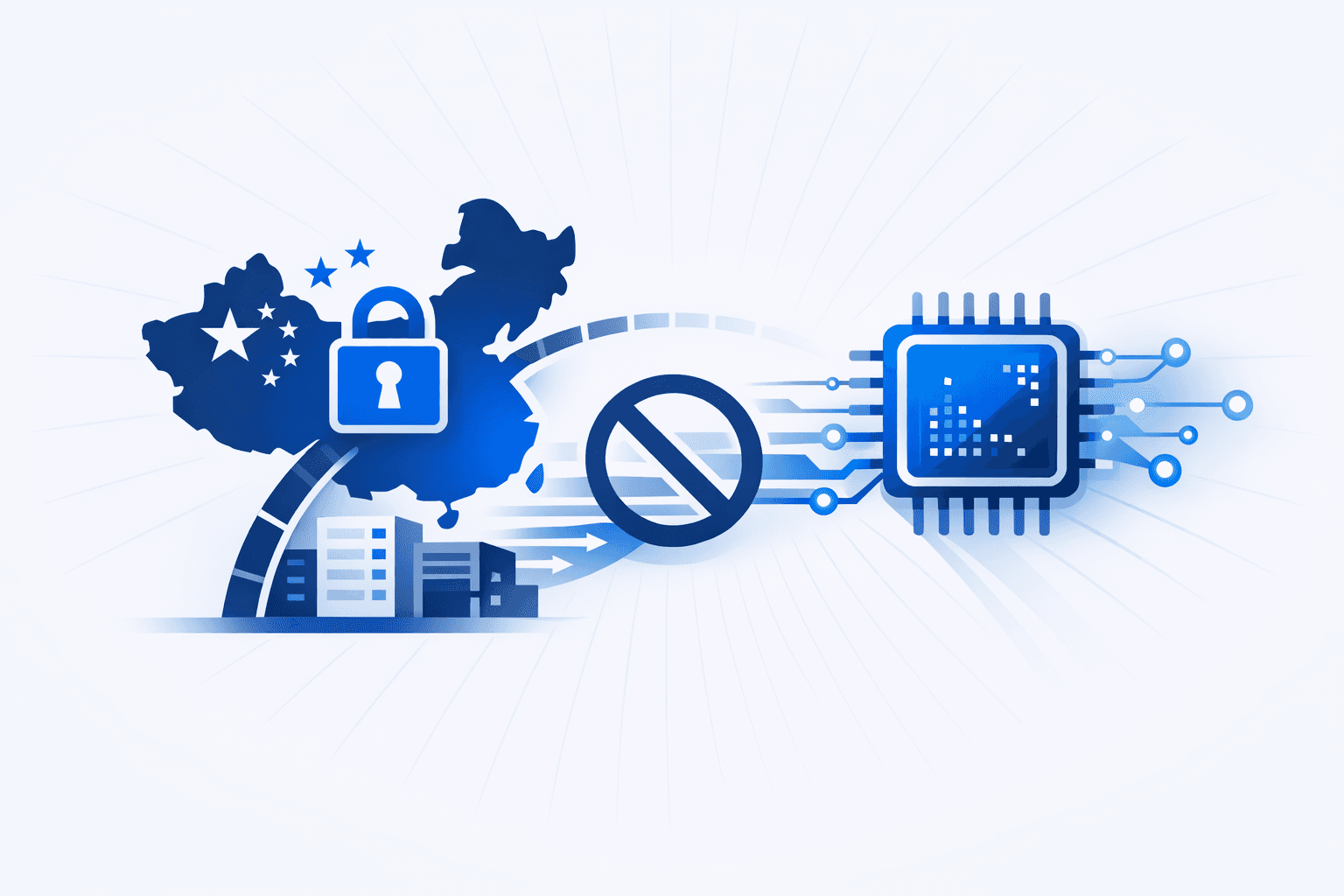
China has implemented a comprehensive ban on the use of foreign AI chips, including those from Nvidia, AMD, and Intel, in any data center projects funded by the government. The directive, which reportedly applies retroactively to projects still in early stages, requires the removal or replacement of foreign accelerators even if they have already been installed. Chinese regulators have instructed that only domestically produced silicon, such as chips from Huawei, Cambricon, and Enflame, may be used in these environments. This move marks a significant escalation from previous policies that merely discouraged foreign chip purchases, and it effectively eliminates the prospects for foreign chipmakers in China's state-backed AI infrastructure. To support this transition and further reduce reliance on foreign technology, local Chinese governments are offering substantial power incentives and subsidies to domestic tech companies like ByteDance, Alibaba, and Tencent. These measures are designed to offset the higher energy costs and lower efficiency of Chinese-made AI chips compared to leading foreign alternatives, particularly Nvidia GPUs. Despite the technological gap, China is accelerating the development and deployment of homegrown AI hardware, with the government leveraging both regulatory and economic tools to promote domestic innovation and self-sufficiency in the semiconductor sector.
Jul 12, 2026
Reporting and commentary highlighted intensifying **U.S.–China competition in AI** driven less by capital and more by access to advanced compute and the ability to shape global AI governance. In China, a wave of Hong Kong IPOs raising **more than $1B** for domestic AI firms was framed as a confidence signal, but industry leaders warned that funding alone cannot close the gap with leading Western labs; Alibaba *Qwen* leadership reportedly assessed China’s odds of “leapfrogging” **OpenAI** and **Anthropic** via fundamental breakthroughs as **below 20%**, citing structural constraints such as compute availability and ecosystem maturity. Separately, policy analysis argued China is expanding international influence through **AI capacity-building diplomacy**, including a **UN General Assembly resolution** on AI capacity-building (co-sponsored by 140+ countries) and initiatives like training workshops, governance action plans, and infrastructure support aimed at the Global South—while warning the U.S. risks ceding agenda-setting power if it cannot sustain consistent engagement. A third piece captured **Nvidia CEO Jensen Huang** publicly pushing back on “doomer” narratives and the idea of imminent “god AI,” emphasizing current systems’ limits; while not a cybersecurity incident, it reinforces the broader theme that near-term AI outcomes are constrained by practical factors (capability limits and compute), not hype alone.
Jun 29, 2026
China reportedly began approving imports of high-end *Nvidia* AI GPUs (including the **H200**) after weeks of uncertainty, with initial licenses expected to prioritize major Chinese internet companies building large AI data centers. Reporting cited by Reuters and the *South China Morning Post* indicates Beijing is attaching restrictive, not-yet-finalized conditions to these licenses—potentially including requirements to bundle purchases with domestic chips—reflecting an effort to balance near-term demand for leading accelerators with longer-term goals of strengthening China’s indigenous semiconductor ecosystem. In parallel, Chinese leader **Xi Jinping** publicly framed AI as an “epoch-making” technological transformation and called for faster progress in domestic development via a “whole-of-nation” approach, positioning AI as central to China’s upcoming 15th Five-Year Plan (through 2030). While not a discrete cybersecurity incident, the combined reporting is relevant to security leaders because it signals continued geopolitical pressure on AI supply chains and potential compliance, procurement, and third-party risk impacts for organizations operating in or selling into China’s AI infrastructure market.
Jun 29, 2026