
Loading story…
Security researchers have identified sophisticated supply chain attacks leveraging typosquatting on popular open source package repositories. In one campaign, a malicious NPM package named polymarket-clob@1.3.1 was discovered targeting cryptocurrency traders by impersonating a legitimate Polymarket Central Limit Order Book (CLOB) library. Upon installation, the package exfiltrates sensitive wallet files, private keys, and environment secrets to an attacker-controlled server, exploiting the trust in open source dependencies within the crypto ecosystem. The package's metadata was crafted to appear credible, with fabricated author details and a plausible description, making it difficult for users to distinguish from legitimate software.
Separately, a novel malware was found on Maven Central, masquerading as a Jackson JSON library extension through a subtle namespace typosquatting attack (org.fasterxml.jackson.core instead of the legitimate com.fasterxml.jackson.core). This malware employed multi-stage payloads, encrypted configurations, and platform-specific executables, demonstrating a high level of sophistication and obfuscation. The attackers also registered a lookalike domain (fasterxml.org) to further deceive users. The malicious package was quickly reported and removed, but the incident highlights the growing threat of supply chain attacks in less-targeted ecosystems like Maven Central, as attackers adapt to increased defenses in other repositories.

Trace attribution and downstream blast radius.
5 events from the most recent confirmed update back to the earliest known activity.
Analysis found code lineage between polymarket-clob and earlier malicious packages including sha256-validator-pro and sha256-validator-pack, showing iterative improvements in credential harvesting. Researchers said attribution remained unclear despite clues such as a Russian email domain in the package metadata.
Researchers discovered polymarket-clob@1.3.1, a malicious npm package masquerading as a legitimate Polymarket CLOB library to target cryptocurrency traders. When installed and imported, it searched for wallet files, private keys, and environment secrets and exfiltrated them to 178.17.62.101:5018.
After discovery, the malicious Maven Central package was quickly removed from the repository and the associated typosquatted domain was reported to GoDaddy. The incident prompted calls for stronger namespace and prefix-similarity protections in Maven Central.
Researchers determined the Maven Central package used typosquatted domains including fasterxml.org and m.fasterxml.org, contacted C2 infrastructure, and downloaded a platform-specific payload identified as a Cobalt Strike beacon. The analysis also surfaced IOCs including IP address 103.127.243.82 and payload hashes, indicating a relatively sophisticated operator.
A threat actor published a malicious Java package on Maven Central that impersonated the Jackson library by using the typosquatted namespace org.fasterxml.jackson.core instead of the legitimate com.fasterxml.jackson.core. The package was designed as a multi-stage trojan downloader and RAT loader targeting Java and Spring Boot environments.
Vulnerabilities, threat actors, malware, products, organizations, breaches, and observables Mallory has linked to this story. Indicator values are masked here and available in full in the app.
Indicator values are masked on this page. View all 18 in Mallory Domains, IPs, hashes, and URLs are exportable to your SIEM.
See attribution and downstream blast radius, and whether this package or vendor reaches your builds.
3 references tracked. Mallory keeps watching after this page renders.
securityonline.info
Open sourcegetsafety.com
Open sourceaikido.dev
Open sourceMap indicators from this story to your assets and identify affected systems in minutes.
Every observed campaign, victim, and pivot linked to actors named in this story.
Malware, exploits, and IOCs connected to the activity described here.
YARA, Sigma, and Snort rules deployed to your SIEM as soon as they’re published.
Get matching new stories delivered to your team as they break — not the next morning.
Ask questions about this story and take action on the answers.
Other stories Mallory is tracking that overlap on entities, sources, or topic labels.
Multiple malicious npm packages have been discovered targeting developers by employing advanced obfuscation techniques and typosquatting to mimic popular legitimate packages such as *TypeScript*, *discord.js*, *ethers.js*, *nodemon*, and *Claude Code*. Security researchers revealed that these packages use up to four layers of obfuscation—including eval wrapping, XOR encryption, URL encoding, and control flow manipulation—to evade static analysis and conceal credential-stealing malware. The attack chain often begins with deceptive tactics, such as displaying fake CAPTCHAs, and proceeds to exfiltrate sensitive information like IP addresses and credentials to attacker-controlled servers. In one notable case, a package impersonating the official Anthropic CLI was found to proxy commands and data back to the threat actor, enabling both credential theft and remote command execution. These incidents highlight the persistent risks posed by weak validation and oversight in the npm ecosystem, allowing threat actors to publish lookalike packages that are difficult to distinguish from legitimate ones. The sophisticated payloads not only target local developer environments but can also compromise CI/CD pipelines, amplifying the potential impact. Security experts emphasize the need for improved package metadata validation and greater vigilance among developers to mitigate the risk of supply chain attacks through open-source dependencies.
Jun 29, 2026
Security researchers reported multiple **software supply chain** threats targeting developers via public package ecosystems. Tenable analyzed a malicious npm package, **`ambar-src`**, that reached roughly **50,000 downloads** in days before removal; it executed during installation via **malicious `preinstall` behavior**, used evasion techniques, and dropped OS-specific payloads for Windows, Linux, and macOS, with typosquatting assessed as the likely lure (mimicking *`ember-source`*). Separate reporting described a campaign using **malicious NuGet packages** (e.g., **NCryptYo**, **DOMOAuth2_**, **IRAOAuth2.0**, **SimpleWriter_**) that impersonated legitimate .NET libraries, executed code on assembly load, and established local proxying/backdoor behavior to facilitate credential theft and persistence in ASP.NET environments. Additional coverage warned of an npm “worm-like” propagation pattern impacting **CI pipelines and AI coding tools**, reinforcing that developer tooling and build systems are high-risk choke points where a single poisoned dependency can spread quickly across environments. While the broader set of articles also included unrelated breach, ransomware, and policy items, the developer-focused supply chain reporting consistently emphasized that **installation-time execution** and **typosquatting/impersonation** enable compromise even when developers never directly call the malicious code, and that traditional detection can lag (e.g., low initial antivirus detection rates for obfuscated .NET payloads).
Jun 29, 2026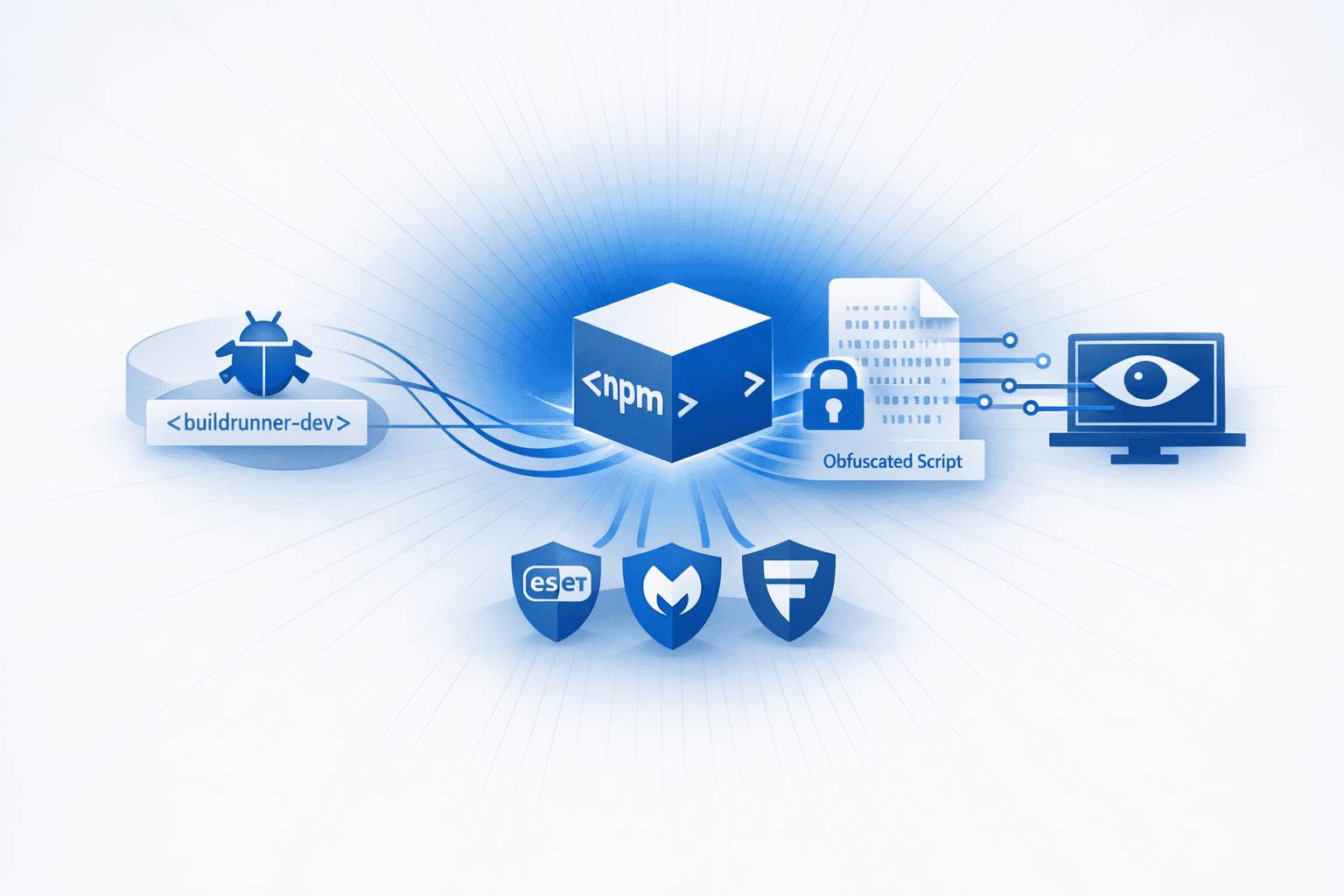
Threat researchers reported an **npm supply-chain attack** in which a typosquatted package (`buildrunner-dev`) delivered **Pulsar RAT** via a multi-stage Windows infection chain. The package executed a script that fetched a large, heavily obfuscated batch file (`packageloader.bat`) containing mostly “noise” to evade static detection, performed security-product checks (including **ESET**, **Malwarebytes**, and **F-Secure**), established persistence by copying itself as `protect.bat` into a hidden folder, and attempted privilege escalation/UAC bypass using `fodhelper.exe`. Separate supply-chain reporting highlighted how package-name deception is evolving beyond human typos into **“slopsquatting”** (AI/hallucination squatting), where attackers register package names that LLMs commonly invent and then rely on developers installing them on AI recommendation. Documented tradecraft includes malicious `postinstall` scripts to exfiltrate secrets from developer environments (API keys, cloud tokens, npm auth tokens) and the use of URL-based dependencies to fetch external payloads at install time, allowing the published package to appear benign to naive scanners.
Jun 29, 2026