
Loading story…
Researchers reported a new Android click-fraud trojan family that uses TensorFlow.js machine-learning models to visually identify and tap ad elements inside a hidden WebView (“phantom” mode), rather than relying on brittle DOM/JavaScript click routines. The malware was observed distributed via Xiaomi’s GetApps store, reportedly seeded into game apps that initially appear benign and later receive malicious components via updates; a second “signalling” mode uses WebRTC to stream the virtual browser view to attackers for real-time interaction (taps, scrolling, text entry), increasing resilience against dynamic ad formats (iframes/video) and enabling more human-like fraud behavior.
Separately, Huntress described a malicious Chrome ad-blocker extension (NexShield) promoted via a Google Ad and masquerading as associated with the uBlock Origin developer, which clones uBlock Origin Lite functionality but adds a delayed payload using Chrome’s Alarms API. The extension intentionally crashes the browser (resource exhaustion via repeated makeBatch() calls and port creation) and then uses a ClickFix variant (“CrashFix”) popup to socially engineer users into running Windows terminal commands, ultimately delivering a new Python RAT attributed to KongTuke. A third item—Group-IB commentary on AI “industrializing” cybercrime (deepfake identity kits, “dark LLMs,” and agentic phishing)—provides broader context on AI-enabled criminal scaling but does not describe the same specific malware incidents.

Trace attribution and downstream blast radius.
3 events from the most recent confirmed update back to the earliest known activity.
Researchers revealed that the Android trojans use TensorFlow and TensorFlow.js in hidden WebViews to visually identify ad elements, click them in a stealthy 'phantom' mode, and in some cases stream the virtual browser view to attackers over WebRTC for live remote interaction.
Huntress reported that a malicious Chrome ad blocker extension named NexShield was promoted through a Google ad while impersonating uBlock Origin's developer. The extension cloned legitimate functionality but intentionally crashed the browser to trigger a social-engineering popup that led victims to run commands, ultimately delivering the Python backdoor ModeloRAT attributed to KongTuke on domain-joined systems.
Dr.Web reported a new Android malware family spread through Xiaomi's official GetApps store via seemingly benign games that later received malicious updates, as well as through third-party APK sites, Telegram channels, Discord, and trojanized modded apps such as fake Spotify and Netflix variants.
Vulnerabilities, threat actors, malware, products, organizations, and breaches Mallory has linked to this story.
See attribution and downstream blast radius, and whether this package or vendor reaches your builds.
3 references tracked. Mallory keeps watching after this page renders.
scworld.com
Open sourcebleepingcomputer.com
Open sourcescworld.com
Open sourceMap indicators from this story to your assets and identify affected systems in minutes.
Every observed campaign, victim, and pivot linked to actors named in this story.
Malware, exploits, and IOCs connected to the activity described here.
YARA, Sigma, and Snort rules deployed to your SIEM as soon as they’re published.
Get matching new stories delivered to your team as they break — not the next morning.
Ask questions about this story and take action on the answers.
Other stories Mallory is tracking that overlap on entities, sources, or topic labels.
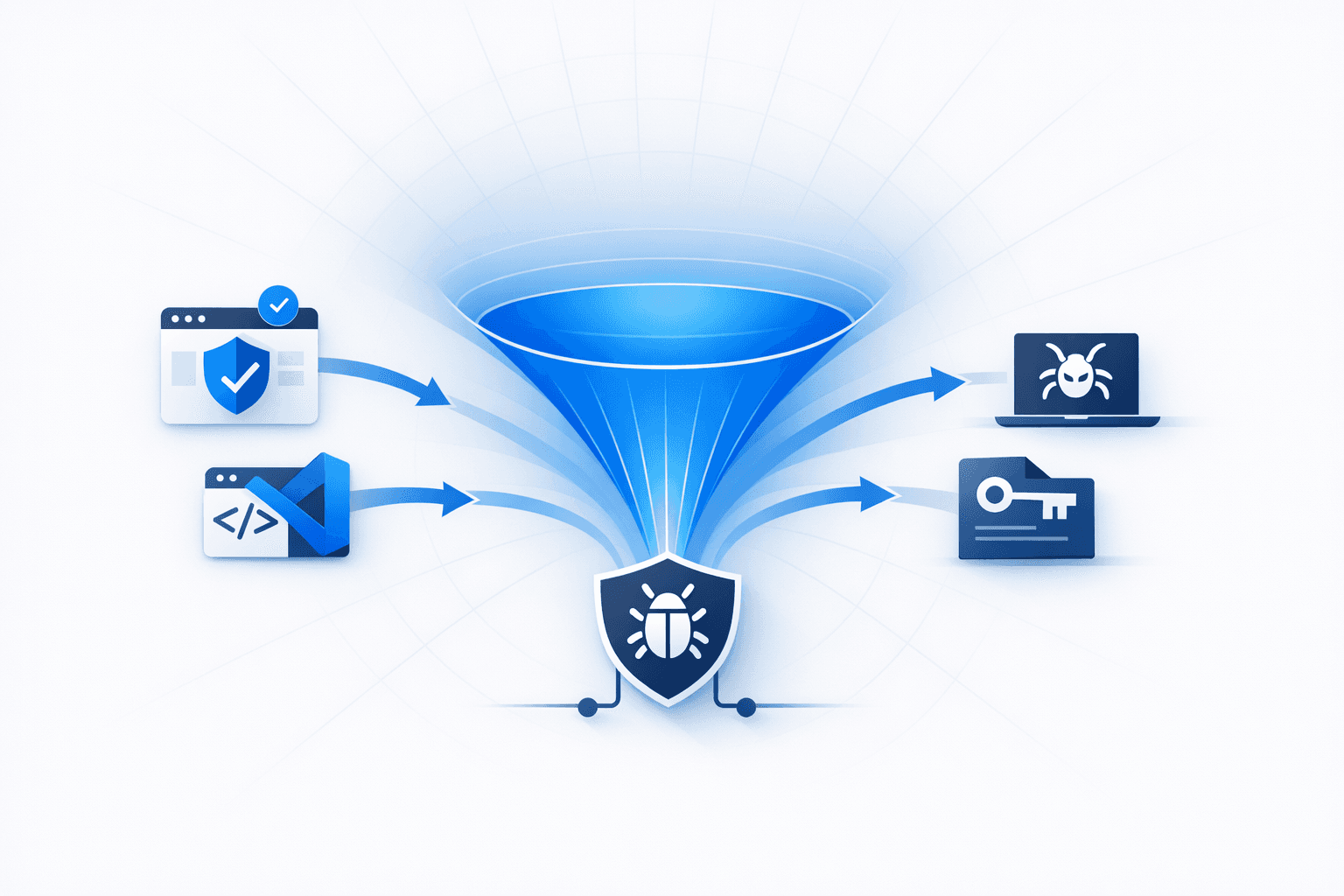
Multiple active malware campaigns are abusing *trusted distribution channels*—including Chrome/Edge extensions, Visual Studio Code extensions, and Google Ads/redirection infrastructure—to trick users into executing payloads that deliver **remote access trojans (RATs)** or **information stealers**. Huntress reported a malvertising-driven fake ad blocker extension, **NexShield**, that intentionally forces Chrome/Edge into a crash/DoS state by looping `chrome.runtime` port connections; on restart it displays a fake “security warning” and uses a **ClickFix-style** social engineering flow (“CrashFix”) to push users to paste and run clipboard-copied commands that trigger an obfuscated PowerShell download-and-execute chain, ultimately deploying the Python-based **ModeloRAT** in corporate environments. Separately, Trend Micro described **Evelyn Stealer** delivered via a trojanized **Visual Studio Code extension** that drops a malicious `Lightshot.dll` side-loaded by legitimate *Lightshot* (`Lightshot.exe`), then runs staged PowerShell and payload retrieval to steal browser credentials, cookies, crypto wallets, VPN/Wi‑Fi data, files, and screenshots before exfiltrating to an attacker-controlled FTP server—posing elevated risk when developer workstations are compromised. South Korea-focused activity also features prominently across several reports, with multiple delivery vectors leading to RAT deployment. ASEC documented **Remcos RAT** distributed via fake installers masquerading as *VeraCrypt* and via gambling-related “lookup” tools, using multi-stage obfuscated **VBS/PowerShell** chains and enabling credential theft, keylogging, and device surveillance (webcam/mic). Genians attributed “**Operation Poseidon**” to the **Konni APT**, describing spear-phishing that abuses Google’s advertising/tracking redirection (e.g., `ad.doubleclick.net` parameters) to make malicious links appear legitimate, redirecting victims to compromised WordPress infrastructure hosting ZIPs with LNK files that launch AutoIt-based loaders to run an **EndRAT** variant in memory. Nextron Systems reported widespread trojanized “free converter” apps promoted via malicious Google ads and lookalike converter sites (e.g., `ez2convertapp[.]com`, `convertyfileapp[.]com`), with some payloads signed using abused/rotating code-signing certificates (e.g., BLUE TAKIN LTD, TAU CENTAURI LTD, SPARROW TIDE LTD) to evade trust checks while installing persistent backdoors.
Jun 29, 2026
Security researchers reported multiple **malicious browser-extension** campaigns abusing official extension stores and search-driven lures to compromise enterprise users. Huntress documented a Chrome Web Store extension, **“NexShield – Advanced Web Guardian”** (a near-clone of *uBlock Origin Lite*), distributed via search/advertising redirection and designed to intentionally “freeze” the browser and present a fake **CrashFix** security prompt that instructs users to paste and run commands via `Win + R`; this social-engineering step results in installation of a previously undocumented Windows RAT dubbed **ModeloRAT** on domain-joined endpoints. Reporting also tied the delivery to a traffic distribution system (**KongTuke**, also tracked as **404 TDS/TAG-124** and other aliases) used to profile victims and route them to payload delivery infrastructure that has been leveraged by other criminal operations, including ransomware affiliates. Separately, Socket.dev analysis described **five coordinated Chrome extensions** targeting enterprise SaaS platforms (**Workday, NetSuite, SuccessFactors**) to enable account takeover via **session hijacking**, including continuous token theft and **bidirectional cookie injection** that can bypass MFA by replaying stolen session cookies. In parallel, Malwarebytes reported “sleeper” extension campaigns attributed to **DarkSpectre** (including **GhostPoster** and **ShadyPanda**) that turned previously benign extensions malicious after updates and used **steganography** (JavaScript hidden in extension images) to evade detection across **Edge, Chrome, and Firefox**, with large download counts and long dwell time. A separate Nextron Systems report described a related distribution pattern—malicious “free converter” apps promoted via **malicious Google ads** and made to look legitimate with **code-signing certificates**—highlighting the broader trend of search/advertising-driven initial access leading to persistent RAT deployment, though it is not the same extension-specific incident as the NexShield/CrashFix chain.
Jun 29, 2026
Multiple reports highlighted **ClickFix**, a social-engineering technique that uses fake verification or update prompts to coerce users into manually executing attacker-supplied commands, as a recurring initial access method in recent malware activity. In the **OCRFix** botnet campaign, victims were lured to a typosquatted site impersonating *Tesseract OCR* (`tesseract-ocr[.]com` lookalike) via SEO poisoning and reported **LLM poisoning** (chatbot recommendations pointing users to the malicious site). The site presented a fake CAPTCHA that copied an obfuscated PowerShell command to the clipboard and instructed the user to paste it into PowerShell; this led to retrieval of a malicious MSI (`98166e51.msi`) from `opsecdefcloud[.]com`, after which victims were redirected to the legitimate GitHub project to reduce suspicion. The loader then queried a **BNB TestNet** smart contract to obtain C2 details, using **EtherHiding** (blockchain-hosted instructions) to make takedown and disruption more difficult. A separate investigation described a **Chrome extension supply-chain compromise** of *QuickLens – Search Screen with Google Lens* (7,000+ users), where attackers acquired the extension and shipped an update embedding malicious scripts and elevated permissions to enable credential/crypto theft and staged payload delivery; the campaign also incorporated a **ClickFix** flow that masqueraded as a legitimate browser update to trick users into executing malicious code. Other items in the set covered different topics: an AiTM phishing-kit attribution case study (focused on reverse-proxy phishing infrastructure rather than ClickFix), research on **Funnull/Fangneng CDN** as cybercrime-enabling infrastructure and related supply-chain activity, and Zscaler reporting on **Dust Specter APT** targeting Iraqi government officials with password-protected RAR delivery and custom malware modules—none of which were primarily about ClickFix.
Jun 29, 2026