
Loading story…
Fortinet/FortiGuard Labs reported that the Interlock ransomware group—described as a smaller, non-RaaS operation—ran a months-long intrusion campaign primarily targeting the education sector in the US and UK. Initial access was observed via MintLoader, including “ClickFix” social-engineering lures, followed by post-compromise activity using a JavaScript implant referred to as NodeSnakeRAT, lateral movement with valid accounts and living-off-the-land techniques, and broad discovery prior to impact. The operation follows a double-extortion pattern, with data exfiltration (including use of AZcopy) preceding ransomware deployment, and has been observed impacting both Windows endpoints and Nutanix hypervisor environments.
A key technical finding is Interlock’s use of a Bring Your Own Vulnerable Driver (BYOVD) technique to neutralize endpoint defenses. Researchers identified a custom tool dubbed “Hotta Killer” (associated with polers.dll) that drops a kernel driver UpdateCheckerX64.sys, described as a renamed vulnerable anti-cheat driver (GameDriverx64.sys, CVE-2025-61155). Because the driver is legitimate and digitally signed, it can pass initial trust checks; once loaded, it is abused for kernel-level process termination to kill EDR/AV processes, with reporting noting targeting of Fortinet security tooling specifically, enabling subsequent ransomware execution with reduced detection and response capability.
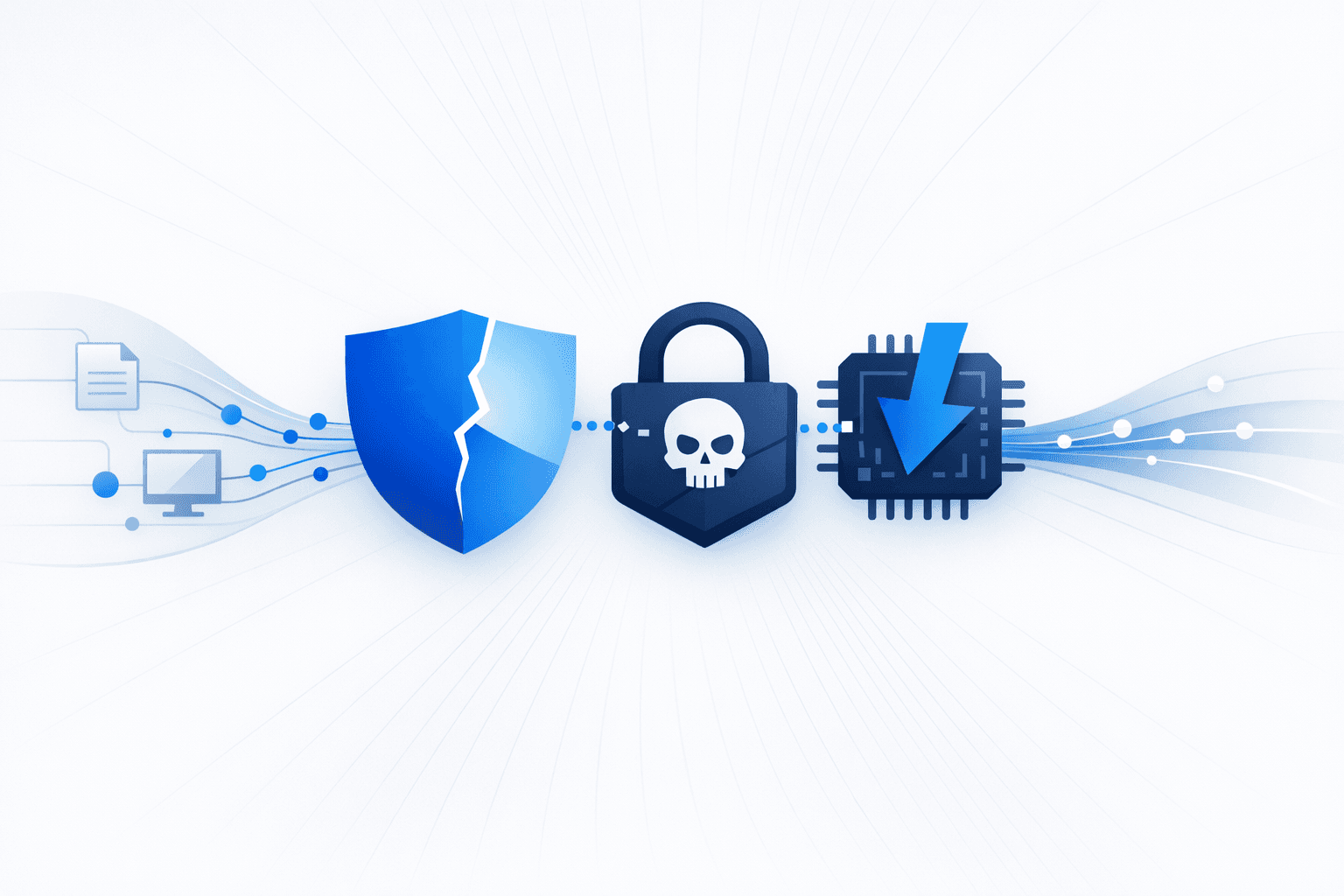
TTPs, infrastructure, and targeting history in one profile.
6 events from the most recent confirmed update back to the earliest known activity.
Fortinet publicly reported that Interlock used a custom EDR/AV killer called Hotta Killer, which exploited a zero-day in the signed anti-cheat driver GameDriverx64.sys via a BYOVD technique. The flaw was tracked as CVE-2025-61155 and was used to terminate security software, including Fortinet products, at kernel level.
Following the start of encryption, the attackers generated roughly 5,000 rogue domain user accounts. The purpose was unclear, but FortiGuard suggested it may have been intended to create confusion or hinder incident response.
On October 10, 2025, Interlock began encryption using a Linux encryptor against Nutanix servers and a JavaScript payload called jar.jar against Windows endpoints. The operation affected both hypervisor and endpoint environments.
By September 2025, the attackers had escalated the intrusion by exfiltrating more than 250 GB of data using AZcopy to cloud storage. This activity supported the group's double-extortion model before encryption was launched.
After initial access, Interlock deployed a custom JavaScript implant known as NodeSnake RAT to maintain long-term access and support lateral movement using valid accounts and living-off-the-land techniques.
FortiGuard Labs reported that an Interlock ransomware intrusion against the education sector began with a MintLoader infection, likely delivered through ClickFix social engineering. The campaign targeted education organizations in the U.S. and U.K.
Vulnerabilities, threat actors, malware, products, organizations, and breaches Mallory has linked to this story.
See this adversary's TTPs, infrastructure, and targeting history, correlated against your exposure.
3 references tracked. Mallory keeps watching after this page renders.
scworld.com
Open sourcecybersecuritynews.com
Open sourcesecurityonline.info
Open sourceMap indicators from this story to your assets and identify affected systems in minutes.
Every observed campaign, victim, and pivot linked to actors named in this story.
Malware, exploits, and IOCs connected to the activity described here.
YARA, Sigma, and Snort rules deployed to your SIEM as soon as they’re published.
Get matching new stories delivered to your team as they break — not the next morning.
Ask questions about this story and take action on the answers.
Other stories Mallory is tracking that overlap on entities, sources, or topic labels.

Ransomware operators have been observed using **bring-your-own-vulnerable-driver (BYOVD)** techniques and custom anti-security tools to shut down endpoint protections before encrypting enterprise networks. Kaspersky documented a MedusaLocker intrusion in Brazil in which attackers accessed an SMTP server over RDP with valid administrative credentials, used **Mimikatz** to extract NTLM hashes, and moved laterally with pass-the-hash via PowerShell-based WMI and SMB execution before deploying a new AV-killer tool, `All.exe`. That tool loaded a renamed **TechPowerUp `ThrottleStop.sys`** driver (`ThrottleBlood.sys`), exploited vulnerable IOCTLs for physical memory read/write, hijacked kernel execution through `NtAddAtom`, and repeatedly terminated products from Microsoft Defender, CrowdStrike, SentinelOne, Sophos, Symantec, Bitdefender, ESET, Avast, AVG, McAfee, Panda, Quick Heal, and Kaspersky; the driver issue was assigned **`CVE-2025-7771`**. A separate report on **The Gentlemen** ransomware described a similar pattern in enterprise attacks across the Asia-Pacific region, where the group likely gained entry through an exposed FortiGate device or stolen credentials, then conducted Active Directory reconnaissance, used **PsExec** for lateral movement, established persistence with **AnyDesk**, abused **GPO** and **NETLOGON** for domain-wide deployment, and exfiltrated data with **WinSCP** for double extortion. TrendAI said the group evolved from generic anti-AV tooling to customized variants tailored to the security products installed in each victim environment, while also disabling Windows Defender and recovery mechanisms before dropping `README-GENTLEMEN.txt` and encrypting files with the `.7mtzhh` extension. Together, the incidents show ransomware crews increasingly pairing credential abuse and lateral movement with vulnerable-driver abuse and bespoke defense evasion to maximize encryption success.
Aug 21, 2026
Sophos reported that the Interlock ransomware group, also tracked as **GOLD EMBRACE**, used legitimate memory-forensics tools including **WinPmem** and **Volatility3** to steal Windows credentials during a March 2026 intrusion. The attack began with a **ClickFix** social-engineering lure on a compromised website after a user searched for Dynamics 365 via ChatGPT and was tricked into pasting a malicious command. That command downloaded PowerShell code and installed a remote-access payload on an unprotected Windows 10 endpoint, giving the attackers an initial foothold. Over roughly 26 hours, the attackers conducted LDAP discovery, privilege escalation, **Kerberoasting**, and NTLM downgrade-based lateral movement before reaching a domain controller. Sophos said Interlock used the forensic tools to extract NTLM and LM hashes, local account data, cached domain credentials, and other secrets, then created new domain-admin accounts, established persistence with a scheduled task and `node.exe`, tampered with Microsoft Defender, exfiltrated sensitive data including AWS credentials, and ultimately deployed ransomware that locked the victim out of hypervisors. The campaign reflects Interlock’s broader double-extortion operations against organizations in North America and Europe, including critical infrastructure, healthcare, and education, and its use of malware such as **NodeSnake** and **InterlockRAT**.
Aug 10, 2026
Ransomware operators are using **Bring Your Own Vulnerable Driver (BYOVD)** attacks to load legitimately signed but flawed Windows kernel drivers, gain ring-0 access, and terminate security products protected by Protected Process Light (PPL). Reported examples include the WatchDog Antimalware v1.1.100 and `eb` kernel drivers, whose unauthenticated IOCTL interfaces can reportedly be abused to kill protected processes. Qilin's Killer Ultra and RansomHub's EDRKillShifter have used the technique through user-mode launchers that drop, load, and control vulnerable drivers. Defenders should detect the sequence of suspicious driver drops, rapid driver installation or loading, low-prevalence driver hashes, and subsequent termination of endpoint-security processes. Organizations should inventory and baseline deployed drivers, enforce Windows Defender Application Control (WDAC) driver policies, enable Microsoft’s Vulnerable Driver Blocklist and HVCI, maintain EDR tamper protection, and restrict administrative privileges to reduce exposure to known vulnerable drivers, including those catalogued by LOLDrivers.
Sep 28, 2026