
Loading story…
Researchers detailed two Windows malware strains that spread through removable media and target cryptocurrency users. Microsoft-tracked Trojan:Win32/CryptoBandits.A uses malicious .LNK shortcut files on USB drives to hide legitimate documents, replace them with look-alike shortcuts, and copy itself to newly attached media. Once launched, it steals seed phrases and private keys, captures screenshots, replaces copied wallet addresses with attacker-controlled values, and uses a bundled Tor client over localhost:9050 for command-and-control; an EVAL backdoor command also enables arbitrary code execution on infected hosts.
Separate reverse-engineering of a Phorpiex sample showed similar USB and network-drive worm behavior alongside downloader and crypto-theft functions. The malware copies itself to writable locations for persistence, creates a Run key named Windows Settings, deletes its Zone.Identifier alternate data stream, adds Windows Defender exclusions, and disables Windows Update- and Defender-related protections. It also spreads as VolDrvConfig.exe, performs clipboard hijacking to redirect cryptocurrency payments, and downloads additional payloads, including cryptominers, from hard-coded infrastructure such as 185.215.113.66 into the temp directory under randomized filenames.
Pull IOCs and campaign context straight into your stack.
2 events from the most recent confirmed update back to the earliest known activity.
Microsoft Threat Intelligence identified an active Windows malware campaign tracked as Trojan:Win32/CryptoBandits.A that has been affecting users since at least February 2026. The malware spreads through malicious .LNK shortcut files on USB drives and steals cryptocurrency-related data while maintaining Tor-based command-and-control access.
A reverse-engineering write-up documented a Phorpiex Windows worm sample that spreads via USB and network drives, establishes persistence, weakens Windows defenses, performs crypto-clipping, and downloads additional payloads from hard-coded infrastructure.
Vulnerabilities, threat actors, malware, products, organizations, breaches, and observables Mallory has linked to this story. Indicator values are masked here and available in full in the app.
Indicator values are masked on this page. View all 14 in Mallory Domains, IPs, hashes, and URLs are exportable to your SIEM.
Pull the IOCs, campaigns, and victimology behind this family, ready to push into your SIEM and EDR.
2 references tracked. Mallory keeps watching after this page renders.
Map indicators from this story to your assets and identify affected systems in minutes.
Every observed campaign, victim, and pivot linked to actors named in this story.
Malware, exploits, and IOCs connected to the activity described here.
YARA, Sigma, and Snort rules deployed to your SIEM as soon as they’re published.
Get matching new stories delivered to your team as they break — not the next morning.
Ask questions about this story and take action on the answers.
Other stories Mallory is tracking that overlap on entities, sources, or topic labels.
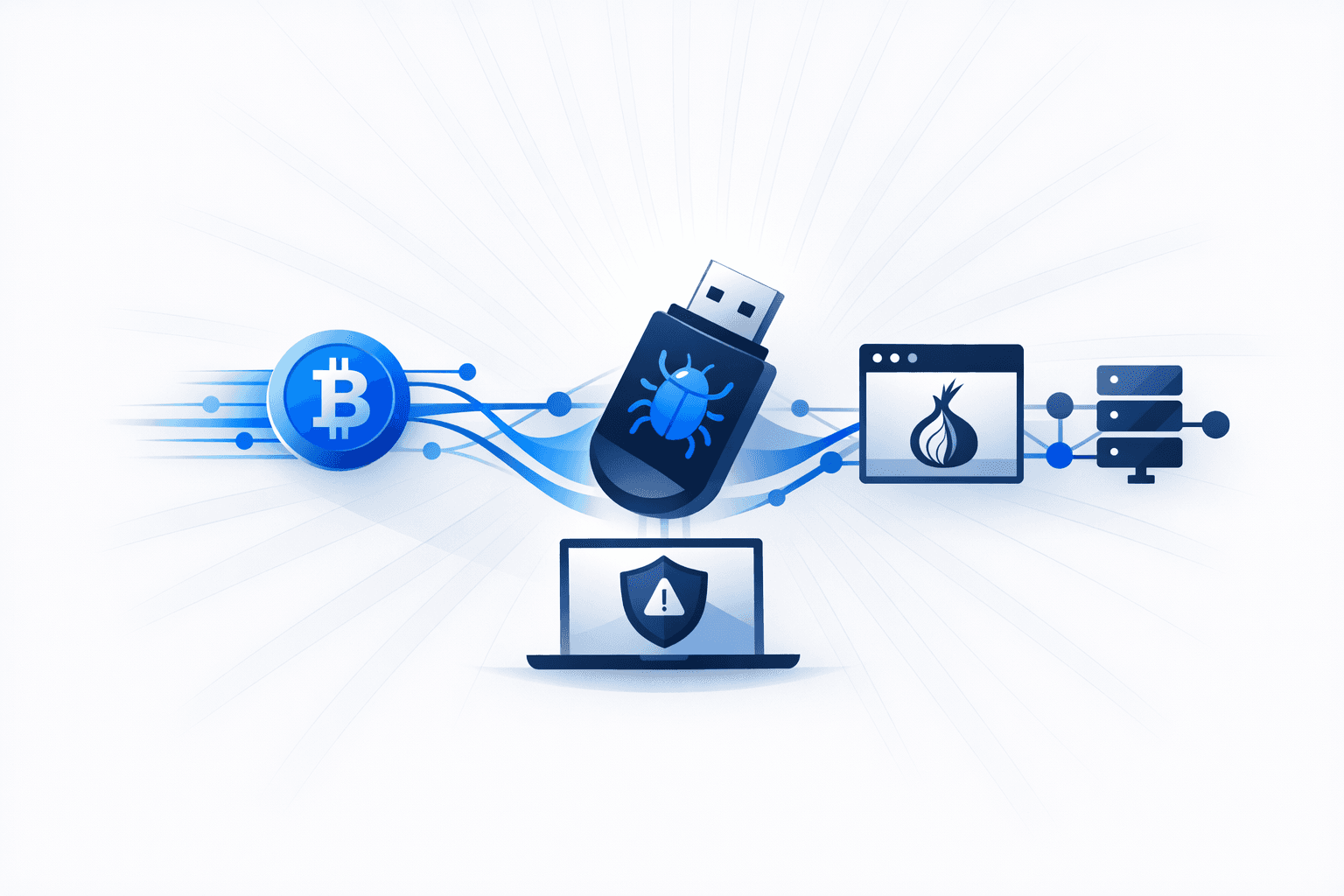
Microsoft disclosed an active Windows cryptocurrency theft campaign that spreads through malicious `.lnk` shortcut files, often delivered via USB devices, and combines worm-like propagation with a script-based clipper and stealer. The malware has been active since February 2026 and uses Windows Script Host, ActiveX, and a bundled Tor client to reach hidden-service command-and-control infrastructure through `localhost:9050`, avoiding conventional installer and IP-based infrastructure. Microsoft said the threat is detected as **Trojan:Win32/CryptoBandits.A** and related **CryptoBandits** signatures. Once installed, the malware monitors the clipboard roughly every 500 milliseconds for **BIP39 seed phrases**, Ethereum keys, Bitcoin WIF keys, and wallet addresses, then replaces copied cryptocurrency addresses with attacker-controlled ones while also stealing screenshots. Microsoft said the operators added persistence through scheduled tasks, Defender exclusions, layered obfuscation, and packaging with **PyArmor** and **PyInstaller**, while also terminating execution if Task Manager is detected. The campaign also supports remote code execution through an `EVAL` command from its C2, effectively giving the operators lightweight backdoor access; defenders were urged to block `.lnk` execution from removable media, restrict script hosts, and hunt for suspicious script activity, clipboard inspection, `curl`-based exfiltration, PowerShell screen capture, and Tor SOCKS5 traffic over `localhost:9050`.
Jul 12, 2026
Multiple reports describe **active malware campaigns targeting Windows users** with a focus on **credential, session, and wallet theft** delivered through social engineering and abuse of legitimate services. **CharlieKirk Grabber**, a Python infostealer packaged with *PyInstaller*, is distributed via phishing, cracked software, cheats, and social-media lures; it kills browser processes (via `TASKKILL`) to access credential stores, collects passwords/cookies/autofill/Wi‑Fi data, zips the loot, uploads it to *GoFile*, and relays the download link to operators via **Discord webhooks** or **Telegram bots**. Separately, attackers are buying **Facebook ads** impersonating Microsoft to drive victims to cloned Windows 11 download pages on lookalike domains (e.g., `ms-25h2-update[.]pro`), delivering a malicious installer that steals saved passwords, browser sessions, and **cryptocurrency wallet** data; the campaign uses **geofencing/sandbox evasion** to show benign content to data-center IPs while serving malware to likely end users. Other contemporaneous activity highlights broader Windows-targeted intrusion tradecraft and adjacent threats. FortiGuard Labs reported **Winos 4.0 (ValleyRat)** phishing campaigns in Taiwan using tax and e-invoice lures, with delivery chains including malicious **LNK** downloaders, **DLL sideloading**, and **BYOVD** using the vulnerable driver `wsftprm.sys`, supported by rapidly rotating domains and cloud hosting. In LATAM, a fake bank-receipt lure delivers **XWorm v5.6** via a `.pdf.js` double-extension WSH dropper that uses junk-padding and Unicode obfuscation, then reconstructs and runs PowerShell (spawned via WMI) and abuses trusted hosting (e.g., Cloudinary) for later stages—enabling credential theft and potential ransomware follow-on. Additional reporting covered a USB-propagating **Monero cryptomining** operation capable of crossing air-gapped environments, a new Linux **SysUpdate** variant with encrypted C2 traffic (and a Unicorn Engine-based decryption approach developed during DFIR), and the **Foxveil** loader abusing **Cloudflare Pages, Netlify, and Discord** to stage shellcode and persist via services or *SysWOW64* masquerading—these are separate threats but reinforce the trend of attackers blending into trusted infrastructure and common user workflows.
Jun 29, 2026
Researchers reported two malware campaigns that install cryptocurrency miners through trojanized downloads delivered from pirate streaming sites and fake software portals. In one operation, users visiting illicit movie and TV sites were shown a bogus video-plugin update that delivered a ZIP archive containing a legitimate executable and a malicious DLL; the DLL sideloaded a multi-stage miner framework with persistence, defense evasion, a watchdog, a **RAT** component, and CPU/GPU mining modules. The malware, a modified fork of SilentCryptoMiner, used DNS tunneling for execution gating, installed a service named `GoogleUpdateTaskMachineQC`, weakened Windows defenses, injected into `conhost.exe` and `explorer.exe`, and communicated through rotating domains and infrastructure tied to `107[.]172[.]212[.]235`. Microsoft described a related cryptojacking-focused campaign aimed at owners of high-performance PCs, using fake downloads of popular utilities and hardware-monitoring tools that were promoted through SEO poisoning and, more recently, surfaced in AI assistant recommendations. Those ZIP archives also paired a legitimate executable with a malicious DLL for sideloading, then installed **ScreenConnect** for persistent remote access, set registry autoruns and scheduled tasks, added Microsoft Defender exclusions, checked for analysis tools, and used process hollowing to launch payloads inside trusted Windows processes. After profiling infected systems, the attackers fetched GPU miners including **gminer**, **lolMiner**, and **SRBMiner-MULTI**; researchers warned the access could support not only cryptomining but also data theft, lateral movement, and eventual ransomware deployment.
Jun 29, 2026