
Loading story…
New benchmark results indicate that the framework surrounding an AI model is often the decisive factor in both cybersecurity and desktop automation tasks. On macOS, the MacAgentBench benchmark measured 676 tasks across 25 applications and found that Claude Opus 4.6 paired with the OpenClaw framework reached 73.7% first-try success, while the same model using only screenshot-based mouse-and-keyboard control achieved 39.2%; GPT-5.4 led bare-agent setups at 58.4%. Researchers said much of OpenClaw’s advantage disappeared on tasks without prebuilt recipes, suggesting that skill libraries and task-specific scaffolding, rather than model quality alone, accounted for most of the gains. Reliability also remained uneven: the best setup completed 85.2% of tasks at least once in four attempts but only 58.6% correctly on all four runs.
Cybersecurity-focused evaluations reported a similar pattern. Comparative reviews of CyberMetric, NYU CTF Bench, InterCode CTF, and CAIBench found that models perform well on knowledge-heavy tests but drop sharply on multi-step exploitation and attack-defense tasks, where success rates often fall into the 20–40% range. A separate CyBench study discussed on r/netsec found no single scaffold dominated every challenge, while combining heterogeneous scaffolds and a shared blackboard architecture solved 19 of 33 tasks (57.6%) and reduced execution time. Safety findings also pointed to the harness as the main control point: one SkillHarness study said explicit skill boundaries and risk guards enforced user-consent and sensitive-data restrictions before execution, and that removing those boundaries increased attack success by 9.6 percentage points. Across the studies, researchers warned that stronger automation without robust guardrails could enable unauthorized file access, credential harvesting, and other misuse.

Track how attackers are adapting to this technology.
4 events from the most recent confirmed update back to the earliest known activity.
A write-up on SkillHarness reported that safety is enforced through explicit skill boundaries and planner-checked risk guards tied to environment state, such as requiring user consent or blocking sensitive-data submission. It cited an ablation study showing that removing skill boundaries increased attack success by 9.6 percentage points, supporting the conclusion that the harness boundary provides the primary safety function.
A 2026 arXiv paper discussed on r/netsec reported benchmarking five cybersecurity scaffolds using the same alias2-mini model across 33 CyBench challenges. The study found no single scaffold was best on every challenge, while a shared blackboard architecture solved 19 challenges, or 57.6%, and reduced execution time.
An analysis comparing CyberMetric, NYU CTF Bench, and InterCode CTF reported that LLMs perform strongly on knowledge-based cybersecurity tests but much worse on multi-step offensive tasks such as exploitation and attack-defense scenarios. It cited CAIBench as showing a persistent gap, with knowledge benchmarks above 70% success and multi-step attack scenarios often only 20–40%, while also noting that scaffolding can affect outcomes more than model choice.
Researchers reported results from MacAgentBench, a benchmark of 676 tasks across 25 macOS applications, finding that Claude Opus 4.6 with OpenClaw achieved 73.7% first-try success while bare-agent setups performed substantially worse. The reported analysis concluded that much of the gain came from framework-provided skill libraries and task recipes rather than the underlying model alone, and also highlighted reliability and misuse concerns.
Vulnerabilities, threat actors, malware, products, organizations, and breaches Mallory has linked to this story.
Follow how adversaries are adapting to this technology, and where it touches your stack today.
4 references tracked. Mallory keeps watching after this page renders.
reddit.com
Open sourcemedium.com
Open sourcehelpnetsecurity.com
Open sourcecodeby.net
Open sourceMap indicators from this story to your assets and identify affected systems in minutes.
Every observed campaign, victim, and pivot linked to actors named in this story.
Malware, exploits, and IOCs connected to the activity described here.
YARA, Sigma, and Snort rules deployed to your SIEM as soon as they’re published.
Get matching new stories delivered to your team as they break — not the next morning.
Ask questions about this story and take action on the answers.
Other stories Mallory is tracking that overlap on entities, sources, or topic labels.
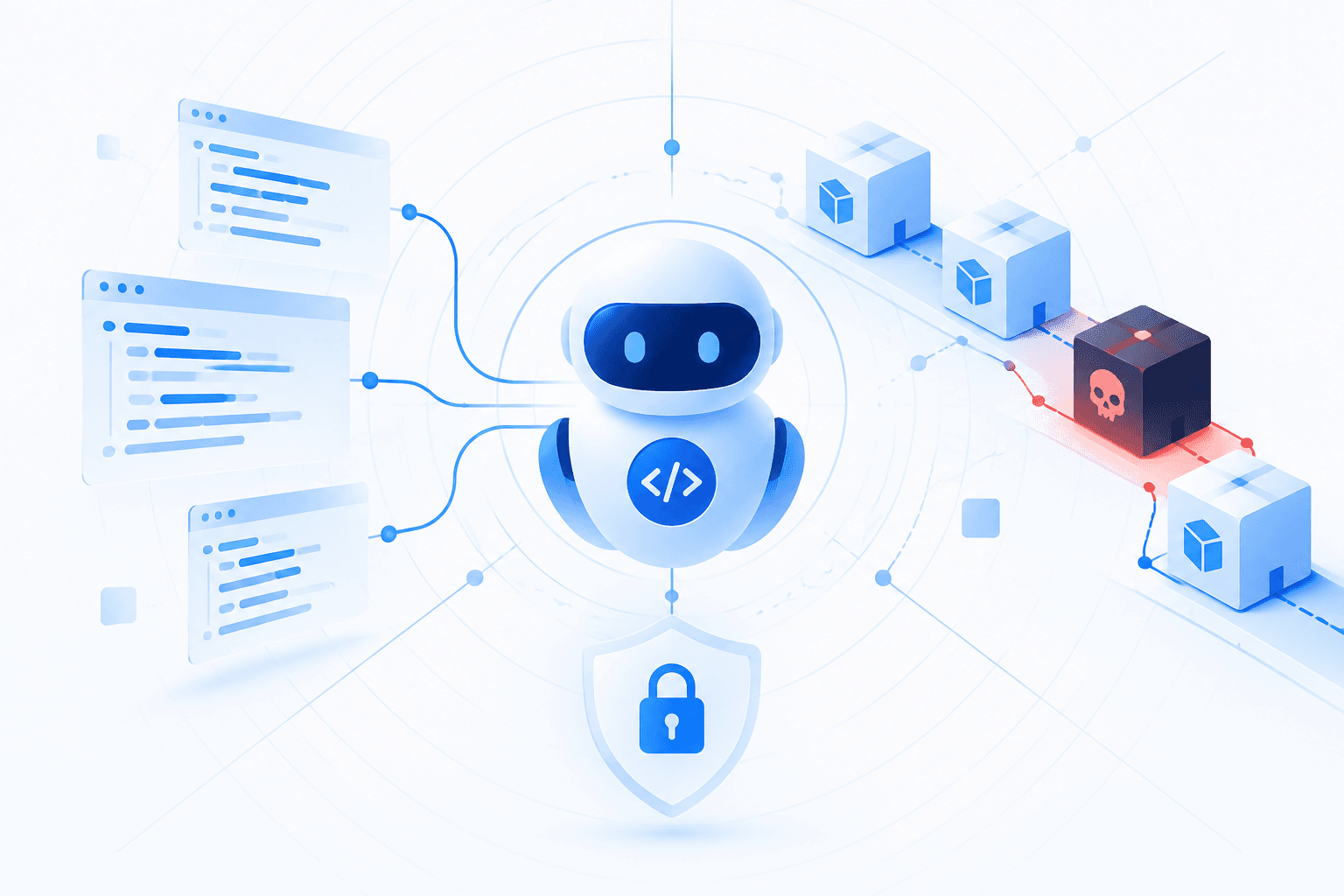
An empirical review of 3,171 public GitHub repositories found confirmed security defects in **16.0%** of AI coding-agent harness configurations. The review covered 2,660 multi-component agent setups and 511 published skill collections, assessing instruction files, skills, hooks, subagents, and Model Context Protocol (MCP) server declarations. The most common issues were unpinned MCP server versions, overly broad execution pre-approvals, and skills that pre-authorized shell access for installers; researchers did not confirm a credential-exfiltration path. The harness surrounding a coding model—its prompts, tools, skills, MCP servers, and orchestration—creates a material supply-chain and prompt-injection attack surface. Mutable remote MCP services, trusted prompt formatting, YAML skill metadata, and self-propagating payloads such as CopyPasta can be abused to influence agent actions. Organizations should inventory harness trust relationships, enforce least privilege and human approvals, pin and validate external components, independently monitor runtime behavior, and assign governance and incident-response ownership for agentic AI.
Sep 11, 2026
Recent research and evaluations indicate **AI agents are becoming capable of finding and exploiting vulnerabilities with high success rates using standard offensive tooling**, lowering the barrier to semi-autonomous attacks. A study by Irregular in collaboration with **Wiz** reported that leading models (Anthropic *Claude Sonnet 4.5*, OpenAI *GPT-5*, and Google *Gemini 2.5 Pro*) solved **9 of 10** web security CTF challenges modeled on real-world incident patterns, including **authentication bypass**, **exposed secrets**, **stored XSS**, and **SSRF** (including **AWS Instance Metadata Service (IMDS)**-style SSRF). Researchers noted that even when success required multiple stochastic runs, the **low per-run cost (~$2) and limited repeats** could make exploitation practical without necessarily triggering monitoring, with most challenge successes costing **under $1** and multi-run cases totaling roughly **$1–$10**. Separate evaluation results highlighted by Bruce Schneier, citing an Anthropic post, describe *Claude Sonnet 4.5* successfully executing **multistage attacks across simulated networks** using only **standard open-source tools** rather than custom cyber toolkits, including exfiltrating all simulated PII in a high-fidelity **Equifax-breach** simulation by recognizing and exploiting a known **publicized CVE**. In parallel, Dark Reading reported security concerns around the rapid adoption of an open-source autonomous assistant, **OpenClaw** (formerly *MoltBot/ClawdBot*), which can connect to email, files, messaging, and system tools, execute terminal commands and scripts, and maintain memory across sessions—creating **persistent non-human identities and access paths** that may fall outside traditional **IAM** and secrets controls, increasing enterprise risk as “bring-your-own-AI” agents gain privileged access.
Jun 29, 2026
Security researchers and vendors documented rapid progress in using large language models and autonomous agents for offensive security testing, from early machine-learning-driven exploitation in **Deep Exploit** to newer multi-agent systems such as **BLADE** and Mastra-based workflows. In controlled demonstrations, these systems automated parts of reconnaissance, privilege-escalation analysis, credential discovery, lateral movement, and reporting, while broader evaluations found modern models increasingly capable of code understanding, vulnerability reasoning, and black-box web assessment tasks. The reporting also highlighted industry milestones such as AI-assisted pentesting tools reaching top bug bounty rankings and the growing use of agent patterns including **ReAct**, **Plan-and-Execute**, and orchestrated multi-agent designs for security assessments. At the same time, the same body of work warned that AI-for-security deployments are creating new attack surfaces. Researchers observed internet scanning for exposed OpenAI-compatible `Chat Completions` endpoints, with likely goals including fingerprinting LLM servers, abusing unauthenticated inference, causing denial of service, and reaching downstream integrations such as **RAG**, tool calling, and URL fetching. Separate analysis warned that long-term memory in AI agents can preserve attacker-influenced instructions, stale conclusions, or misleading context across sessions, making provenance, freshness, access control, correction, and deletion critical controls. Across the studies, the message was consistent: AI agents are becoming more useful for security operations and testing, but their deployment requires strict governance, authentication, and safeguards against prompt injection, unstable execution, and low-quality automated findings.
Aug 15, 2026