
Loading story…
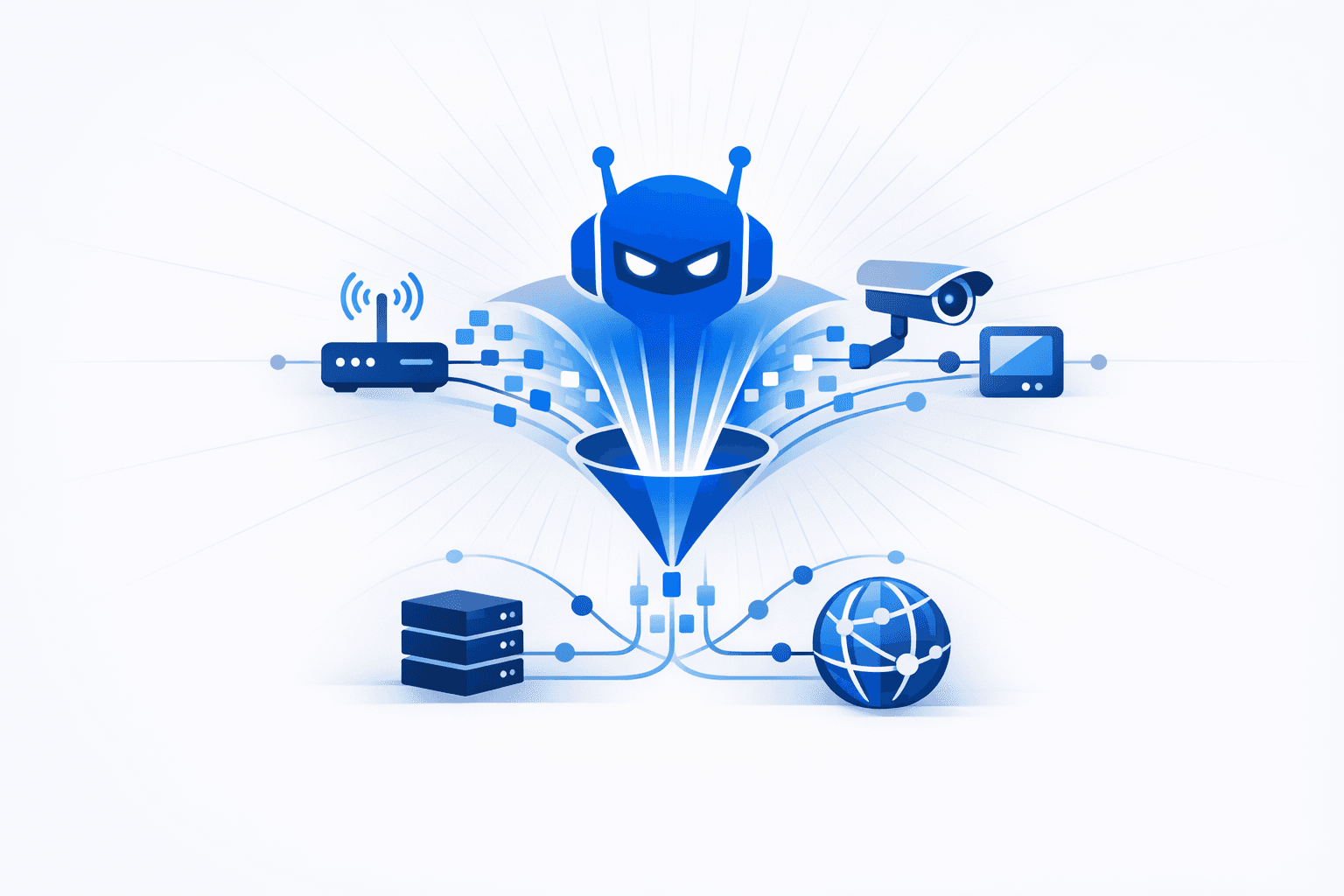
FortiGuard Labs disclosed a previously undocumented Linux botnet, Evooo1Bot, a Mirai-derived malware family that has been actively targeting Internet-facing devices since at least July 2026. The botnet exploits known vulnerabilities in routers, firewalls, IP cameras, and other edge hardware from vendors including Alcatel, D-Link, Mitsubishi Electric, Netgear, Tenda, and Telesquare, then deploys architecture-specific binaries from a shared loader at 91.92.40[.]118. Researchers said the malware clears bash history after infection, performs anti-analysis and anti-sandbox checks, and communicates with its command-and-control infrastructure over encrypted channels on port 443.
Evooo1Bot expands on typical Mirai behavior with SSH brute-force scanning, credential sniffing for default or exposed access credentials, persistence mechanisms, and an integrated exploit module for multiple known flaws. Researchers highlighted its reverse SOCKS proxy capability as the most consequential feature because compromised edge devices can be repurposed as long-lived relay nodes to conceal attacker origin, support lateral movement, and enable follow-on intrusions into internal networks. Reported activity has been concentrated across North America, South America, Europe, India, China, and Japan, underscoring broad exposure for organizations running unpatched perimeter devices.
Pull IOCs and campaign context straight into your stack.
3 events from the most recent confirmed update back to the earliest known activity.
FortiGuard Labs said telemetry from Evooo1Bot command-and-control infrastructure showed the botnet had been actively targeting Internet-facing devices since July 2026. The activity involved exploitation attempts against multiple known vulnerabilities with payload callbacks to a common loader URL.
The Mirai botnet source code was publicly released in 2016, enabling numerous later malware variants. Evooo1Bot is described as one such Mirai-derived descendant.
FortiGuard Labs reported a previously undocumented Linux botnet family named Evooo1Bot and detailed its Mirai-derived architecture, encrypted C2, SSH brute-force scanning, SOCKS proxying, credential sniffing, persistence, and exploit modules. The report also stated FortiGuard security products detect or block the malware and associated infrastructure.
Vulnerabilities, threat actors, malware, products, organizations, breaches, and observables Mallory has linked to this story. Indicator values are masked here and available in full in the app.
Indicator values are masked on this page. See the values in Mallory Domains, IPs, hashes, and URLs are exportable to your SIEM.
Pull the IOCs, campaigns, and victimology behind this family, ready to push into your SIEM and EDR.
12 references tracked. Mallory keeps watching after this page renders.
xakep.ru
Open sourcesecurityaffairs.com
Open sourcecyberveille.ch
Open sourcedarkreading.com
Open sourceinfosecurity-magazine.com
Open sourcetherecord.media
Open sourcefeeds.fortinet.com
Open sourcefortinet.com
Open sourceMap indicators from this story to your assets and identify affected systems in minutes.
Every observed campaign, victim, and pivot linked to actors named in this story.
Malware, exploits, and IOCs connected to the activity described here.
YARA, Sigma, and Snort rules deployed to your SIEM as soon as they’re published.
Get matching new stories delivered to your team as they break — not the next morning.
Ask questions about this story and take action on the answers.
Other stories Mallory is tracking that overlap on entities, sources, or topic labels.

Researchers tracked the Mirai-derived **Echobot** botnet as it rapidly expanded from 18 exploits to 59 and then **71** exploits, broadening propagation across routers, cameras, NAS devices, smart home hubs, servers, SD-WAN appliances, Oracle WebLogic, Barracuda Web Application Firewall, Citrix NetScaler, video conferencing systems, and administration tools. The malware relied heavily on publicly available remote code execution and command-execution exploits, including both legacy flaws dating back to 2003 and newer issues such as **`CVE-2019-15107`** in Webmin, showing how quickly commodity botnet code can be upgraded into large-scale exploit-driven malware. The most notable escalation was Echobot’s move into industrial environments through exploitation of **`CVE-2019-14927`** affecting Mitsubishi Electric remote terminal units, an uncommon step for a Mirai-family botnet toward **SCADA** and critical infrastructure-related devices. Researchers said the malware spread through a bash dropper named **Richard**, which downloaded, compiled, and executed payloads for at least 13 processor architectures, while infrastructure linked to the campaign included open or compromised servers and changing command-and-control domains and ports. The activity underscored Mirai’s continued evolution away from simple default-credential abuse and toward aggressive exploit-based propagation to build larger botnets, likely for **DDoS** operations.
Aug 15, 2026
Mirai-related botnets remained highly active as operators rapidly incorporated newly disclosed remote code execution flaws and weak-credential attacks against internet-facing IoT and network security devices. Palo Alto Networks Unit 42 reported an active campaign exploiting vulnerabilities including `CVE-2021-27561`, `CVE-2021-27562`, `CVE-2021-22502`, and `CVE-2020-26919` across products such as SonicWall SSL-VPN, D-Link DNS-320, Yealink Device Management, Micro Focus Operation Bridge Reporter, Netis routers, and Netgear ProSAFE Plus devices. Fortinet likewise observed roughly 200 attacks per day in a three-week honeypot study, with nearly 4,000 of about 4,700 Telnet attacks tied to Mirai-related malware families and variants quickly adding exploits such as OptiLink GPON RCE, `CVE-2021-1498`, and `CVE-2021-31755`. Successful compromises typically fetched shell scripts that installed multi-architecture Mirai binaries, and in some cases added SSH brute-force and scanning tools, attempted persistence, removed artifacts, and blocked management ports to retain control. Researchers said the broader botnet ecosystem also remained resilient beyond Mirai alone: Fortinet identified active variants including **SORA**, **SYLVEON**, **Hajime**, and **MANGA**, while earlier Netlab 360 analysis showed Hajime continuing to grow through a modular peer-to-peer architecture and propagation via TR-069 flaws and weak Telnet credentials. The combined reporting underscores that unpatched edge devices and default or weak passwords continued to fuel large-scale botnet expansion.
Aug 15, 2026
Researchers reported renewed **Moobot** activity as operators updated infrastructure and scanned for exploitable internet-facing devices, especially **Tenda routers**, while continuing a broader pattern of targeting networking gear and embedded systems. Alien Labs linked the latest activity to a Mirai-derived botnet probing for known flaws including `CVE-2014-8361`, `CVE-2017-17215`, `CVE-2018-14558`, and `CVE-2020-10987`. Earlier reporting described Moobot as an active DDoS botnet that spread through weak Telnet credentials and exploits affecting routers, DVRs, IP cameras, GPON devices, ThinkPHP, and Android Debug Bridge, with operators using obfuscation, modified packers, DNS TXT-based command-and-control delivery, and proxy infrastructure including SOCKS and Tor to complicate analysis. Separate campaigns showed the botnet repeatedly shifting to new device classes and vulnerabilities to grow its node base. Unit 42 documented MooBot exploiting four **D-Link** router flaws — `CVE-2015-2051`, `CVE-2018-6530`, `CVE-2022-26258`, and `CVE-2022-28958` — to fetch shell-script droppers and architecture-specific binaries, while Netlab 360 and CNCERT reported exploitation of a zero-day command-injection flaw in **UNIX CCTV DVR/NVR** devices through port `8000`, affecting about **6,000** exposed systems. Across the campaigns, the malware retained core Mirai traits, including embedded credentials, persistence, and DDoS capability, while variants such as `Moobot_xor` and `Moobot_leet` introduced altered encryption keys, encrypted resources, and Tor-based C2 channels.
Aug 28, 2026