
Loading story…
Attackers used spear-phishing emails with TinyURL links and an actor-controlled redirection server to deliver the 9002 Trojan from a Google Drive-hosted ZIP archive. The redirection chain embedded a target email address and destination URL in base64-encoded parameters, apparently to track victim clicks, and one lure targeted a legitimate Myanmar politician and human rights activist. The downloaded executable posed as a PowerPoint file, displayed a Myanmar-related conference decoy, and installed malware through DLL sideloading by abusing a legitimate RealNetworks executable.
Researchers linked the campaign’s infrastructure and beaconing artifacts to broader activity associated with Poison Ivy, PlugX, Zupdax, HenBox, and the later-identified Farseer malware family. Farseer shared tradecraft including DLL sideloading with signed binaries, encrypted and compressed payloads, obfuscated configuration data, registry persistence, and command-and-control over domains such as update.tcpdo[.]net, honor2020[.]ga, and up.outhmail[.]com. The overlapping infrastructure and Myanmar- and Southeast Asia-themed lures indicate a sustained intrusion set focused on targets in Myanmar, Taiwan, and the wider region.

Get the infrastructure and lures behind it.
5 events from the most recent confirmed update back to the earliest known activity.
Unit 42 observed more than 30 unique Farseer samples over roughly two and a half years, with most appearing in 2017 and a smaller number in 2018. The malware family used DLL sideloading, encrypted payload components, and registry-based persistence.
The Farseer report states that Poison Ivy samples had used tcpdo[.]net as command-and-control infrastructure, with activity dating back to mid-2015. This established historical infrastructure overlap later used to connect Farseer with Poison Ivy-linked operations.
Palo Alto Networks Unit 42 identified a previously unknown Windows backdoor family and named it Farseer based on a string found in an embedded PDB path. The report linked Farseer through overlapping infrastructure and tradecraft to HenBox, Poison Ivy, Zupdax, PlugX, and 9002-related activity.
Unit 42 reported a spear-phishing campaign that used TinyURL links, an actor-controlled redirector, and a Google Drive-hosted ZIP archive to deliver the 9002 Trojan. The campaign targeted at least one legitimate Myanmar politician and human rights activist and used DLL sideloading with a signed RealNetworks executable for execution.
The 9002 dropper opened a decoy PowerPoint presentation about a Myanmar conference titled "Role of JMVTI Aung San and Building of Clean and Safe Automobile Society." The presentation concerned a conference scheduled for July 30, 2016, showing the lure theme used against targets.
Vulnerabilities, threat actors, malware, products, organizations, breaches, and observables Mallory has linked to this story. Indicator values are masked here and available in full in the app.
Indicator values are masked on this page. View all 113 in Mallory Domains, IPs, hashes, and URLs are exportable to your SIEM.
Get the infrastructure, lures, and IOCs behind this campaign, ready to push into your email and identity stack.
3 references tracked. Mallory keeps watching after this page renders.
unit42.paloaltonetworks.com
Open sourceresearchcenter.paloaltonetworks.com
Open sourceattack.mitre.org
Open sourceMap indicators from this story to your assets and identify affected systems in minutes.
Every observed campaign, victim, and pivot linked to actors named in this story.
Malware, exploits, and IOCs connected to the activity described here.
YARA, Sigma, and Snort rules deployed to your SIEM as soon as they’re published.
Get matching new stories delivered to your team as they break — not the next morning.
Ask questions about this story and take action on the answers.
Other stories Mallory is tracking that overlap on entities, sources, or topic labels.

Researchers documented several **multi-stage malware campaigns** that used phishing lures, fake software updates, and DLL sideloading to deploy credential theft and remote access payloads. In one June 2026 intrusion targeting a small number of German financial institutions, a spear-phishing email posing as an urgent VPN update delivered a 7-Zip self-extracting archive that dropped a signed copy of **Radmin VPN** alongside a trojanized `Qt5Core.dll`, launching **HijackLoader** and ultimately **Vidar v2.1** through process hollowing into a signed `dBpoweramp` binary. A parallel chain used Opera sideloading to install **SnappyClient RAT**. Separate reporting also described a targeted Spanish-language phishing lure that delivered a password-protected archive containing a .NET loader and a byte-reversed DLL payload, as well as a fake browser update chain that used a signed **G DATA AntiVirus** binary to sideload **PlugX** linked to suspected **Mustang Panda** activity. Across the cases, the malware families showed strong emphasis on **credential theft, stealth, and layered execution**. Vidar samples were observed harvesting browser passwords, cookies, screenshots, FileZilla and WinSCP data, and cryptocurrency wallet information, while also bypassing Chromium App-Bound Encryption by launching legitimate Chrome and Edge instances with specific flags and using dead-drop resolvers such as **Steam** and **Telegram** to locate command-and-control servers. The PlugX implant used multiple decoding and encryption layers, manual PE mapping, registry-based persistence, and WinHTTP communications to `fruitbrat[.]com:443`, while another credential-stealing sample tied in open sources to **RedFoxtrot** targeted Firefox and Internet Explorer data and used proxy-aware HTTP communications with hardcoded infrastructure. The reporting highlights continued attacker reliance on signed binaries, staged loaders, and obfuscated payload handling to evade detection while stealing credentials and enabling follow-on access.
Jul 12, 2026
A spear-phishing campaign targeted Japanese organizations with HR-themed lures impersonating company representatives and delivered a multi-stage malware chain built around **PXDropper**, the **PoisonX** kernel driver, and the modular **10FXRAT** remote-access trojan. Victims were directed to Google Cloud Storage-hosted archives containing ZIP, RAR, LNK, or EXE payloads, including polyglot Windows shortcut files that dropped decoy Japanese PDFs and used obfuscated downloaders to fetch second-stage malware such as `RuntimeBroker.exe`. The operators also disguised payloads as legitimate Feishu/Lark and Baidu Netdisk installers and abused DLL sideloading with signed binaries including `dashost.exe` and `unregmp2.exe` to decrypt and launch the malware. Once installed, PoisonX used kernel-level capabilities to terminate security tools and conceal malicious processes and network traffic, while 10FXRAT provided remote shell access, SOCKS5 tunneling, persistence, plugin-based expansion, and tampering with Microsoft Defender. Researchers said the activity continued into May and expanded to Chinese organizations, with the operators shifting from a signed PoisonX driver to **BYOVD** techniques using legitimately signed but vulnerable drivers such as **ASUSTeK `EneIo64.sys`** and Microsoft **`procexp.sys`**. The campaign exposed at least 61 indicators, including 49 SHA-256 hashes and 12 IPv4 command-and-control addresses; notable infrastructure included the Google Cloud Storage bucket `opentokenaiit`, the URL `https://storage.googleapis.com/opentokenaiit/newgram.exe`, and C2 address `101.32.190.202`. Researchers assessed the tradecraft as consistent with a China-nexus operation, with one report noting a possible but unconfirmed link to **Silver Fox**.
Jun 29, 2026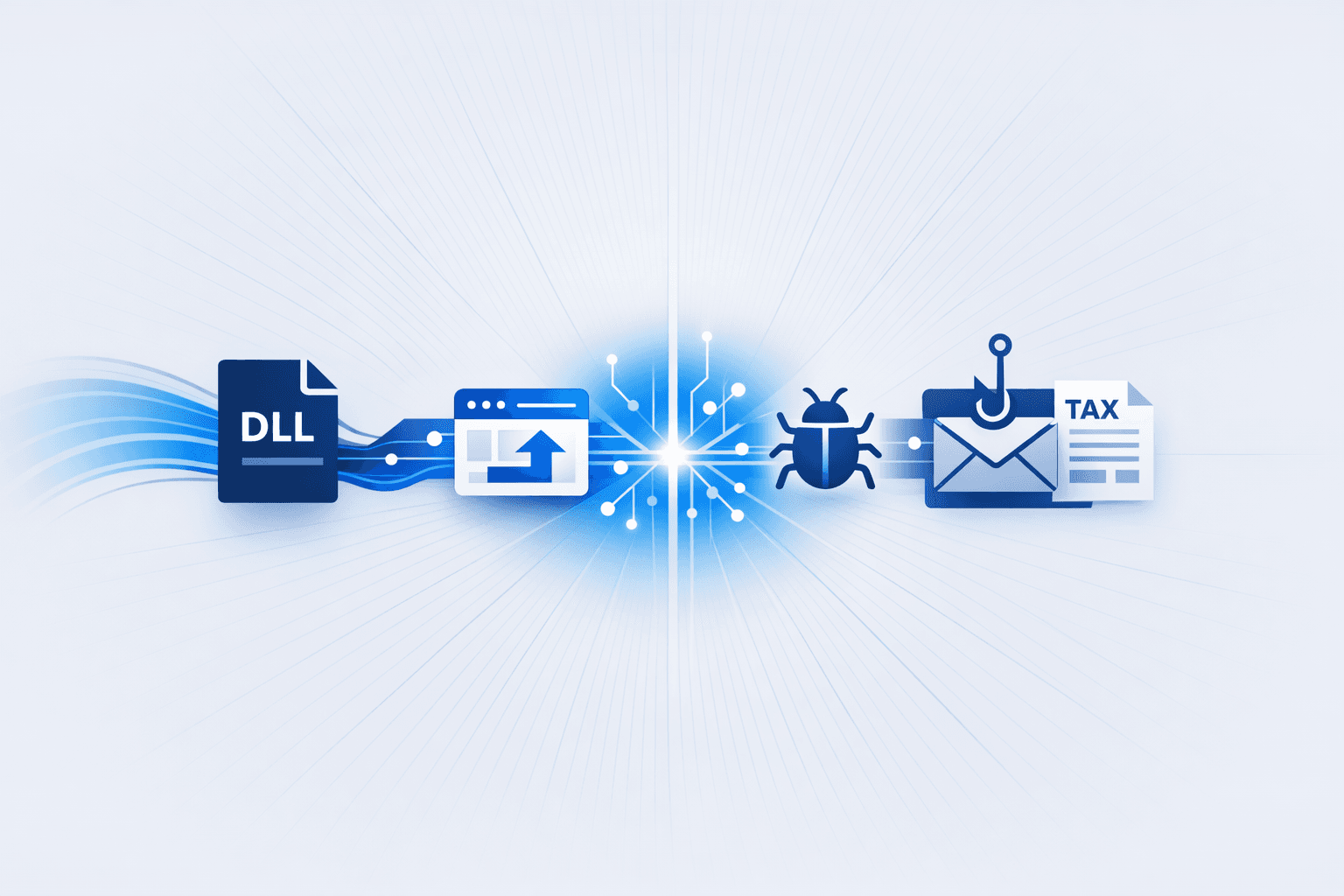
Attackers distributed remote-access malware through two distinct delivery chains: a fake **FileZilla** website serving trojanized installers and phishing emails impersonating South Korea’s **National Tax Service**. In the FileZilla campaign, victims received either a portable archive containing a malicious `version.dll` for DLL sideloading or a bundled installer that deployed legitimate FileZilla alongside a rogue DLL in the install path. The malware acted as a multi-stage loader, decrypting payloads in memory before launching a RAT that could steal credentials, log keystrokes, capture screenshots, and provide **HVNC**-based remote control. The operators also used DNS-over-HTTPS to Cloudflare’s resolver to look up `welcome.supp0v3[.]com`, likely to reduce visibility to DNS-based defenses, and included anti-analysis checks for VMware and VirtualBox environments. In the tax-themed campaign, recipients were lured to spoofed tax-notice pages and prompted to download a ZIP archive containing a legitimate signed Intel executable, a malicious sideloaded DLL, and an encrypted `BIN` payload. The malware decrypted shellcode and a RAT/backdoor from `vulkan-1.bin` using a modified RC4 routine, then established persistence through a service named **"Microsoft Compatibility system"**. Researchers said the backdoor supports remote control, privilege escalation, process injection, file theft, and lateral movement over RPC. Infrastructure analysis linked the activity to multiple variants and multilingual lures, including impersonation of tax and court authorities in Malaysia and India, indicating an organized, evolving multi-country operation.
Jun 29, 2026