
Loading story…
Threat actors used punycode and other lookalike domains to impersonate Ledger and target cryptocurrency users after the company's customer data breach became public. Proofpoint reported thousands of phishing emails directing victims to a spoofed Ledger site that offered trojanized Ledger Live installers for Windows, macOS, and Linux. The altered application removed normal setup options, coerced users into entering wallet recovery phrases, validated the words against the BIP-39 mnemonic list, and exfiltrated completed seed phrases over HTTP, enabling theft of associated cryptocurrency. A parallel campaign used fake Ledger web pages, likely distributed by SMS, to steal recovery phrases without requiring a download.
Separate infrastructure analysis tied Ledger-themed domains to a broader homograph-domain operation that also impersonated Brave, Signal, and Telegram through internationalized domain names encoded with the xn-- Punycode prefix. Silent Push identified domains such as xn--brav-yva[.]com, promoted through Google ads, that delivered ISO files linked to the RedLine infostealer, and said the registrations and hosting overlapped with other brand-impersonation activity. Together, the reporting shows attackers combining breach-themed social engineering, IDN spoofing, and malware delivery to compromise cryptocurrency holders and steal credentials or wallet access without attacking Ledger hardware directly.

Get the infrastructure and lures behind it.
5 events from the most recent confirmed update back to the earliest known activity.
The domain xn--brav-yva[.]com, impersonating Brave as bravė[.]com, was registered through NameCheap. Silent Push linked it to a broader cluster of punycode lookalike domains impersonating brands including Ledger, Signal, and Telegram.
By this point, the same actor had launched a second campaign that stole Ledger recovery phrases through a web flow rather than a malicious application. The landing pages, likely distributed by SMS, guided victims through fake wallet connection steps before collecting mnemonic words.
Proofpoint discovered several thousand phishing emails impersonating Ledger that claimed users’ assets were at risk and directed recipients to a spoofed Ledger Live download page. The campaign used a punycode lookalike domain and offered trojanized installers for Windows, macOS, and Linux.
Ledger disclosed a breach involving 9,500 customers’ names and contact information. The company warned users to watch for phishing attempts and said it would never ask for the 24 words of a recovery phrase.
A Brave security engineer reported an impersonating domain promoted through Google ads. Silent Push found the site delivered an ISO installer that appeared to contain the RedLine infostealer and tied it to related homoglyph infrastructure.
Vulnerabilities, threat actors, malware, products, organizations, breaches, and observables Mallory has linked to this story. Indicator values are masked here and available in full in the app.
Indicator values are masked on this page. View all 71 in Mallory Domains, IPs, hashes, and URLs are exportable to your SIEM.
Get the infrastructure, lures, and IOCs behind this campaign, ready to push into your email and identity stack.
4 references tracked. Mallory keeps watching after this page renders.
blog.morphisec.com
Open sourcesilentpush.com
Open sourceproofpoint.com
Open sourceen.wikipedia.org
Open sourceMap indicators from this story to your assets and identify affected systems in minutes.
Every observed campaign, victim, and pivot linked to actors named in this story.
Malware, exploits, and IOCs connected to the activity described here.
YARA, Sigma, and Snort rules deployed to your SIEM as soon as they’re published.
Get matching new stories delivered to your team as they break — not the next morning.
Ask questions about this story and take action on the answers.
Other stories Mallory is tracking that overlap on entities, sources, or topic labels.
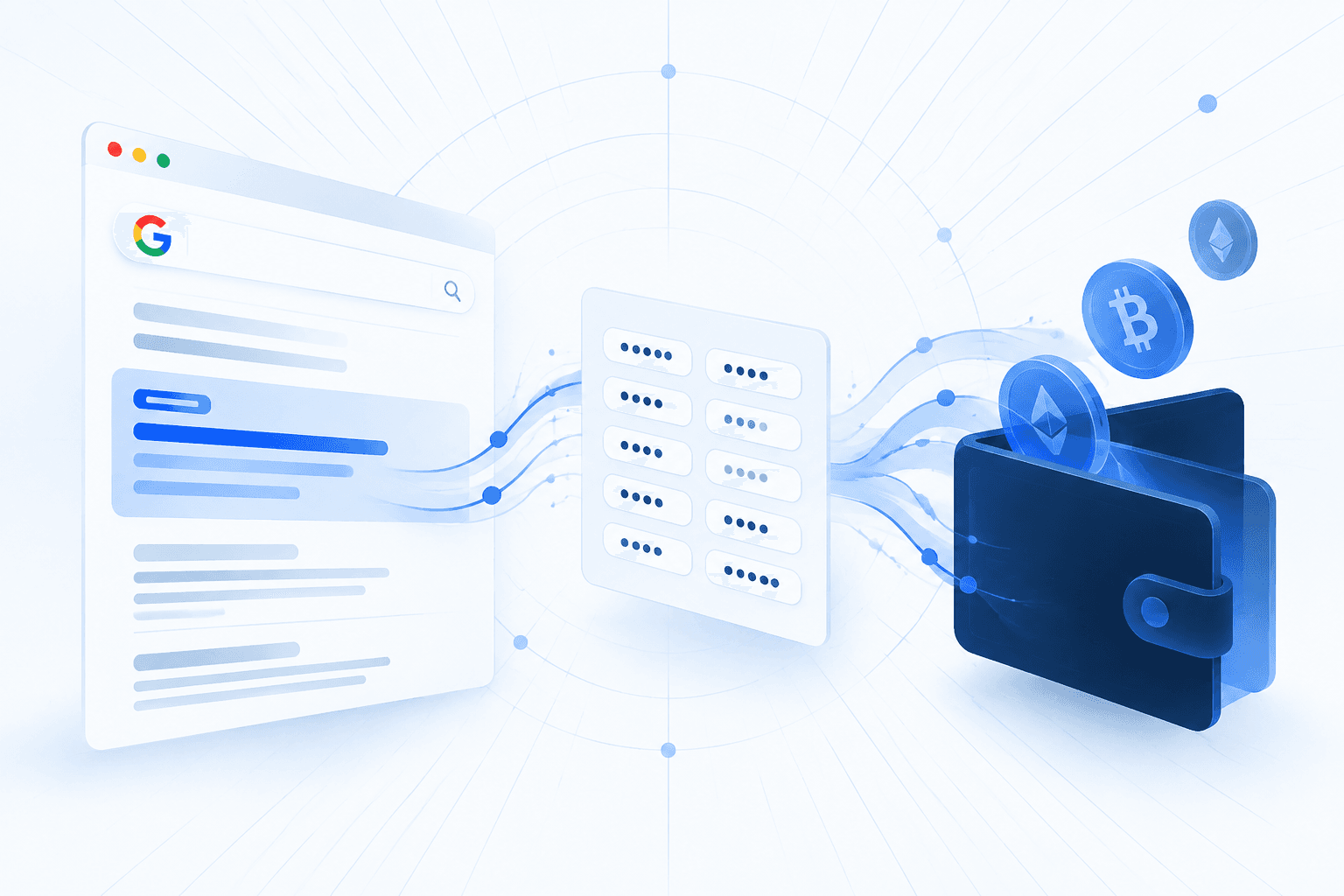
Threat actors used fraudulent, Google-verified sponsored advertisements impersonating **Ledger** to target hardware-wallet users in the United States, Europe, and parts of Asia. Victims were routed through a multi-stage chain involving Google Cloud Storage, rapidly rotating Vercel redirect domains, and Google Sites pages that embedded a counterfeit Ledger site in an iframe; the Vercel infrastructure rotated approximately every 15–20 minutes to frustrate reputation-based blocking. The fake site fingerprinted visitors and mimicked Ledger software-download, device-setup, and firmware-verification workflows before requesting the victim's secret recovery phrase. It used the BIP-39 English wordlist to provide phrase autocomplete and collected device and behavioral metadata; submitted phrases were exfiltrated, including to attacker-controlled Vercel endpoints, enabling operators to restore victims' wallets and transfer funds without access to the physical Ledger devices.
Sep 28, 2026
Rapid7 uncovered an active cryptocurrency fraud operation, tracked as **Operation ASTERIX**, after finding an exposed attacker server containing phone-number datasets, account-validation tools, phishing panels, Asterisk-based dialing infrastructure, and counterfeit wallet applications impersonating **Trezor**, **Ledger**, and **Exodus**. The campaign validated more than 100,000 phone numbers against cryptocurrency services including **Crypto.com** and **Kraken**, enriched confirmed leads with personal details, and then used coordinated phishing emails and vishing calls to direct victims to fake wallet software or recovery-phrase entry pages. The malware and infrastructure were built to steal wallet seed phrases and other victim data, with artifacts showing Telegram bot exfiltration, deceptive domains, trojanized installers, and macOS persistence via LaunchAgents. Rapid7 said the fake Trezor malware used Electron, process replacement, hidden windows, and local logging, while a trojanized **Claude Code** installer secretly deployed a fake **Ledger Live** payload alongside the legitimate tool to reduce suspicion. Recovered logs also showed the operator relied heavily on AI coding assistants including **GitHub Copilot**, **Claude Code**, and **Kimi** to develop, obfuscate, and host components of the scam infrastructure.
Aug 18, 2026
Researchers and incident responders documented a targeted intrusion campaign by **CryptoMimic**—also tracked as **Dangerous Password**, **CageyChameleon**, and **Leery Turtle**—that focused on banks, financial organizations, and especially cryptocurrency businesses. The attacks used spear-phishing lures that delivered ZIP or RAR archives containing malicious `.lnk` shortcut files and decoy documents; when opened, the shortcuts launched `mshta.exe` to fetch remote HTML or VBScript payloads. JPCERT/CC said the activity hit Japanese organizations tied to cryptocurrency operations, while later analysis captured a full intrusion chain in which the initial script deployed staged implants including **Cabbage RAT** variants, a browser information stealer, **msoRAT**, and a credential theft component that abused Windows Security Packages. Across the reports, the malware showed consistent tradecraft: persistence through Startup-folder shortcuts and registry changes, victim filtering and antivirus checks, host reconnaissance via WMI, and command-and-control through **Bitly** links and spoofed cloud-themed domains such as **cloudfiles.club** and **msupdatepms.xyz**. The operators collected browser cookies, saved passwords, OS and hardware details, process lists, and likely system credentials, then used interactive follow-on access, including legitimate **VNC** tools, for manual post-compromise activity and possible cryptocurrency theft. Investigators also observed cleanup actions such as event log deletion and destructive behavior, and noted that the tooling and operational patterns shared multiple similarities with activity previously linked to **Lazarus**, though attribution remained unconfirmed.
Aug 15, 2026