
Loading story…
Malicious Google search advertisements were used to impersonate legitimate software and brand websites, steering users to spoofed download pages that delivered IcedID malware. In one documented chain, a search for AnyDesk led through Google ad infrastructure and a traffic distribution system to a fake site, wwwanydesk[.]top, which served a ZIP archive from Google Firebase Storage containing an MSI installer. The installer abused rundll32.exe to launch a malicious DLL export named init, installing IcedID through modified legitimate DLLs such as sqlite3.dll, tcl86.dll, libcurl.dll, and ConEmuTh.x64.dll to evade detection.
Researchers and U.S. law enforcement said the campaign relied on pay-per-click malvertising, cloned websites, and lookalike domains that appeared prominently in search results with little visual distinction from legitimate links. After infection, compromised hosts contacted multiple IcedID command-and-control servers and in some cases pulled follow-on payloads tied to Cobalt Strike, Sliver, and DonutLoader, underscoring the risk of data theft and ransomware. The FBI warned that the same ad-abuse tactic is also being used to steal credentials and cryptocurrency funds, and urged users to verify URLs, avoid downloading software through ads, and report incidents to IC3.

Get the infrastructure and lures behind it.
4 events from the most recent confirmed update back to the earliest known activity.
On 2022-12-21, the FBI warned that cybercriminals were abusing search engine advertisement services to impersonate legitimate brands and direct users to spoofed sites. The advisory said the sites could deliver malware, including ransomware, or steal credentials and financial information.
After infection, the host communicated with multiple IcedID command-and-control servers and generated additional traffic including VNC backchannel activity. The infection chain also fetched follow-on payloads associated with Cobalt Strike and Sliver and/or DonutLoader, illustrating post-compromise escalation.
On 2022-12-14, a Google search for AnyDesk led through Google ad infrastructure and a traffic distribution system to a fake AnyDesk page at wwwanydesk[.]top that offered a malicious download. The activity was part of a broader December 2022 IcedID malvertising campaign abusing Google pay-per-click ads and cloned brand websites.
The downloaded ZIP archive contained an MSI installer that dropped a DLL and executed it with rundll32.exe using the export name "init" to install IcedID. Trend Micro described this MSI-delivered loader as an atypical December 2022 IcedID technique built from modified legitimate DLLs to evade detection.
Vulnerabilities, threat actors, malware, products, organizations, breaches, and observables Mallory has linked to this story. Indicator values are masked here and available in full in the app.
Indicator values are masked on this page. View all 32 in Mallory Domains, IPs, hashes, and URLs are exportable to your SIEM.
Get the infrastructure, lures, and IOCs behind this campaign, ready to push into your email and identity stack.
3 references tracked. Mallory keeps watching after this page renders.
trendmicro.com
Open sourceic3.gov
Open sourceisc.sans.edu
Open sourceMap indicators from this story to your assets and identify affected systems in minutes.
Every observed campaign, victim, and pivot linked to actors named in this story.
Malware, exploits, and IOCs connected to the activity described here.
YARA, Sigma, and Snort rules deployed to your SIEM as soon as they’re published.
Get matching new stories delivered to your team as they break — not the next morning.
Ask questions about this story and take action on the answers.
Other stories Mallory is tracking that overlap on entities, sources, or topic labels.

Sophos reported that a malvertising campaign used **bad ads** to lure users into downloading malware, leading to infections with the banking trojans **IcedID** and **Gozi**. The activity shows threat actors continuing to abuse online advertising as an initial access vector, using deceptive ads and likely fake download or redirect chains to place malware on victim systems. The infections are significant because both **IcedID** and **Gozi** have long been associated with credential theft, financial fraud, and follow-on compromise. The campaign highlights the ongoing risk posed by poisoned search results and malicious advertisements, where a single user click can expose organizations to malware capable of stealing banking information, harvesting credentials, and enabling broader intrusion activity.
Jun 29, 2026
A cloud-hosted tech-support scam campaign used more than 250 Google Ads campaign IDs to route users through a benign-looking fake “ShopEase” storefront before presenting operating-system-specific security lockers impersonating Microsoft Defender on Windows and Apple on macOS. Between August 31 and September 14, it affected at least 619 organizations, chiefly in the United States, Japan, and Australia, with ads appearing across at least 284 legitimate publisher sites. Victims were pressured to call a fraudulent support number through full-screen browser takeovers, keyboard locking, hidden cursors, warning audio, and intentional browser-performance degradation. The campaign reflects advanced browser-based scareware techniques also documented in CypherLoc, which uses encrypted JavaScript loaders to validate, decrypt, and execute concealed payloads before replacing the initial page with a fake security warning. Such lockers evade automated inspection through interaction checks such as required mouse movement and staged AES decryption of command-and-control details and payloads, while assembling the malicious interface entirely in browser memory. They can further heighten credibility by displaying a victim’s public IP address and fake login forms, while repeatedly relocking the browser when users attempt to recover control.
Sep 24, 2026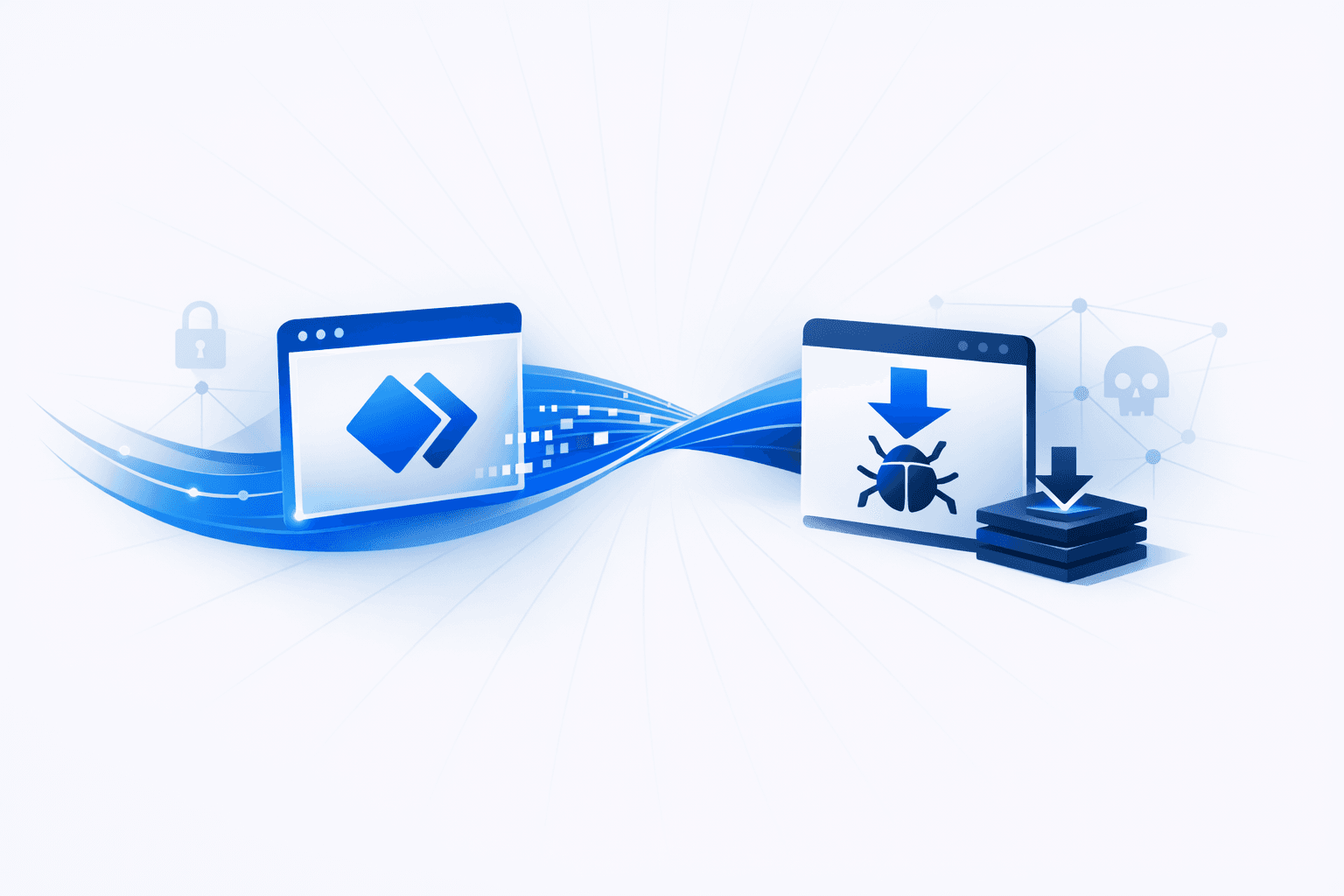
Attackers used malicious Google search ads impersonating **AnyDesk** to deliver **PikaBot**, redirecting victims through traffic-filtering and fingerprinting infrastructure before serving a digitally signed MSI installer from Dropbox. Researchers said the chain included JavaScript-based anti-analysis checks and likely virtualization detection, echoing earlier fake software ad campaigns that used spoofed AnyDesk pages, MSI installers, and staged payload delivery to infect Windows systems. PikaBot is a loader designed to fetch and execute additional malware, with commands for shell execution, payload retrieval, shellcode launch, and system profiling over encrypted HTTPS communications. Its emergence in malvertising expands a malware family already linked to initial-access activity and ransomware delivery ecosystems, reinforcing a broader criminal model in which loaders such as **PikaBot**, **IcedID**, and **TrickBot** establish footholds that are later used for tools like **Cobalt Strike** and, in some cases, hands-on ransomware deployment.
Aug 15, 2026