
Loading story…
Researchers documented a SmartApeSG malware campaign using fake CAPTCHA pages and the ClickFix social-engineering technique to trick victims into launching an initial script that led to a multi-stage infection. In observed intrusions, Remcos RAT executed first, followed within minutes by NetSupport RAT, then StealC, and later Sectop RAT identified as ArechClient2. The activity relied on compromised web infrastructure, rotating delivery domains, attacker-controlled command-and-control servers, and multiple payload packages, with several stages using DLL side-loading through legitimate executables while NetSupport RAT was deployed as a legitimate remote administration tool configured for malicious control.
Separate analysis tied Sectop RAT / ArechClient2 to additional follow-on infections, including a chain where a victim seeking cracked software downloaded a password-protected archive that installed Lumma Stealer before fetching a 64-bit DLL from enotsosun[.]pw and executing it via rundll32 using the LoadForm export. Investigators reported concrete indicators including malware hashes, filenames, persistence artifacts, malicious URLs, and network traffic from Sectop RAT to 91.92.241[.]102 over ports 9000 and 443, reinforcing that ArechClient2 is being used across varied delivery lures as part of broader credential theft and remote-access operations.

Pull IOCs and campaign context straight into your stack.
6 events from the most recent confirmed update back to the earliest known activity.
On 2026-05-27, a SmartApeSG ClickFix infection chain was observed delivering an unidentified initial RAT that communicated with 89.110.110[.]119:443, followed by a malicious NetSupport Manager RAT package communicating with 185.163.47[.]217:443. The report identified lure and delivery infrastructure including hiddenplanetlab[.]top and silverharvestnetwork[.]com, plus installation and persistence files such as processor.vbs, token.bat, and setup.cab under C:\ProgramData.
A separate malware infection chain was documented in which a user searching for cracked software downloaded a password-protected archive that installed Lumma Stealer, followed by a Sectop RAT (ArechClient2) DLL executed via rundll32. The report included C2 domains, malicious URLs, hashes, persistence details, and network traffic to 91.92.241[.]102 over ports 9000 and 443.
VMRay released a report focused on ArechClient2 SectopRAT, adding technical analysis of this malware family and its behavior. The reference indicates public reporting on the malware by March 31, 2026.
On March 24, 2026, Bradley Duncan documented a SmartApeSG infection in which a victim executing a ClickFix script received Remcos RAT first, then NetSupport RAT, followed by StealC and finally Sectop RAT (ArechClient2). The analysis also identified delivery infrastructure, C2 servers, hashes, and use of DLL side-loading for several payloads.
A SmartApeSG campaign was observed using a fake CAPTCHA ClickFix page to infect victims and deliver Remcos RAT. Malware-Traffic-Analysis.net published supporting sample files for this infection chain tied to activity dated March 12, 2026.
An earlier SANS ISC diary reported SmartApeSG using a ClickFix page to deliver NetSupport RAT, showing the campaign had already been using fake CAPTCHA lures before the March 2026 multi-malware chain. The exact activity date is not provided in the reference, so the publication date is used.
Vulnerabilities, threat actors, malware, products, organizations, breaches, and observables Mallory has linked to this story. Indicator values are masked here and available in full in the app.
Indicator values are masked on this page. View all 55 in Mallory Domains, IPs, hashes, and URLs are exportable to your SIEM.
Pull the IOCs, campaigns, and victimology behind this family, ready to push into your SIEM and EDR.
7 references tracked. Mallory keeps watching after this page renders.
cybersecuritynews.com
Open sourceisc.sans.edu
Open sourceisc.sans.edu
Open sourceisc.sans.edu
Open sourceisc.sans.edu
Open sourcemalware-traffic-analysis.net
Open sourceisc.sans.edu
Open sourceMap indicators from this story to your assets and identify affected systems in minutes.
Every observed campaign, victim, and pivot linked to actors named in this story.
Malware, exploits, and IOCs connected to the activity described here.
YARA, Sigma, and Snort rules deployed to your SIEM as soon as they’re published.
Get matching new stories delivered to your team as they break — not the next morning.
Ask questions about this story and take action on the answers.
Other stories Mallory is tracking that overlap on entities, sources, or topic labels.
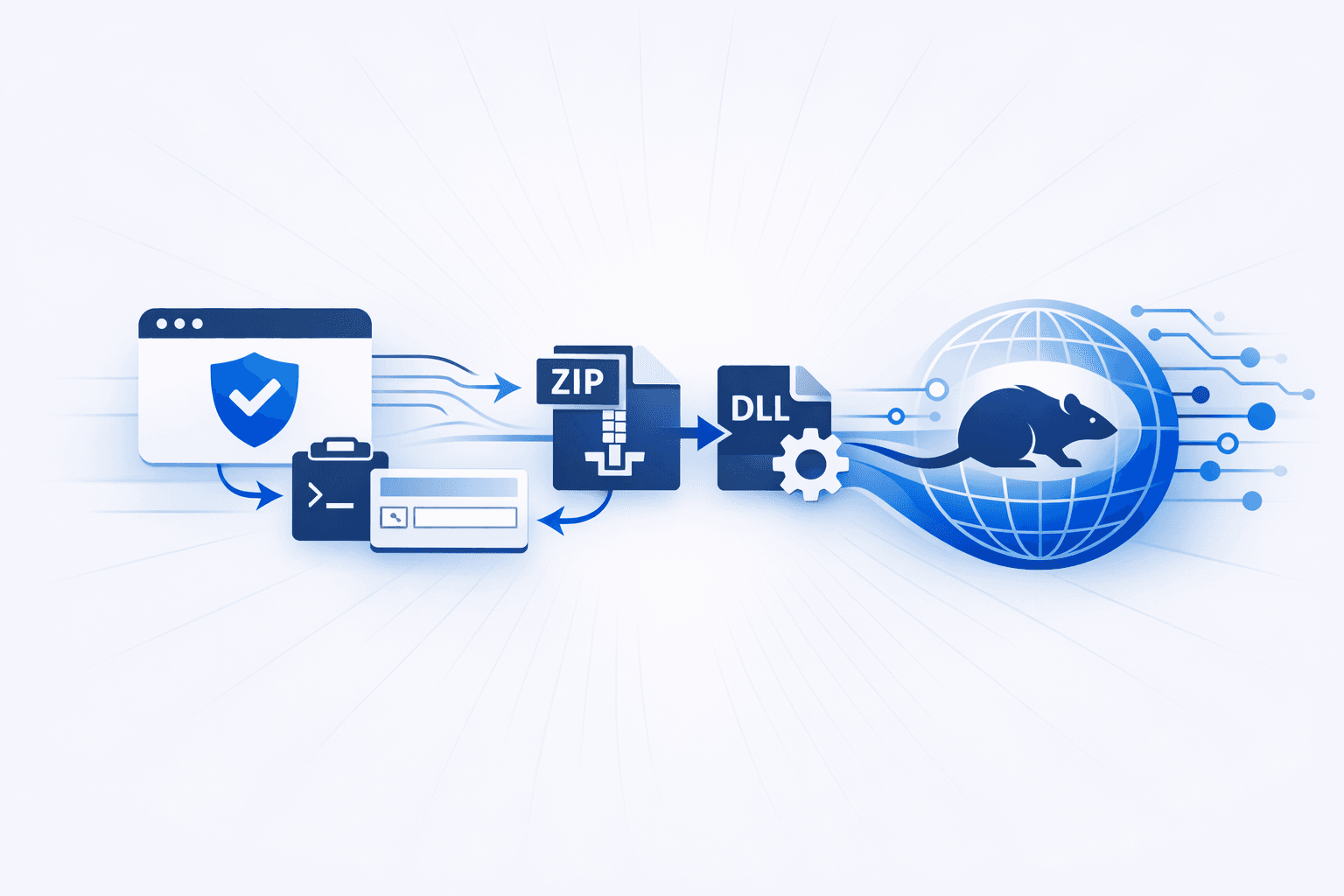
The **SmartApeSG** campaign is using compromised legitimate websites to inject malicious JavaScript that presents a fake CAPTCHA and **ClickFix-style** instructions, tricking users into opening the Windows Run dialog, pasting a clipboard-loaded command, and executing the next stage themselves. In the observed infection chain, the payload was delivered as a ZIP archive disguised with a `.pdf` extension, then executed via **DLL side-loading** to install **Remcos RAT** and establish persistence through a Windows Registry modification. The reporting ties this activity to infrastructure and indicators previously associated with SmartApeSG, also tracked as **ZPHP** and **HANEYMANEY**. A separate report on a **new ClickFix variant** is relevant because it documents the same broader social-engineering delivery technique, but with a different infection chain: a fake CAPTCHA leads victims to run a command that maps a remote WebDAV share using `net use`, launches `update.cmd`, downloads a ZIP archive, and executes a trojanized *WorkFlowy* application containing malicious logic in an `.asar` archive that acts as both a C2 beacon and dropper. Other references describe unrelated APT campaigns, malware families, or vendor detection updates and do not cover the SmartApeSG/Remcos activity itself.
Jun 29, 2026
The **SmartApeSG** campaign has been using compromised websites to display fake CAPTCHA or browser-verification pages that trick users into launching a malicious command, shifting from earlier fake browser update lures to **ClickFix-style** social engineering. In observed infections, hidden injected scripts selectively present a “verify you are human” prompt, copy an `mshta`-based command to the victim’s clipboard, and instruct the user to paste it into the Windows Run dialog, triggering retrieval of additional payloads from attacker-controlled infrastructure. Analysis of multiple infection chains shows the activity leading to **NetSupport RAT** and, in some cases, a second payload such as **Stealc v2** or another RAT. Researchers reported a ZIP-delivered NetSupport package, persistence via a Start Menu shortcut that launches a `.js` file from the user’s Temp directory and then executes the RAT from `C:\ProgramData\`, while packet captures and recovered samples from later cases indicate traffic associated with two separate remote access trojans. The campaign is also tracked as **ZPHP** or **HANEYMANEY**, and its domains, payload packages, and command-and-control infrastructure have been observed changing frequently.
Aug 14, 2026
Researchers reported multiple **ClickFix** campaigns using fake CAPTCHA or reCAPTCHA prompts to trick users into manually running malicious commands, with payloads tailored by platform and victim profile. On Windows, one campaign delivered a modular NodeJS-based RAT and infostealer through a malicious MSI installer, loading key capabilities only in memory after command-and-control was established and using `gRPC` over Tor for persistent communications. An operational security failure exposed the malware’s backend protocol definitions and admin panel API, revealing a malware-as-a-service operation with multi-operator support, Telegram alerts, automation rules, and cryptocurrency wallet tracking. The malware also fingerprinted victims extensively and established persistence through the Windows Run registry key as **LogicOptimizer**. A separate ClickFix chain attributed with high confidence to **Grandoreiro** targeted users of eight Brazilian banks by luring victims through a fake reCAPTCHA page and launching a malicious PowerShell sequence that sideloaded a Delphi banking trojan with legitimate GoToMeeting and Nero binaries. The malware deployed banking overlays, intercepted **PIX** QR-code payments, added Microsoft Defender exclusions, and stole credentials, device information, signatures, and payment confirmation codes. Netskope also documented a macOS variant that used AppleScript and a persistent fake password dialog to harvest Keychain data, browser cookies, saved credentials, extension storage, and cryptocurrency wallet data; the theft of live session cookies can enable attackers to bypass MFA by hijacking authenticated sessions.
Jun 29, 2026